Imagine learning that the river supplying your family’s drinking water is contaminated with nitrate pollution at levels above the Safe Drinking Water Act standard. The Environmental Protection Agency knows about it, says something should be done to clean it up, and then quietly abandons that position after industry lobbies against it.
That’s not a hypothetical situation. It’s what happened in Iowa this past year, and it’s why our organizations filed a federal lawsuit against the Trump administration’s Environmental Protection Agency.

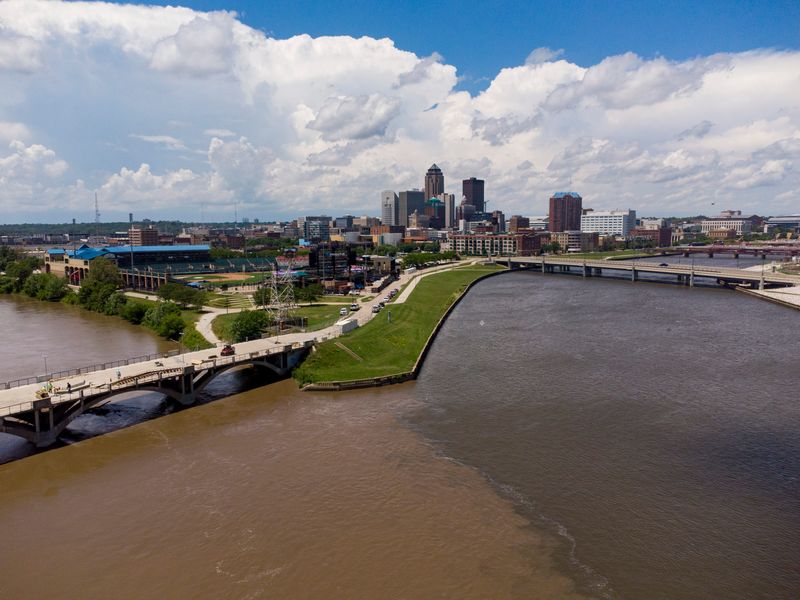
Iowa has a water quality crisis. For years, environmental advocates have sounded alarms about nitrate pollution in Iowa’s waters. High levels of nitrates come predominantly from agricultural fertilizer and concentrated animal feeding operations’ waste. But little has been done to address this pollution. Drinking water providers struggle to clean the pollution out of the water to meet Safe Drinking Water standards. Des Moines Water Works has one of the largest nitrate removal systems in the world. Last year that system could not keep up, and the Des Moines metro saw its first ever lawn watering ban to ensure enough treated water was available for basic uses.
The federal Clean Water Act exists to address this kind of problem. Under the law, Iowa is required to identify water bodies that fail to meet water quality standards and place them on what’s called an “impaired waters list.” Once listed, the state must develop a plan to clean up the waters and bring them back into compliance with water quality standards. It’s a system designed to solve water quality problems, but it only works if triggered by the first step, identifying the problem.
In November 2024, the EPA did its job. After reviewing data submitted by the Iowa Department of Natural Resources (IDNR) and public commenters, the agency determined that seven river segments including stretches of the Cedar, Des Moines, Iowa, Raccoon and South Skunk Rivers contained nitrate concentrations that exceeded water quality standards. EPA partially disapproved Iowa’s impaired waters list for failing to include them, added them to the list, and directed the state to develop cleanup plans. Eighty-three of the 85 public comments EPA received supported that decision.
Then came July 2025.
With no public notice, input, or announcement, the Trump EPA reversed course entirely, sending IDNR a two-page letter rescinding the seven waterways added to the impaired waters list. This was an unprecedented and unsupported action. EPA claimed IDNR had provided new information that warranted reconsideration. In reality, the documents IDNR sent were records Iowa had submitted to EPA to adopt the nitrate standard back in 2001. Nothing was new. Nothing had changed about the waters, the pollution, the science, or the law.
Just days before the reversal, EPA Region 7 held a “listening session” with state-level Farm Bureau organizations including the Iowa Farm Bureau Federation, which had been one of the only public commenters to oppose the nitrate listings in the first place. The meeting agenda listed Iowa’s impaired waters as a topic of discussion.
There is no basis in law for this lobbyist-led decision to remove waters from the impaired waters list. The Clean Water Act requires EPA to follow a transparent, science-based process to protect public health. EPA didn’t do so here in this case.
Iowa already has among the worst nitrate pollution in the country. We are learning more about the consequences every year. Iowa has the second-highest cancer rate in the nation, and a recent report by the Iowa Environmental Council and the Harkin Institute highlighted the scientific research linking chronic nitrate exposure to a variety of cancers. On the heels of last summer’s first-ever lawn watering ban in the Des Moines metro, the nitrate removal system has already run over 100 days in 2026 during the part of the year that typically sees the lowest nitrate levels. EPA’s response was to pretend the problem didn’t exist.
The Trump EPA has abandoned its legal obligations and its duty to protect the public. Our lawsuit asks a federal judge to declare EPA’s reversal unlawful and require the agency to follow through on the Clean Water Act’s requirements.
Iowans in cities, small towns, and rural communities relay on Iowa rivers and groundwater for their drinking water. We deserve a government that recognizes the magnitude of our water quality problems, develops a plan to clean it up, and takes action to keep the water safe.
Josh Mandelbaum is a senior attorney at the Environmental Law & Policy Center in Des Moines. Dani Replogle is a staff attorney with the national advocacy group Food & Water Watch. Michael Schmidt is general counsel at the Iowa Environmental Council.
This article originally appeared on Des Moines Register: Hold the EPA accountable for safe and clean Iowa waterways | Opinion
Reporting by Josh Mandelbaum, Dani Replogle and Michael Schmidt, Guest columnists / Des Moines Register
USA TODAY Network via Reuters Connect