First of a two-part series.
Start with the stick-up, the runners say.

Coppin State University, where they ran track in the mid-90s, was a humble, one-dorm, historically black college. The kind of place where west Baltimore’s young men and women took classes between shifts at docks and factories, hoping to one day move into the middle class.
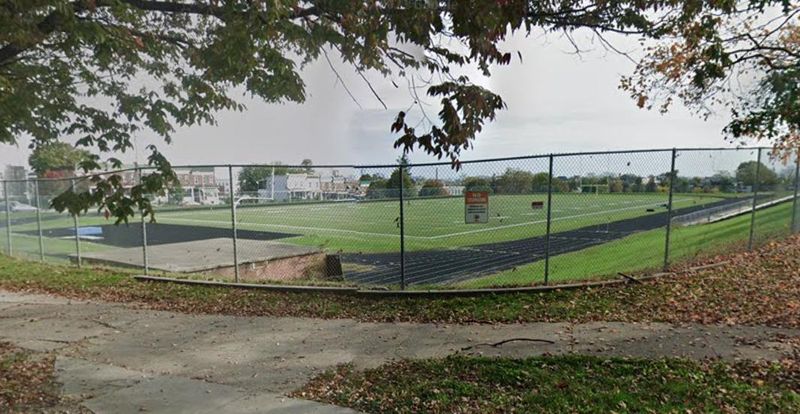
The track team ran sprints around the corner from campus at Frederick Douglass High School. That’s where, one afternoon in 1997, Ian Roberts, Stephon Mark and another runner were walking after practice.
They descended some steps into the high school’s courtyard. While the three chatted, a man strolled out from under some stairs. He pointed a gun.
Among them, the runners lost a cross, a gold chain and some cash. The robber backed away. Scared, Mark said he and the other runner sprinted back to Coppin State, looking for campus security.
But Roberts ran the opposite direction, back to the high school track. Some other members of the team were still there, unwinding after practice. Roberts warned them about the gunman.
Mark worried about Roberts, a mentor who took him on early morning runs, showing him how to become an elite athlete. Mark worried that the robber was watching, that he would attack Roberts for warning his next potential victims.
“He put himself in harm’s way to protect his teammates,” Mark said.
‘A good man’ or a ‘con person’?
The stick-up man didn’t attack again; he left the area before the police responded. But Roberts’ teammates have been thinking about that day a lot in recent months after they got the news that U.S. Immigration and Customs Enforcement agents arrested Roberts on Sept. 26 following a judge’s deportation order.
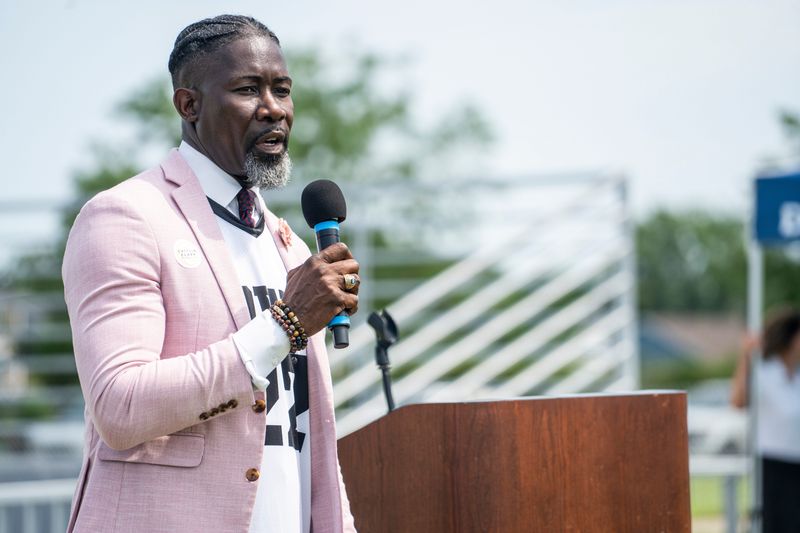
The case has made even those who have known Roberts for years wonder who he really was before his move to Iowa in 2023, when the Des Moines Public Schools Board hired him for the $300,000-a-year post of superintendent.
Teammates at Coppin State and Roberts’ old friends in his native Guyana remembered him as a hero. Top student. All-American. Olympian. Author. Educational leader.
But according to federal prosecutors, Roberts lied on his employment paperwork, falsely attesting that he was a U.S. citizen when he joined the district. In fact, his immigration work authorization had lapsed about three years earlier.
Since then, more information about Roberts has emerged that indicate he is a seasoned fabulist. False academic credentials. False professional awards. An apocryphal memoir. A transcript that was, according to a Des Moines schools investigation, “likely” doctored.
On Thursday afternoon, Roberts walked into U.S. District Court in Des Moines, strapped in handcuffs and donning a green striped Polk County Jail jumper. During a hearing packed with press, he pleaded guilty to charges of making a false statement on his I-9 employment paperwork and illegally possessing a firearm.
Magistrate Helen Adams asked Roberts if he knew he had been in the country illegally prior to his arrest. He said yes. She asked if he lied on his Des Moines Public Schools employment paperwork in June 2023, when he attested that he was a U.S. citizen.
“It was false, correct?” Adams asked.
“Yes, your honor,” Roberts said.
Thursday’s guilty plea also ends Roberts’ chance to contest his immigration case. The criminal charges on his record will lead to, in Adams’ words, “enhanced penalties” if he tries to return to the country.
“You will likely will be removed from the United States, and you won’t be able to challenge that,” Adams said. “You understand that?”
“Yes, your honor,” Roberts said. “I do.”
At the end of the hearing, Roberts exited the room, headed back to the Polk County Jail. He will remain behind bars until his May 29 sentencing hearing.
Thursday’s hearing was Roberts’ first public appearance since he became a figure of national infamy, a reference point for politicians and commentators who support stricter limits on immigration.
The public portrayal has shocked his old friends, who had followed his career on Facebook, proud to see him fulfill their high expectations. Some in Guyana called him a “son of the soil,” an honorific for those who have made their countrymates proud. Former students called him “Dad.”
Now, old friends are divided about what to think. Most support Roberts, saying he was an inspirational teammate, classmate and friend. They argue that Roberts is the victim of racist media manipulation, another Black man portrayed as a brash villain after a mistake. People don’t talk enough about how hard he worked or how much some students loved him, they say.
“I’m tired of hearing people beat him down,” said Ernest Barrett, Coppin State’s former track coach. “He’s a good man.”
“Justice got it wrong,” Mark said. “He’s not a menace to society. He’s an influencer, a mentor.”
Others wonder if Roberts changed over the years, if he indulged in lies to further his career. Still others say they never really knew him, that he had them fooled. After Roberts’ arrest, Des Moines School Board chair Jackie Norris said in a statement that district was “a victim of deception by Dr. Roberts.”
Some who have known Roberts for decades concede that he didn’t have many deep relationships, that they didn’t know him well. His younger brother, Malcolm Roberts, told the Register he has not talked to him in “16 or 17 years,” even though both have lived in the United States.
“I don’t carry on any conversations about him,” Malcolm Roberts said. “For me, personally, since we don’t have any relationship, I don’t talk about him. I don’t think about him.”
Added the mother of one or Roberts’ children: “I look at this person as a con person. He lied to me about a lot of stuff, as you can imagine. I’m not surprised all of this has caught up with him.”
She spoke on the condition of anonymity because she wants to protect her daughter from knowing about Roberts’ history.
‘He always wanted to be a winner’
In Guyana’s capital city of Georgetown, neighbors can still hear the thumps.
They can see Roberts as a teenager, going to work every afternoon on the punching bag that hung from a beam in his yard. They can see the next steps in his routine, the weightlifting and the jogging through Festival City, the middle-class neighborhood in southeast Georgetown where Roberts grew up.
Roberts is the middle of three children. His mother, Verna, was a seamstress from a rural part of the country, a small former British colony on the northern coast of South America. His father, George, was a low-ranking police officer.
George abandoned the family and immigrated to New York City when Ian was about 10, said Conrad Roberts, George’s brother. Conrad declined to say why George left. But he said he noticed a change in Ian after his parents split. Ian never had much of a relationship with his father after that.
“Any child would be impacted by his father and his mother separating,” Conrad said. “It takes a toll.”
Ian Roberts and his brothers took after their mother as children. They were quiet and disciplined and studied hard, Conrad said.
Roberts scored well enough on an entrance exam to enroll at Charlestown Secondary School, which former classmates describe as above average ― though certainly not one of the top schools in town.
There, Roberts thrived. The boys wore a uniform of khakis, white shirts and ties. Classmates recalled Roberts looking exceptionally well-dressed, with a tight, neat haircut and pressed clothes ― a trait that Roberts would carry with him into adulthood.
He was tall and strong for his age and thrived athletically. Cardiss Dick, a classmate a couple of years behind Roberts, said administrators honored Roberts as Charlestown’s top athlete. Patrick Baird, who played basketball with Roberts, remembers him pushing his teammates to run faster and focus more during practice. Roberts also played soccer and ran track.
“He always wanted to be a winner,” Baird said.
Roberts was a leader in the classroom as well. Teachers appointed him as a prefect, a position that required him to enforce discipline among his classmates. Fellow students recalled that he was quiet and serious.
“He was smarter than everybody else,” Dexter Barrow said.
“I used to be scared of him,” Tracy Carter said.
His girlfriend at Charlestown, who spoke on the condition of anonymity because she fears retribution from her current employer in the United States, said Roberts wanted to become an educational leader even then.
The people of Guyana were living through economic and political turmoil following the country’s independence from the United Kingdom. Verna was supporting Roberts and her two other sons by sewing clothes and cleaning a government building, classmates said. But she was not thriving, and Roberts wanted to support the family.
“He thought he was the one who would lead the family out of hardship,” his girlfriend said.
To land a good job after secondary school, students in Guyana take an exam administered by the Caribbean Examinations Council. Roberts’ girlfriend said he could not afford the council’s fee, so he moved near the Guyanese mines, where companies extract gold and diamonds. For five months, Roberts worked as an errand boy for the miners, saving enough money to take the exam.
‘He knew exactly what he wanted’
Roberts scored well enough to begin teaching history, accounting and English at Charlestown, his girlfriend said. His former classmates became his students.
But Roberts soon enrolled in the police academy, following his estranged father’s lead. There, former neighbors and classmates say, Roberts become an inspector, a position on the force’s leadership track.
Two officers who served under Roberts said he helped lead a unit in New Amsterdam, a port town in eastern Guyana. Andrew Rambarron, a former officer, said Roberts helped oversee five stations in the region. Sherlock Cromwell, another former officer, remembers Roberts leading about 100 members of the force.
Both said Roberts was strict. Police officers in Guyana are trained alongside new military recruits, and they operate with similar cultures. Officers from the academy march, stand straight, salute superiors and address each other as “sir.” They expect subordinates to follow their leads and can deduct pay for lapses in decorum.
Had Roberts remained in the country, Cromwell believes he could have run the entire agency as its commissioner.
“Ian would have run circles around (the current commissioner),” Cromwell told the Register.
But a family member offered to sponsor Roberts’ immigration to the United States. Sarah Barrington, a cousin about 30 years older than Roberts, had moved to New York City under the auspices of the Lutheran Church in 1970. She said she became a teacher and principal in the United States and had not seen Roberts since he was a child.
But during a visit to Guyana in the early 1990s, she stayed with Verna. She said Roberts had just returned from a police training overseas and she was impressed by “his brilliance.” She said she filed an immigration petition to sponsor Roberts.
“I told him that I would let him come to the U.S. and pursue higher education, and he would do well,” she said. “He has done that.”
According to the U.S. Department of Homeland Security, Roberts entered the United States on a B-2 tourist visa in 1994. Immigrants on tourist visas can stay varying lengths of time, based on the discretion of Customs and Border Protection officers. The government usually allows immigrants to stay for about six months. But the visa is often valid for 10 years, allowing immigrants to repeatedly visit the United States for six months at a time after returning to their home countries.
His girlfriend from Charlestown had also immigrated in the mid 1990s, settling in the Bronx.
She said Roberts briefly moved in with his father. The two did not become close.
“Ian did not have a relationship with his father,” she said.
Roberts enrolled at St. Francis College in Brooklyn at the beginning of 1995. He played soccer at the small school, according to an article in Newsday. He told a journalist at the time that he took up track to stay in shape.
But his performance caught the attention of Barrett, the Coppin State coach in Baltimore. An immigrant from Jamaica, Barrett recruited Caribbean runners and the children of Caribbean immigrants who had settled in New York City.
As the coach of a small college with few resources, Barrett sought overlooked athletes. His contacts in New York alerted him to Roberts, and Barrett believed that he had found his next great 800-meter runner.
‘This dude is a robot’
Roberts transferred to Coppin State in the fall of 1996, but NCAA rules at the time barred him from competing during his first year at the school. Still, other Coppin State runners gawked at his broad chest, bulging biceps and thick quads. He pushed 225 pounds off the bench press with the easy rhythm of an NFL linebacker.
“Who is this monster?” said Mark, his fellow 800-meter runner.
“This dude is a robot,” said William Thomas.
“A machine,” said Ian Smith.
At almost half a mile, the 800-meter is a race that challenges runners both mentally and physically. Bodies break on the last half of the final lap. Backs stiffen. Runners fail to lift their knees as high as they need. They pump their arms too much, desperately propelling their bodies to the finish line.
“Your chest, your legs are on fire,” Mark said. “You’ve got to try to keep your running form, work on your breathing. And your mindset: ‘I’m getting to that finish line before whatever I’m up against.’ At that last straightaway, that last 150 meters, everybody has the same pain and the same agony in the same area of the body.”
Roberts’ teammates remember him outlasting his competitors, chasing them down in the final stretch. They attributed his wins to his training, his determination to run as hard in the final minutes of practice as he did at the beginning. He ran extra in the mornings, before practice. In the evenings, they watched him run up a hill next to the dorm.
When teammates played “Olympic Summer Games: Atlanta 1996” on PlayStation, Roberts hit the floor for pushups and crunches. At parties, he drank water. On road trips, he told his teammates to refrain from sex before races to preserve their legs. He spent most of his free time in the library and would eventually graduate from Coppin State with a 3.6 grade point average, according to his transcript.
“He was a very focused person,” said his girlfriend from Guyana. “He knew exactly what he wanted. That’s why our relationship fell aside. He wasn’t thinking about having a girlfriend or having kids.”
Teammates who spoke to the Register said Roberts’ zeal did not annoy them. They named him their team captain and celebrated when he became an All-American. After he ran at the NCAA Nationals, Roberts gave a towel from the event to Lisa Lee, one of his Coppin State teammates. Inside the towel, she found a note, telling her that Roberts envisioned her running at Nationals one day.
“He pushed all of us to be better, to do better,” she said. “He saw potential in you.”
“He just walked with grace, this poise about him,” said Allen.
But he was also quiet. Teammates said they knew little about his background. Some thought he was a “born and bred New Yorker,” Thomas said. Allen knew he came from Guyana and had been a police officer. He kept a photo of Verna in his dorm, but teammates rarely saw evidence of his life before college.
Teammates did know one thing: Roberts was older than a typical college student. Still, they didn’t know exactly how old he was.
According to a Newsday article in the late 1990s, Roberts would have been 22 or 23 years old during his final season at Coppin State. But based on the age attributed to Roberts in an article about a decade later, he would have been 24 or 25. The age on his driver’s license, meanwhile, would have put him at 27.
“I knew he was older,” Thomas said. “I just didn’t know how much older.”
“How is Ian so strong?” said Mark, recalling a conversation he and his teammates had three decades ago. “How is he running? He’s damn near a grown (expletive) man. He’s 24, 25 years old. No wonder. Nobody knows actually how old he really is.”
His age would continue to be a mystery over the years, as would most other details of Roberts’ private life. On his Wikipedia page, which Roberts seemed to have edited himself, his date of birth changed several times in the years before his arrest.
“He kind of was a private guy,” Mark said. “A lot of information you got about Ian would be surface level.”
Next: As he climbs the educational leadership ladder, Ian Roberts embellishes his image.
This article originally appeared on Des Moines Register: Hero or con? Many lauded DMPS superintendent Ian Roberts before arrest
Reporting by Tyler Jett and Nick El Hajj, Des Moines Register / Des Moines Register
USA TODAY Network via Reuters Connect