THE MIDDLE OF IOWA — To get here — right here — you have to take the interstate, I-35, the one that carves the country straight down the middle like the scalpel of a steady surgeon.
Get off at the exit just past Ames and follow the curve onto E-29. Two miles gets you to the Milford Township Schoolhouse, a temple to rural grit built by local men using local bricks in 1923. Now, after school consolidation meant fifth- and sixth-graders stopped being bused out here in the ’90s, it’s a boutique hotel complete with rentable ballroom, a temple to rural elasticity — which is grit rewritten for the modern set.

Go one more mile, give or take. If you’ve hit Indian Creek, a spitter of a country streamlet, you’ve gone too far. Walk back west, say, a stone’s throw. Then head into the soybean fields, all the way until the green tide reaches your waist ― 220 feet, if you want to be exact about it.
You’re here. Right here. The geographical center of Iowa.
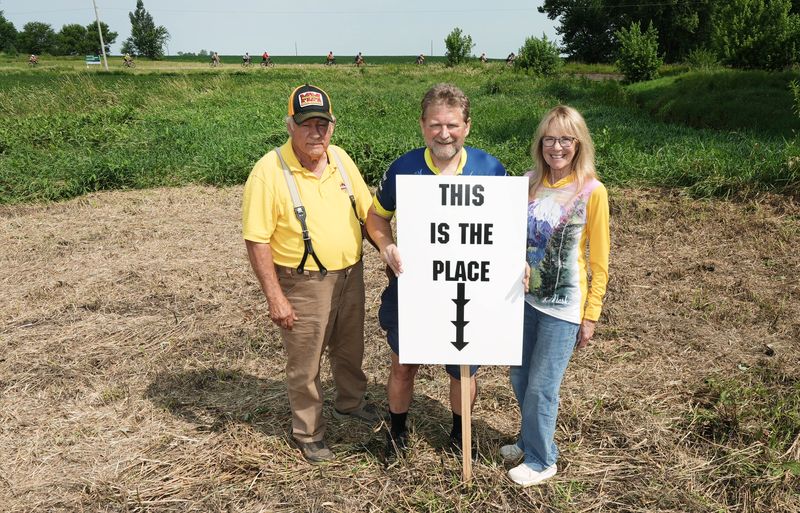
Marked, for now, by a small, mowed path, just enough for a golf cart, a stake and a bright pink flag. (Though please don’t take the cut grass as a welcome mat to waltz on in. The land is working and those beans are income, thank you.)
This is Loren Book’s farm, in his family for about 50 years, and the land just down the road for three decades longer. The year the Books moved in was the year Loren Book was born, 1946, and he still lives in the house his parents homesteaded.
The black soil’s kept him rooted here just as much as it does his beans.
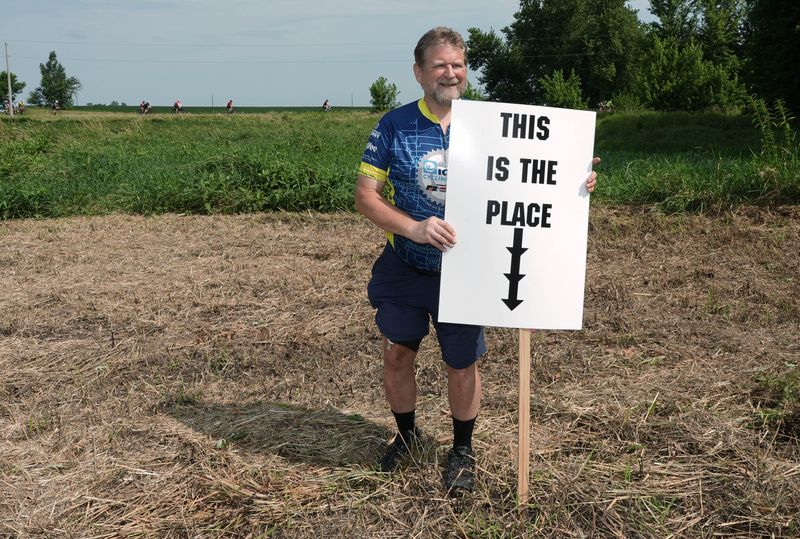
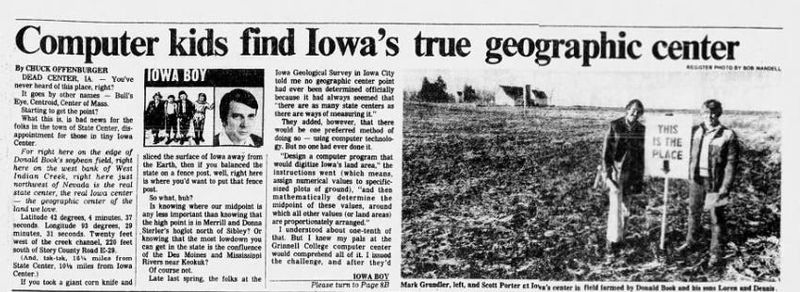
But, oh, Book insists this story isn’t about him. No, no, no. It’s about Scott Porter, he says, the numbers genius and programming whiz who pinpointed this spot. Right here. The college student who, back in 1979, showed up on Book’s farm with a computer rendering of a latitude and longitude and a sign declaring, “This is the Place.”
“I can’t really say I found it because it was always there,” says Porter, ever the mathematician striving for accuracy in ordinals as well as verbs. No, he identified it, he says.
Center of Iowa Gravity. Midpoint from any Iowa Border. Dead Center. Bull’s Eye.
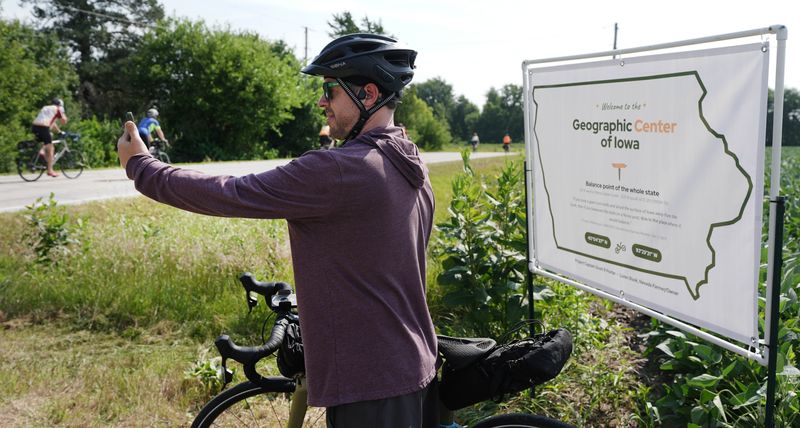
And then, well, he lived a life. Passed the bar before leaving the courtroom to enter the classroom as a computer science professor. Retirement. RAGBRAI. And in all those trips across the state, he always wondered: What are the chances they’d come biking by that spot on E-29, a stone’s throw from Indian Creek?
Best he can say now is that it took him 16 years of river-to-river crossings, 47 years of breathing, to find himself in the area of Book’s acreage again.
But on Wednesday, July 22, he made it back here. Right here.
Finding the exact middle: a college student, a computer and a center revealed
The beginnings of this story are a bit of a work. You see, back in 1979, Chuck Offenburger, beloved Register columnist, was trying to settle the score between State Center and Iowa Center, two towns claiming the same superlative.
And in that old-time, tongue-in-cheek columnist way, Offenburger contacted the Iowa Geological Society for the answer — and some easy copy — only to discover they actually didn’t know.
There would be one preferred way to determine the real center, however, the society told Offenburger: “Using computer technology.”
“Design a computer program that would digitize Iowa’s land area,” they offered, “and then mathematically determine the midpoint of these values, around which all other values are proportionately arranged.”
Now, remember, this is in 1979, when a telephone had a cord and the concept of a computer in your pocket was as realistic as an Iowan, yet-to-be-born, captaining a spaceship boldly going where no one had gone before. This was the era of metallic polyester jumpsuits and Donna Summer’s “Bad Girls.” It was the dawn of the Sony Walkman — the one for cassettes, mind you — and the debut of the Happy Meal.
And it was the year that Pope John Paul II came to Iowa and said: “You who live in the heartland of America have been entrusted with some of the Earth’s best land.
“You are stewards of some of the most important resources God has given to the world.”
So, yes, today, artificial intelligence would not only tell us where the point is in a matter of milliseconds, but bots would be waiting in the digital wings to suggest a luncheonette nearby before asking us to leave a review and inquiring whether we wanted to finally buy that thing we lingered on while scrolling just the other day.
But back then? There wasn’t even any digitized database of coordinates of the State of Iowa. Whoever figured this out was in the prologue’s prologue: Before you could mathematically calculate the center, you had to write an algorithm, and before that you had to create the data.
Offenburger turned to Grinnell College senior Scott Porter, a math and chemistry major and a law school hopeful.
He and a few of his brainy friends had been conquering the then-nascent college computer programming competitions, a feat for the little liberal arts college that didn’t even have computer science courses, Porter says.
“We made all the big state schools cry by winning the Midwest regional and going on to the nationals,” Porter says. And that was just their first year. The team went to the college computer programming nationals two more times and a smaller pairing, Porter and a friend, won the international competition.
So Porter had credentials, he could build the dataset and algorithm and calculations from scratch, but he needed a computer. Or, more specifically, time with the college’s computer.
Yes, the college’s computer. The one. A state-of-the-art machine gifted for student use by Bob Noyce, alumnus and co-founder of Intel, the chip maker. A Digital Equipment Corp. model PDP 11/70, for which the college sacrificed the varsity locker room of Darby Gym to install.
With an administrator’s curiosity piqued just enough to help secure time on the schedule, Porter set out to make sure his result would be “rock-solid provable.”
He took his theorem on how to determine the geographic center point of a large area of land — he was keeping that the large area was Iowa sub rosa at that point — to the college’s Math Journal Club, a salon of sorts for the arithmetically inclined where students presented problem sets and proposed solutions.
“The idea was if there was a mistake, a hole in the proof, a strange case that wasn’t considered,” Porter says, “you would end up with a stronger concept by having it vetted by all these people.”
Porter got tacit approval from the club “since they couldn’t shoot me down,” he told Offenburger back in 1979.
And off to the green-and-white screen of the computer he went. And the machine crunched the data. And crunched. And crunched.
“It’s one of those watched-clock sort of problems because your answer gets better with the more data you feed it,” Porter says. “But the more data you feed it means there’s more calculations that have to be done on those data.”
Porter told Offenburger he invested 750 hours into the problem. The computer’s records showed it invested 17 hours, 35 minutes and 17 seconds until…
Latitude: 42 degrees, 4 minutes, 37 seconds north. Longitude: 93 degrees, 29 minutes, 31 seconds west.
They’d done it, found the center.
And it was accurate to within 1/100th of a degree, Porter said at the time. “On a football field, that would be accuracy within 3 ½ inches,” he elaborated. “On the entire land mass of Iowa, that is accuracy within a half mile.”
So accurate that when Offenburger went back to the Geological Society, a programmer who’d been inspired by the original inquiry and found a different point, though one still within that half-mile radius, said to go with the kids.
“My technology is not nearly as technical as theirs,” he told the columnist.
Poor State Center was more than 16 miles off from the Real Center. And shucks for Iowa Center, over 10 miles away.
But finding the point on a map had prompted another inquiry, Porter says. Honestly, one more important than the original question.
“Then it was like, ‘OK, but where in the heck is that?’”
So, where is it? On the land of the Books of Story County
By the time Offenburger came to the house looking for the owner of the farm down the road, Loren Book had married Ruth, the mailman’s daughter, his high school sweetheart. They’d gone to Iowa State together and then onto the Peace Corps. Pacific islands. Micronesia, to be specific.
And they’d arrived back here — right here — to farm alongside his dad, Donald, and raise three Iowa girls.
Some of the exact details are lost to memory, but Book, 80 now, doesn’t remember a long conversation. Offenburger was looking for dad, who wasn’t around, so the writer explained to him and his brother, Dennis, what the Grinnell computer kids did and what they found.
Book had no idea that their 1,200 acres of corn and soybeans, some oats and some alfalfa, was the center of anything but his own world. And why would he?
“Now do we have to put a town out there?” he asked Offenburger. Farmer’s humor.
Ruth can’t even place when Loren told her. A teacher in the next town over and a farm wife, she was pregnant with their third girl.
And it’s not like they were going to put a shrine in their fields, so, well, you get on with it.
“It’s a fun piece of information to tell people,” Ruth admits. Family trivia.
But really, they “just happen to be the ones,” the owners of this patch of heartland, Earth’s best land, at this moment, in this time.
Understand, however, that they are incredibly honored. Normally, a farm is named after the land’s owners, but they started calling this tract the Center of Iowa Farm. Always brought a little smile to his face, Loren says, when he’d order fertilizer or ring up the co-op and tell them to deliver to the Center of Iowa.
Porter didn’t solve Offenburger’s problem for anything but bragging rights — maybe an eventual mention on Wikipedia — but, still, he’s got an affinity for this spot. Right here.
As last winter gave way to spring, Porter watched the RAGBRAI route, seeing if it would change for road construction or the like. But his section of E-29 endured.
So he reached out to the house he thought was nearest to the Center.
And soon, word made it to Susan — the daughter with whom Ruth was pregnant when Offenburger drove out to the farm all those years ago — who’d been contacted by a friend, whose parents had been contacted by Porter, who was looking for the family that owned that land. Center of Iowa Farm.
This your folks? The friend asked.
The Books were happy to help Porter memorialize the space. They have a soft spot for the Register’s Annual Great Bicycle Ride Across Iowa anyway. A few decades ago ― long before Porter was riding, dad still lived in the homestead and they lived down the road where just a red garage stands now ― RAGBRAI came through.
Their eldest daughter set up a lemonade stand and tempted riders with donuts for sale with a sprinkler hose and the property’s shade trees.
When “for sale” became “almost sold out,” Loren had to take the Jeep the back way, through his field, on an emergency run to the bakery in town.
“But our daughter made enough money that day to buy her first bike,” Ruth says, “and that’s RAGBRAI to me.”
A recent article about the local RAGBRAI hoopla and the route’s path elicited Facebook comments from residents who used to be bused out to Milford School that just tickled Ruth: “To this day, I still look out there every time I drive by, looking for something that marks the spot,” one commenter wrote.
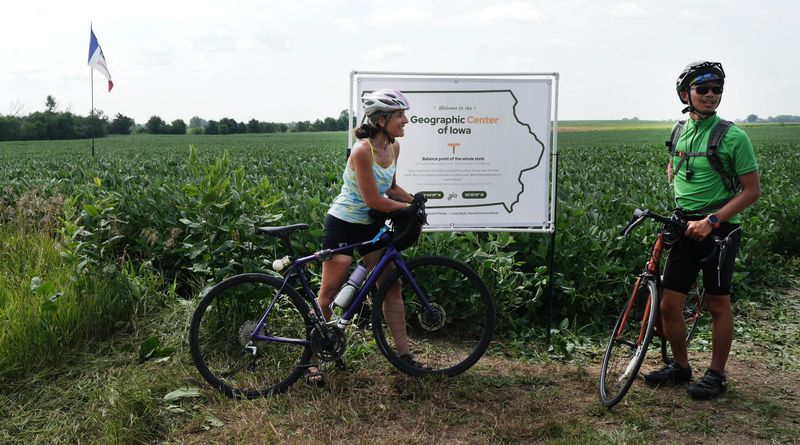
Inspired by all this excitement, the Books are hoping to change the spot’s bareness. They reached out to Story County for a sign to hang on their fence row. The supervisors “acted positive,” Loren says. “So we’ll see what comes of that.”
That way the temporary signs they made for this year’s RAGBRAI riders’ selfies at the roadside can hang “probably as long as we’re here” in their barn, the one Loren re-sided with the old Highline poles that dotted his parents’, now his, slice of black soil. The one right next to the other outbuilding that houses the old “Prairie Gold” Minneapolis-Moline tractor dad used to plant and harvest his piece of heartland, now Book’s.
“We love the history of Iowa,” Ruth says. “We’re really proud of this land and the soil and we talk about how it was formed.”
“There’s all sorts of treasures, I think, in Iowa.”
Well, there’s one here. Right here. Just 220 feet into Loren Book’s field — though, please, mind the beans.
Courtney Crowder is a senior writer and Iowa Columnist. She co-wrote and directed “SHIFT: The RAGBRAI Documentary,” which told the story of the annual trek across Iowa from the perspective of riders and volunteers. You can contact her at (515) 284-8360 or ccrowder@dmreg.com.
This article originally appeared on Des Moines Register: The exact center of Iowa was unknown. Until one student found it.
Reporting by Courtney Crowder, Des Moines Register / Des Moines Register
USA TODAY Network via Reuters Connect
By Courtney Crowder, Des Moines Register | USA TODAY Network