The contours of Iowa’s 2026 legislative session were clear from the outset.
Property tax cuts would be lawmakers’ top priority, while eminent domain, the state budget, immigration and criminal justice would occupy significant legislative time.

But while the Iowa Legislature’s Republican majorities were clear about their priorities, the end result was sometimes different.
Here’s what happened to five of the biggest issues that dominated the Iowa 2026 legislative session before the final gavel fell on May 3.
Property tax bill crosses the finish line
Overhauling Iowa’s property tax system dominated the session more than any other issue after Republican leaders pledged to deliver legislation cutting homeowners’ tax bills.
And they ultimately succeeded, getting legislation across the finish line in both chambers in the session’s final hours with a 41-1 vote in the Senate and a 62-22 vote in the House.
The bill includes a 2% growth cap on cities and counties’ general fund levies and a 10% homestead tax exemption up to $20,000, which would be adjusted for inflation.
Republicans cheered their efforts to rewrite the state’s property tax system and vowed it would lower Iowans’ tax bills.
“By capping local government revenue growth at 2% with clear and responsible guardrails, this plan brings certainty and discipline to a system that needed both,” Gov. Kim Reynolds said in a statement.
Senate Minority Leader Mike Klimesh, R-Spillville, said Republicans rallied around a measure to modernize Iowa’s property tax system.
“We made great strides in reining in local government spending, reforming the property tax system and now Iowa homeowners will see billions in property tax relief over the next several years,” Klimesh said.
Democrats were mixed in their views on the measure.
Sen. Tony Bisignano, D-Des Moines, said it “isn’t perfect.”
“But it brings real property tax relief for homeowners, avoids the hard cap on our local governments and moves Iowa away from prioritizing commercial interests,” he said in a statement.
Rep. Aime Wichtendahl, D-Hiawatha, said the bill shuffles funding sources and would not meaningfully overhaul the property tax system.
“This bill does nothing to address the actual singular cause of increasing property taxes, which is rising valuations,” Wichtendahl said. “As long as valuations continue to rise faster than inflation, there can be no true property tax relief and this bill will join its predecessors by failing to deliver property tax relief to Iowans.”
Lawmakers head home without action on eminent domain
Republican leaders were unable to find consensus on a proposal to limit eminent domain for carbon pipelines, despite efforts by the House and Senate.
That means Iowa’s eminent domain laws will remain unchanged as Summit Carbon Solutions continues its efforts to build a multibillion-dollar carbon pipeline across multiple states.
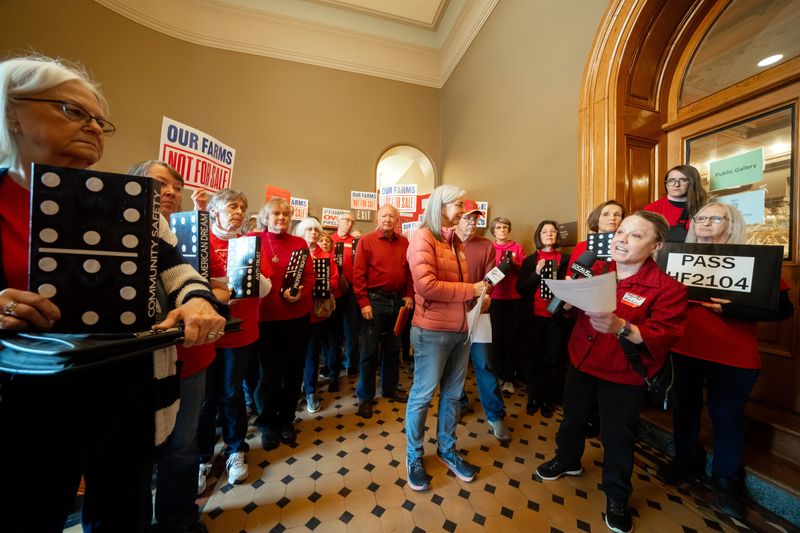
Landowners traveled to the Iowa Capitol weekly during the session, calling on Republican Senate leaders to bring a ban on eminent domain for carbon pipelines to a vote.
The House fast-tracked the bill, House File 2104, passing it in January. But it never received a vote in the Senate.
Neither did Klimesh’s proposal to allow pipeline companies to talk to landowners up to five miles on either side of the route approved by state regulators. That would let companies alter the project’s path to avoid landowners unwilling to grant access to their property.
Unlike last year, when a dozen Republican senators withheld their support from the budget to force a vote on eminent domain, this year’s session ended without a high-profile rebellion.
But angry landowners promise it will come up on the campaign trail.
“We are making eminent domain an election issue,” said Julie Glade, a landowner Wright County. “And if you are on the wrong side, we will do everything in our power to remove you from office.”
House Speaker Pat Grassley, R-New Hartford, said “yet again, we leave without having seen anything come over from the Senate,” and he wished for more progress.
“We’ve tried, I’m guessing around a half-dozen bills to try to find a level of a solution on this issue to give some certainty to property owners in the state of Iowa,” Grassley said. “And again, we share your frustration that we’re unable to get something, but that doesn’t mean that that’s something our caucus won’t continue to fight for as we move forward.”
Tight budget leaves legislators looking for new revenue sources
Republicans took the rare step of raising two health care-related taxes this year as they looked for money to fill out Iowa’s $9.6 billion state budget.
Iowa’s budget is set to spend over $1 billion more than the state will receive in revenues this year, as revenues have declined because of the state’s recent income tax cuts.
Republicans have said those revenue declines were expected. They are making up the difference using money from Iowa’s Taxpayer Relief Fund, which holds about $4 billion.
Still, they’ve been careful to avoid a large increase in state spending. This year’s budget represents a 1.43% spending increase over the prior year.
And they’re also looking for new sources of revenue to shore up the state’s Medicaid budget.
In March, lawmakers passed a temporary tax increase on some private health insurance providers that will allow the state to bring in matching federal funds. That will help offset next year’s anticipated $167.6 million Medicaid deficit.
And in the final hours of the legislative session, lawmakers approved a 5-cent tax on vapes and alternative nicotine products.
Republicans expect to raise between $15 million and $18 million from the tax in its first year. The first $3 million is earmarked for pediatric cancer research and the remainder would be used to fund Medicaid.
Lawmakers require E-Verify, SAVE to check employees’ immigration status after Ian Roberts’ arrest
Iowa will have stricter rules for employment verification and citizenship checks when applying for jobs, driver’s licenses and voting under a suite of new legislation.
Lawmakers took action following the immigration arrest of former Des Moines Public Schools Superintendent Ian Roberts last fall.
One piece of new legislation requires all public employers, including state agencies, counties, cities and school districts — as well as private schools — to use the federal E-Verify system to check the citizenship status and employment eligibility of new hires.
The law also requires public employers to use the Systematic Alien Verification for Entitlements (SAVE) system, which allows users to check someone’s immigration status against other federal databases.
It codifies and expands on an executive order Reynolds signed last fall requiring the use of the programs for state agencies and anyone receiving a state license.
The bill also contains language Reynolds proposed that requires anyone registering to vote in Iowa to swear that they are a United States citizen. Current law requires voters to attest that they are a citizen when they cast their ballots.
And it creates a presumption that undocumented immigrants arrested for any crimes other than a simple misdemeanor are a flight risk and should not be granted bail.
Lawmakers also passed legislation making it a crime to knowingly and intentionally falsely claim to have an academic degree or credentials — another response to Roberts’ arrest.
And other legislation requires state officials to use SAVE to check someone’s immigration status when they apply for or renew a driver’s license.
Repeat felony offenders to face steeper sentences under ‘3 strikes’ bill
Repeat felony offenders will see steeper sentences in Iowa under a “three strikes” bill lawmakers approved on the final weekend of the legislative session.
The bill says anyone convicted of a third felony would be sentenced as a habitual offender and would face a mandatory seven-year prison sentence. After serving a minimum of seven years, they would become eligible for parole.
Currently, Iowa’s habitual offender law requires a minimum of three years in prison for a third felony conviction, but the sentence can be deferred or suspended.
House Republicans made “tough on crime” policies a major part of their agenda for the year and originally proposed a far more aggressive bill with mandatory 20-year prison sentences for repeat offenders convicted of felonies and some misdemeanors.
But they said they were still pleased with the compromise proposal.
“Now we will truly have a three strikes, you’re out standard in Iowa,” said Rep. Steven Holt, R-Denison. “We are closing the revolving door.”
Stephen Gruber-Miller covers the Iowa Statehouse and politics for the Register. He can be reached by email at sgrubermil@registermedia.com or by phone at 515-284-8169. Follow him on X at @sgrubermiller.
Marissa Payne covers the Iowa Statehouse and politics for the Register. Reach her by email at mjpayne@registermedia.com. Follow her on X at @marissajpayne.
This article originally appeared on Des Moines Register: Here’s what happened to 5 of the biggest issues in Iowa’s 2026 session
Reporting by Stephen Gruber-Miller and Marissa Payne, Des Moines Register / Des Moines Register
USA TODAY Network via Reuters Connect