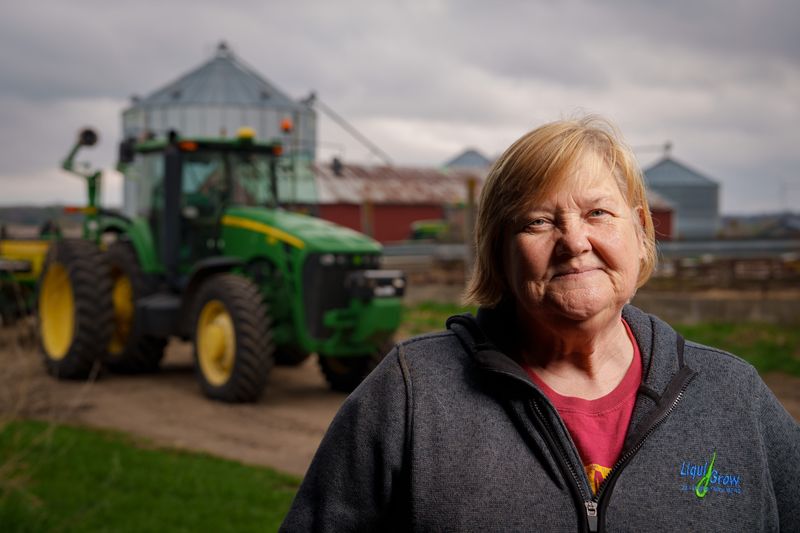
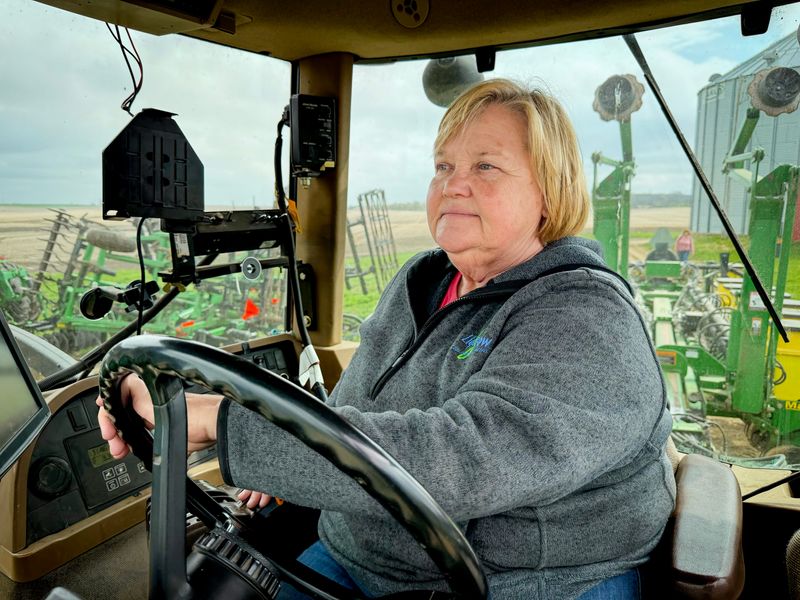
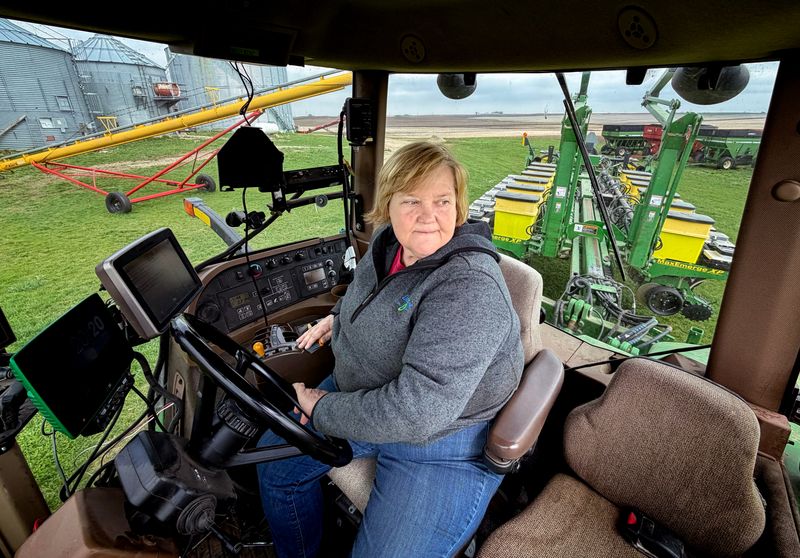
In 1985, April Hemmes decided to ditch Washington, D.C., stuffy committee meetings, power suits and pantyhose for her family’s north Iowa farm, wide-open spaces, blue jeans, boots and a tractor.
“I made the call and said I want to come home,” said Hemmes, who was then 25 and working for U.S. Rep. Jim Ross Lightfoot, an Iowa Republican.

Times back in Iowa were tough, and Hemmes knew she would need to pay her own way on the farm. That meant adding to the family’s income, so she bought 50 bred gilts ― sows having their first litters― and “I worked for the corn to feed them,” said Hemmes, now 66.
It was the height of the 1980s Farm Crisis, a nearly decade-long agricultural recession that remains one of the worst economic periods in Iowa’s history. Farmers struggled with a U.S. embargo on wheat sales to Russia that crashed crop and farmland prices while double-digit interest rates drove production costs sky-high.
Farmers filed hundreds of bankruptcies. Families watched as county sheriffs auctioned off their land, machinery and homes. Suicides mounted. Grassroots groups placed crosses on courthouse lawns to mark the loss of generational farms. Rural Iowa’s population plunged.
Now, as thousands of Iowa farmers plant this year’s corn, soybeans and other crops, some farm and business leaders worry the state and nation could be in another farm crisis. Producers face a fourth year of losses and new projections that show U.S. farm income will continue to decline over the next decade.
A Purdue University survey in April found about 40% of farmers expect tough times to continue over the next five years.
“That’s different than just a short-term shock, with farmers back to profitability in a few months,” said Michael Langemeier, a Purdue agricultural economist who leads the survey. “That tells me that they’re expecting tight margins to continue for the foreseeable future.”
U.S. farmers already were struggling with high production costs and low prices when President Donald Trump placed tariffs on the country’s largest trade partners last year, cutting exports of commodities like soybeans and leaving farmers with record-size crops they struggled to sell profitably.
Now his administration is sending $12 billion to farmers to help offset the tariffs’ impact and provide a bridge to beefier government safety net supports later this year. Congressional leaders are discussing sending $15 billion more to farmers to compensate for the war with Iran driving farm fertilizer and fuel prices higher.
Even with aid, many U.S. farmers are haunted by the prospect of unsustainable debt. Nationally, farm bankruptcies were 44% higher last year than in 2024, and in Iowa, they more than doubled.
Hemmes said she tells young growers “this is your Farm Crisis.” She urges them to keep repairing old equipment so it works another year, add a side hustle to boost cash flow — “do whatever it takes to make a go of it, to keep your head above water.”
At the same time, she hears farmers around her age say they’re ready to quit, unwilling to continue bearing the losses that eat into their families’ assets.
She said the downturn will likely lead to more consolidation — fewer farms that get bigger and bigger. “It’s been happening since the 1800s,” she said. “And it’s just going to escalate.”
Statistics provide a snapshot of the Farm Crisis’ devastation
As a lawyer in Mount Pleasant in the 1980s,Tom Vilsack counted among his early clients a man whose son hanged himself from a barn rafter, distraught because he thought he was responsible for the family losing their land.
“Seeing a grown man cry, you can’t help but be impacted by that,” Vilsack told a Columbia University researcher for an oral history on the Obama presidency. Vilsack said he was able to save a portion of the man’s farm so his client could continue his life’s work.
At the World Food Prize headquarters in Des Moines, where he now serves as CEO, the 75-year-old said the memories of the Farm Crisis have driven his work to improve income for farmers — first as the governor of Iowa and then U.S. secretary of agriculture under Presidents Barack Obama and Joe Biden, both Democrats
“Those memories of the farmers in the ’80s will never leave me,” Vilsack said.
Statistics help explain why the Farm Crisis haunts Vilsack and others who experienced it:
Vilsack said the effects of the Farm Crisis continue, with national farm policies that drive consolidation by providing the most support to the largest farmers. Another set of national safety net programs is needed to support small and mid-sized farmers, he said.
To illustrate the problem, Vilsack pointed to 2022, when farmers saw rocketing corn and soybean prices — and record farm income. In the best of times, half of the farmers — “good farmers” — “didn’t make enough money to support their families” and worked off-farm jobs for their income, he said.
“What do you think is happening today?”
7% of U.S. corn growers plan to leave farming
The National Corn Growers Association in a survey released in February asked 1,000 farmers about changes they were planning, given the economic downturn. Of those surveyed, 7% said they would retire or exit farming earlier than planned.
If that happens the group said, “the U.S. could lose over 131,000 farms in a single year — dropping total farms to 1.7 million. That pace would be seven times the average annual decline of the past decade and the largest single year loss since 1982.”
Conversely, 13% of those surveyed said they planned to postpone retiring, given concerns about the next generation’s ability to remain in the industry without their support.
Altogether, nearly 80% of growers “believe the next generation will not be able to succeed on their farm without support from the current generation,” said a summary of the findings.
The responses indicate both established and beginning producers are stressed, said Krista Swanson, the National Corn Growers Association’s chief economist.
“There’s uncertainty about who will be farming in the next generation and what environment they’re entering,” she said.
Purdue University’s April Ag Economy Barometer echoed the pessimism, with 44% of those surveyed reporting they were worse off than a year earlier. Still, it was better than February, when 50% of respondents felt they were in worse condition.
Langemeier credits the improved outlook to federal aid payments and a temporary boost in commodity prices.
Economists: This downturn could be similar to 2014-19 recession
Langemeier and Chad Hart, an Iowa State University agricultural economist, said they see this recession playing out like a 2014-19 downturn. That six-year slump followed near-record high commodity prices that pulled production costs higher.
As now, the higher seed, chemical and other costs were slow to decline. Like now, farmers found themselves caught in the trade war that occurred in Trump’s first term.
That recession drove 125 Iowa farm bankruptcies, court data shows. The impact on the broader economy was negligible, however, with the state’s unemployment rate never rising higher than 4.5% over the six years and falling below 3% during all of 2018 and 2019.
“There are a lot of parallels between the two,” Hart said.
But there also are differences: This downturn is driven by “sheer productivity,” he said, with multiple years of record or near-record corn and soybean harvests since 2020, driving down prices.
Last year produced a record corn crop, for example, and the country’s seventh-largest soybean harvest.
Luckily, corn is experiencing strong demand, helped by the lower prices, while soybeans lag, mostly due to tit-for-tatt tariffs between the U.S. and China, the world’s largest soy buyer.
“We’ve produced a tremendous amount of crops and livestock, and for the most part, that production has been large enough to not only meet usage around the globe, but also big enough to bring prices down across the board,” Hart said.
He believes this downturn could be shorter than the six-year dive, with demand “lining up with supplies.”
“But there are a lot of things that could extend it,” Hart said, pointing to the war with Iran, which is driving fertilizer and fuel costs higher.
“Here we are, challenged financially, with the war driving costs possibly even higher,” he said.
Unlike the 1980s, Iowa farmland values are holding up
Like Hemmes, Tom Adam started farming in the 1980s crisis.
Adam, a producer in southeast Iowa, said this recession doesn’t feel like the ’80s. “There were farm sales left and right,” he said, as land prices fell and banks foreclosed on farmers.
Urged by Earl Butz, agriculture secretary in the Nixon and Ford administrations, to “get big or get out,” many farmers bought farmland with little money down in the 1970s.
By 1980, Iowa farmland values had climbed to a median of $2,066 per acre, nearly five times what they were a decade earlier, ISU data shows. Then the bubble burst, leaving farmers struggling with debt as interest rates soared. Farmland values plummeted to $787 an acre by 1986, a 63% decline.
So far, farmland values have held steady, increasing less than 1% to $11,549 an acre last year from 2024, ISU data shows. And about 80% of Iowa farmland was owned debt-free, a 2022 ISU survey showed.
Even with hundreds laid off over the past two years at ag-related businesses like farm equipment manufacturers Deere & Co. and Kinze Manufacturing, Iowa’s jobless rate has remained between 3%-3.5%, below the national average.
Adam, the Iowa Soybean Association’s board president, said it’s unlikely Iowa will see the same magnitude of losses as it experienced before.
“But that’s very little consolation to the farmers who are going out of business because the bank says he doesn’t have the working capital,” he said.
Hemmes said that when she starts to worry, she runs through her expected yields, crop prices she’s secured and her expenses so far.
“You take a breath and go, ‘It’s OK. I’ll be OK,’” she said.
“I’m not the only one doing it. I talk with farmers who are very successful, and they say, ‘God, it’s going to be hard to make money this year,’” she said.
Former state, U.S. ag secretaries, CEOs warn of ‘widespread collapse’
Farm Credit Services of America in Omaha reports producers are relying more on debt to get through the downturn, with operating loans climbing about 45% to nearly $11 billion from 2023 to 2025.
The Midwest ag lending cooperative, primarily serving Iowa, Nebraska, South Dakota and Wyoming, saw nonperforming loans triple over that time to $392 million, according to the group’s annual report.
But overall, nonperforming loans were less than 1% of Farm Credit Services’ loan portfolio, which includes lending to grain elevators, manufacturers and other industries, in addition to farmers and ranchers.
“Lenders tells us … about 10%-15% or so of their portfolio is facing real challenges,” while the other 85% is “still in a really strong position,” thanks to stable farmland values, Nate Kauffman, a senior vice president of the Kansas City Federal Reserve Bank, said at the USDA’s farm outlook conference in February.
But Neil Hamilton, a Drake University professor emeritus of law, wonder what will happen if farmland values begin to weaken.
“I think it has to be in a lot of people’s minds,” said Hamilton, former director of the Drake Agricultural Law Center. “Could this land-price bubble burst or start to leak?
“That’s part of what we ran into in the 1980s — land values going up and up in the 1970s,” then falling in the 1980s, said Hamilton, who worked on government policies to help farmers in the 1980s. “You start to ask yourself, how can you justify paying $25,000 an acre for land,” while growing corn and soybean at a loss, he said. “It just doesn’t pencil out.”
In February, about 30 former corn, soybean, milk, pork and other commodity leaders, state and national ag secretaries, agribusiness CEOs and farmers wrote congressional leaders, warning that the ag economy is in crisis, given Trump administration policies.
While noting that Biden’s administration failed to secure new trade deals, the group said: “It is clear that the current administration’s actions, along with Congressional inaction, have increased costs for farm inputs, disrupted overseas and domestic markets, denied agriculture its reliable labor pool” and “defunded critical ag research and staffing.”
“At the same time that farm country is reeling from these blows to agriculture, rural health care cuts are threatening a vital safety net for America’s farm families,” the group said. “Congress needs to assert itself on behalf of farmers if we are to avoid a widespread collapse of American agriculture and our rural communities.”
‘We’re seeing unprecedented levels of distress,’ Farm Aid leader says
In September 1985, singers Willie Nelson, Neil Young and John Mellencamp held their first Farm Aid concert in Champaign, Illinois. About 80,000 people came to hear them, Bob Dylan, Billie Joel, Bonnie Raitt and other stars. The show raised $7 million for groups that helped distressed growers.
Today, the group is still helping farmers.
“We’re seeing unprecedented levels of distress,” said Hannah Tremblay, Farm Aid’s policy and advocacy manager, citing calls to the group’s national hotline. “They’re being squeezed in a lot of different ways, and it’s coming through in these calls.”
At the 40th anniversary concert last year, many farmers worried about their kids’ and grandkids’ ability to continue farming, said Jennifer Fahy, the group’s co-director.
“As we talked about the 1980s Farm Crisis, a lot of people said it’s happening again,” she said.
“Farmers are making really hard decisions” about whether they want to hang on, Fahy said. Among them, she said: Should they sell off parts of their farms to generate cash to continue operating?
Farmers told the group the government aid packages help, but they’re mostly passed through to their lenders and suppliers. “The payments aren’t making farmers whole,” Tremblay said, adding that specialty crop farmers haven’t yet received any payments from $1 billion included for them in the U.S. aid package.
Hemmes, the north Iowa farmer, said uncertainty around trade, farm policy and the war in the Middle East adds to farmers’ financial turmoil.
“It adds to the pressure,” she said. “We just want some stability.”
Donnelle Eller covers agriculture, the environment and energy for the Register. Reach her at deller@registermedia.com
This article originally appeared on Des Moines Register: Could Iowa be facing another farm crisis? Fears grow as costs rise
Reporting by Donnelle Eller, Des Moines Register / Des Moines Register
USA TODAY Network via Reuters Connect