For the first time on record, the Des Moines region’s water authority has banned its 600,000 commercial and residential customers from watering their lawns, effective immediately, as high levels of nitrate pollutants in the Raccoon and Des Moines rivers threaten to outstrip its treatment capabilities.
Central Iowa Water Works customers who repeatedly violate the ban could face losing water service, officials said in announcing the measure Thursday, June 12.

Federal drinking water regulations limit nitrate content in drinking water to 10 milligrams per liter, and Water Works’ equipment for removing it already is operating at capacity.
For now, treated drinking water continues to meet all state and federal regulations for drinking and household uses, the regional water authority said.
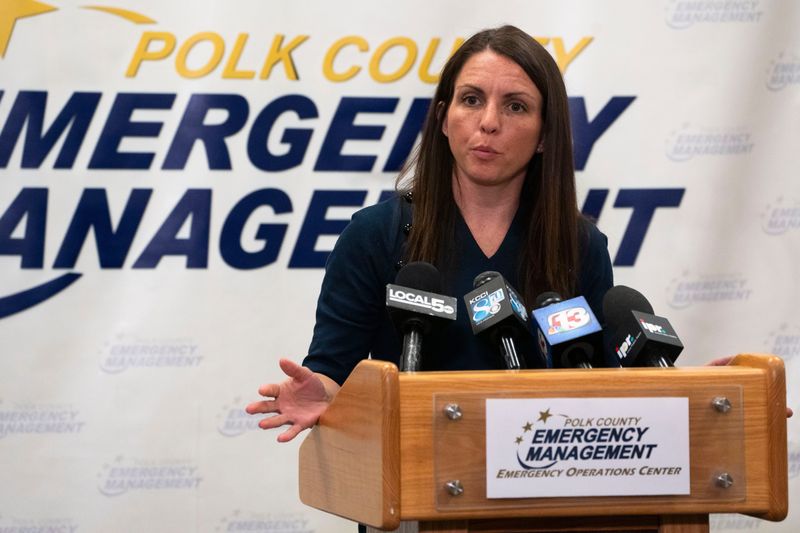
“Our plants are having a difficult time treating the high nitrate concentrations in the river, which means that our plants are unable to produce enough water to keep up” with demand, Tami Madsen, Central Iowa Water Works executive director, said at a news conference at the offices of Polk County Emergency Management.
The authority’s nitrate removal plant, only used when nitrate levels are excessive, has been running for more than 50 days straight, Madsen said. The plant costs hefty $14,000 to $16,000 a day to run, the authority said.
The Raccoon River’s nitrate levels were close to 18.5 milligrams per liter Thursday, and the Des Moines was at 17.15 milligrams per liter. The agency’s finished drinking water bumped near the federal limit, at 9.18 milligrams.
Earlier this week, the Raccoon River’s nitrate levels edged over 20 milligrams per liter, the highest level recorded since 2013, when it hit a record 24.39 milligrams per liter.
The Raccoon River’s nitrate levels have been so high that it became unusable as source water, Madsen said earlier this week.
Drinking water over the federal limits is unsafe for consumption by infants under 6 months and pregnant women, Juliann Van Liew, director of the Polk County Health Department, said during the news conference.
The ban will continue until further notice. It comes one day after the agency requested a voluntary 50% reduction in lawn watering.
Madsen said the water authority saw no noticeable reduction in water usage after asking for voluntary reductions, beginning with a request May 30 for a 25% cut in usage.
“We are pulling all levers at our treatment facilities and nitrate removal processes to prevent a violation,” Madsen said in a statement before the news conference. “Now we need full cooperation from the public. This is no longer a voluntary request.”
Violators could lose water service
The regional water authority said it made the decision to enact the lawn watering ban to ensure that treatment facilities can produce enough water for essentials uses.
Central Iowa Water Works is tapping all its low-nitrate sources, like the 200-acre Maffitt Reservoir, storage wells and shallow aquifers to meet demand, officials said Wednesday.
Des Moines metro area lawn irrigation during warm weather consumes about 20 million gallons of water daily, a 40% increase from the average use, according to the regional authority.
“Everyone must be involved in solving this problem,” Clive Mayor John Edwards said at the news conference, adding that the city stopped its irrigation and is looking ways to save water at its aquatic center and splash pads. “We’re trying to make sure that we conserve all the water that we can.”
If everyone stops watering their lawns, “We can get through this without a crisis,” Edwards said.
Des Moines also has cut off lawn irrigation at city-owned properties and is reducing its splash-ground operations to noon to 6 p.m., it said online.
If conditions were to worsen, Madsen said, the next possible step would be to ration water. “But that’s not even on the radar,” she said. “If we all work together, and get through the next few weeks, we won’t even have to have that discussion.”
Members of Central Iowa Water Works, made up of cities and local water providers, will enforce the ban, based on their rules, Madsen said.
Customers of Des Moines Water Works, the largest member of CIWW, who irrigate in violation of the ban will be notified via a tag left at their property, according to a city of Des Moines online post. If they don’t stop watering within 48 hours, their water service may be terminated, they said.
Des Moines Water Works has set up a dedicated phone line to report violations: 515-323-6247.
In Johnston, Evan Summa, general manager and chief operating officer of the Hyperion Field Club, said the golf club already had cut back on watering at the request of the city, ceasing irrigation of its driving range. The course itself continues to be watered, but the source there is wells on the property, not the public water supply, Summa said.
“We’re willing to work with the city as long as we can maintain the areas we need to maintain over there,” he said, adding, “I don’t know what all these other courses are doing that don’t have a well.”
The ban affects all Central Iowa Water Works members: the cities of Ankeny, Clive, Grimes, Johnston, Norwalk, Polk City, Waukee; unincorporated Polk County; all Des Moines Water Works customers including residents of Des Moines, Alleman, Berwick, Bondurant, Cumming, Pleasant Hill, Runnells and Windsor Heights; the Urbandale Water Utility; the Warren Rural Water District; West Des Moines Water Works; and Xenia Rural Water.
Nitrates connected to health threats
Consuming water with high levels of nitrates is associated with infant asphyxia, known as blue baby syndrome, and even lower levels of nitrates have been linked to cancer.
Nitrates occur naturally in soil, but in heavily agricultural states like Iowa, they also leach from manure and commercial fertilizer applied to farmland into rivers, lakes and streams, often via drainage tiles underlying fields. Fertilizers also can wash into waterways from urban sources like lawns and golf courses.
In 2015, Des Moines Water Works filed a lawsuit against rural drainage districts in Sac, Buena Vista and Calhoun counties it said were funneling high levels of nitrates into the Raccoon River.
The utility sought damages and penalties for the costs it incurred removing nitrates from central Iowa drinking water, saying it had spent $1.2 million to operate its nitrate removal equipment in 2015.
It also sought to have the drainage districts, and indirectly farmers, regulated under the federal Clean Water Act as a “point source” of pollution, much like businesses and manufacturing plants.
But the two-year-plus legal battle ended after the judge dismissed the lawsuit, saying Iowa’s water quality issues were an issue for the Legislature, not the courts, to resolve. Though the state has programs encouraging farmers to adopt practices that reduce fertilizer use and runoff, the measures remain voluntary.
Conservation group American Rivers in an annual report in 2021 named the Raccoon River among the 10 most endangered in the nation, saying Iowa’s voluntary strategy had “failed spectacularly.” But Iowa Agriculture Secretary Mike Naig rejected the report as propaganda and stood by the state’s approach.
Utilities, meanwhile, have focused on measures to safeguard their water supply against the nitrate onslaught. Central Iowa Water Works is in the process of expanding the Saylorville treatment center, which will have nitrate removal capabilities, and it’s adding large underground storage facilities, filling them with finished water during the winter, when nitrate levels are generally lower, and tapping them in the summer when demand explodes.
In addition to cutting lawn watering, the regional authority asks customers to repair leaky faucets, run only full loads in their washers and dishwasher, take shorter showers and avoid filling pools, washing cars or using water toys to conserve water.
People watering gardens or flowers should do so with a hand-held container and not use a sprinkler or run water through a hose.
Central Iowa Water Works began operations Jan. 1. Previously, Des Moines Water Works has called for voluntary watering restrictions during droughts or spike in water nitrate content. But Thursday’s mandatory ban was a first for the region.
In many regions of the country, watering bans enforced with fines are a routine part of summer, especially in Sunbelt states like Texas, Florida, Arizona and California.
Des Moines Register staff writers Virginia Barreda and Phillip Joens contributed to this article.
Donnelle Eller covers agriculture, the environment and energy for the Register. Reach her at deller@registermedia.com.
This story was updated to add a video.
This article originally appeared on Des Moines Register: Central Iowa Water Works issues first-time lawn-watering ban as nitrate crisis intensifies
Reporting by Donnelle Eller, Des Moines Register / Des Moines Register
USA TODAY Network via Reuters Connect