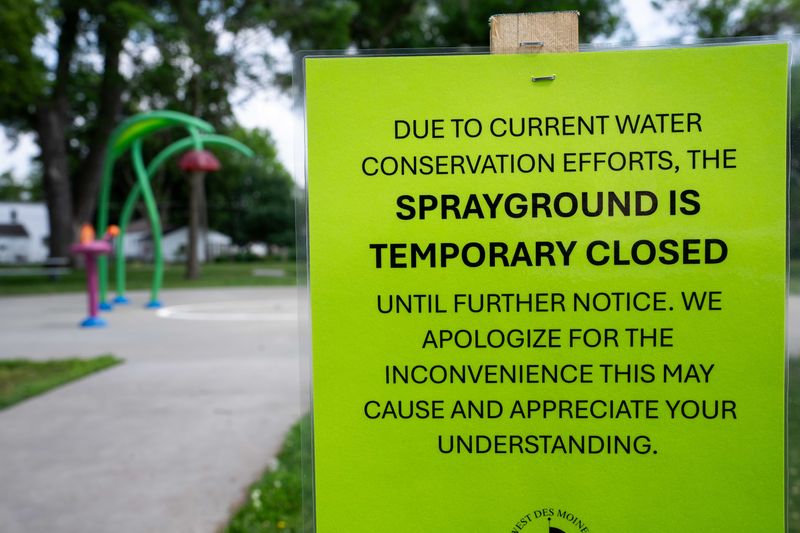
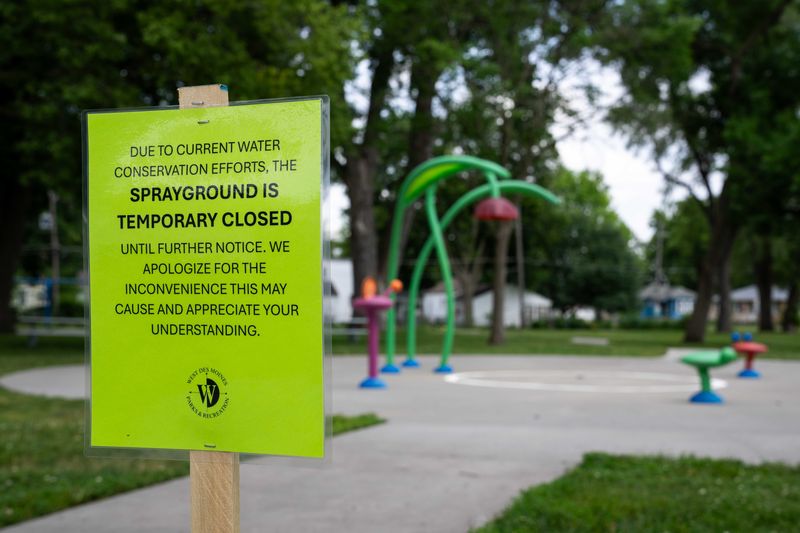
Central Iowa Water Works says its first-ever ban on lawn watering is cutting demand and easing worries that its utilities — hampered by high levels of health-endangering nitrates in the Raccoon and Des Moines rivers — will be able to meet residents’ and businesses’ essential water needs and allow them to avoid more drastic measures.
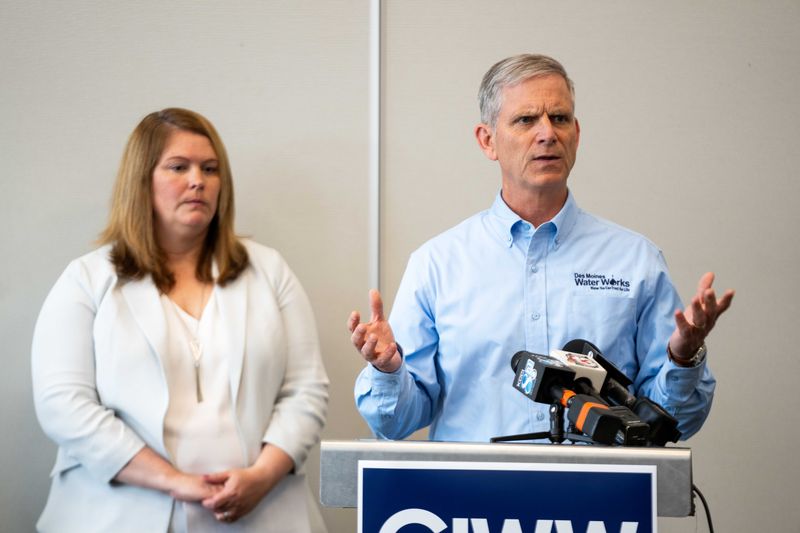
Still, residents should prepare to continue the mandatory conservation measure for “weeks, not days,” given continued high nitrate levels, Des Moines Water Works General Manager Ted Corrigan said in a news conference Tuesday, June 17.

Des Moines metro residents have slashed demand 30% in the ban’s first five days. But nitrates remain around 15 milligrams per liter in both the Raccoon and Des Moines rivers, data show.
That’s still about 50% above the federal safe drinking water standard and extensive treatment is necessary to render the water acceptable for consumption.
“Right now, we are still facing a very significant nitrate challenge,” said Corrigan, who was joined at the news conference by Tami Madsen, Central Iowa Water Works executive director, and West Des Moines Water Works General Manager Christina Murphy.
Corrigan said the regional water authority has been able to continue meeting federal limits on nitrates in drinking water because of residents’ conservation efforts. Without them, “we would have violated the drinking water standard,” he said.
High nitrate levels in drinking water make it especially unsafe for infants and pregnant women, and have been linked to cancer.
Utility officials said in the news conference that $344 million in new nitrate treatment equipment will come online over the next seven years, improvements the regional authority and its members have worked on for months.
“We’re not just talking about nitrates, we’re planning for the future,” Murphy said.
Why are nitrates so high in Des Moines?
While nitrates wash into waterways from urban lawns, golf courses and wastewater treatment facilities, fertilizers applied to Iowa’s 23 million acres of corn and soybeans are the primary source of nutrient pollution.
Nitrogen as well as phosphorus, another nutrient, are critical to growing crops, but they become pollutants when they enter Iowa’s waterways.
Corrigan said Tuesday about 90% of the nitrates that make their way to central Iowa come from upstream farm fields.
Heavy spring rains pick up nitrates from manure and commercial fertilizer and carry them through drainage tiles beneath the fields to Iowa’s rivers, streams and lakes, said Chris Jones, a former University of Iowa research engineer. Heavy storms also can cause surface runoff of fertilizer.
Drought conditions in Iowa from 2020 and 2023, followed by this year’s average spring rains, can result in the funneling of large amounts of nitrates through drainage tiles, Corrigan said. Recent storms across northwest and north central Iowa, part of the Raccoon and Des Moines river watersheds, also may prolong high nitrate levels, he said.
Another factor affecting nitrate release is when farmers apply fertilizers, Jones said. After skyrocketing fertilizer costs caused by supply disruptions during the COVID 19 pandemic, more farmers may be applying fertilizer in the fall, when it’s typically cheaper than in the spring, Jones said.
Knowing that fertilizer can be lost over the winter, when crops aren’t growing, farmers may apply up to 20% more nitrogen, Jones said, increasing the amount that can be swept into rivers when spring rains return.
He added that farmers also are installing more drainage tiles beneath their fields, or replacing old ones, providing additional conduits for nitrogen and phosphorus.
Consumers are cutting their water use
While Central Iowa Water Works customers have cut usage by 30%, don’t expect the regional authority to raise the ban on water use until nitrates have fallen to safe levels, Murphy said in an interview before the news conference.
Once the ban is lifted, demand will likely spike 40%, or 20 million gallons a day, the increase utility officials usually see when temperatures rise, she said.
Central Iowa Water Works issued the watering ban Thursday, June 12, and threatened service shutoffs for those who failed to comply.
The regional authority said the necessity of treating water to lower high levels of nitrates had made it difficult to meet growing demand as summer approaches.
Madsen said the call for a voluntary 25% reduction in lawn watering May 30 and a 50% reduction on June 11 resulted in no noticeable decline in demand. Murphy said demand actually climbed in West Des Moines.
Are data centers to blame for central Iowa’s lawn watering ban?
West Des Moines Water Works data shows the city’s growing Microsoft data centers were the utility’s largest water users for the 12 months ending in March, at 70.5 million gallons.
But Murphy said data centers’ average use is about 2% to 7% of the water pumped by the utility — far less than the share that was going to lawn watering.
Microsoft said in an email that “efficient data center water use is a priority for Microsoft. Beginning August 2024, all our new data center designs began using zero water cooling technology, as we work to make zero-water evaporation the primary cooling method across our owned portfolio.”
Trailing the tech giant — which will have invested $6 billion in West Des Moines facilities since 2012 with its most recent $210 million expansion — were R&R Realty, a commercial property developer and manager, at 66.7 million gallons, and General Growth Properties, the owner of Jordan Creek Town Center, at 51.7 million gallons.
Altoona opted not to join CIWW when it became operational in January, so the city’s Meta data centers, the Facebook owners’ largest, are not among the businesses the regional water authority’s utilities supply. In addition, the eastern metro city uses well water that has not been affected by the nitrate challenges.
More treatment, clean water storage is underway
Over the next seven years, the large projects are expected to add 34 million gallons of water daily to CIWW’s supply, Murphy said.
The water authority is investing $344 million in the expansion, which includes an additional 10 million gallon a day at the Saylorville water treatment plant; greater capacity for the Grimes treatment plant; and plans to build a new treatment plant on the metro’s western edge.
The plants will have nitrate removal built into the normal treatment process, Murphy said. Those plants operate differently than the existing Des Moines Water Works nitrate removal plant, which operates separately from the usual water processing system. Costly to operate, the equipment has been in continuous use for more than 55 days.
In addition to added treatment, the Des Moines, West Des Moines and Urbandale water utilities are adding aquifer storage that will provide 9 million gallons of treated water daily when demand peaks. The facilities typically treat and store the water during the winter, when demand is low and so are nitrate levels.
Altogether, the new plant and expansions will add 25% more nitrate and water treatment capacity for the regional authority, Murphy said.
Did officials wait too long to invest in added nitrate treatment?
Planning for expanded demand has been in the works for months and was part utilities’ and cities’ consideration when they joined Central Iowa Water Works, Murphy said. The large investments needed, along with finding the quantity and quality of water needed, complicates the projects, she said.
“All of us had hoped that we could get there before” the current surge in nitrate levels, Murphy said. “We hadn’t seen this high level of nitrates in a decade.”
Madsen said last week that nitrates in the Raccoon River had reached just over 20 milligrams per liter, twice the level considered safe for infants under 6 months and pregnant women to consume. It was the highest nitrate level recorded since 2013, when they hit a record 24.39 milligrams per liter.
“We’ve seen elevated nitrates before, but we were able to handle it with our existing facilities,” Murphy said. “We certainly want to get these facilities online as soon as possible.
“We’ll look at where we can expedite the process where we can,” she said. “These projects, they just take time to come online, unfortunately.
“I think there’s a misconception that you can just put a well anywhere, and get the amount of water that you want,” she said. “That’s not the reality.”
(This story has been edited to correct the percentage at which nitrate levels in the Raccoon and Des Moines rivers were over the federal safe drinking water limit.)
Donnelle Eller covers agriculture, the environment and energy for the Register. Reach her at deller@registermedia.com.
This article originally appeared on Des Moines Register: Buckle up. Des Moines’s lawn watering ban is cutting demand, but unlikely to end soon.
Reporting by Donnelle Eller, Des Moines Register / Des Moines Register
USA TODAY Network via Reuters Connect