Don’t let stereotypes of cornfields and pastures fool you, Indiana is home to a variety of diverse landscapes that are easy and fun to explore.
The state’s natural history bonanza ranges from rolling sand dunes spilling into Lake Michigan and one of the country’s longest underground rivers to ancient fossil beds along the Ohio River and a high-point that’s, well, really not much more than a hill.

Spring and summer are perfect times to load up friends or family and — to borrow a suggestion emblazoned on Indiana license plates back in the 1980s — “wander” Indiana. To help jumpstart your plans, here are five recommendations we think should be on the bucket lists of all Hoosiers.
There are a lot of ways to make a memorable adventure in these areas, too. You can spend a night in a cave hundreds of feet underground, or take it a bit easier and hike the woods. You can watch the sunset from atop a sand dune or paddle a tree-lined creek while anglers fish. You can even scale the state’s highest point, hidden among the cornfields and trees.
So, as you contemplate your next outdoor adventure, why not start by checking out one of these unique spots in Indiana?
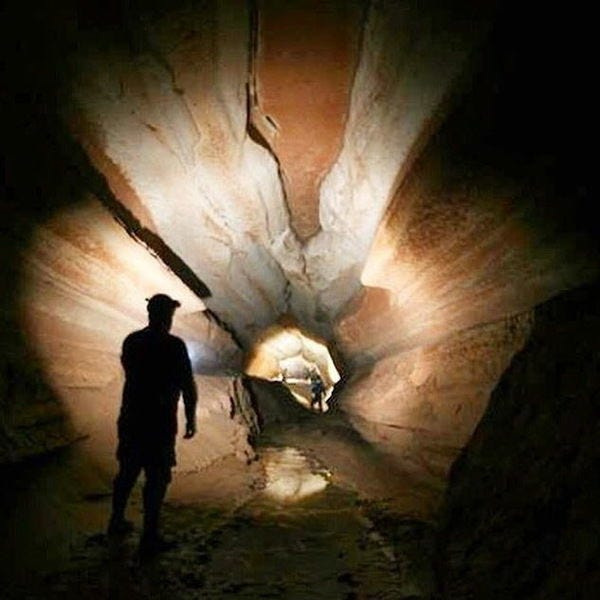
Take an underground boat ride at Bluespring Caverns
Indiana has some spectacular wildlife, from roaming bobcats to eastern hellbenders, but some of the most elusive can be found hundreds of feet underground at Bluespring Caverns.
Blind cavefish and crayfish live in the cave system just north of Hoosier National Forest. These translucent creatures populate the longest navigable underground river in the U.S., where visitors can ride boats and kayaks, traveling under the stalactites stretching from above.
Visitors can explore the 21-mile cave system for short 1-hour trips or longer 3-hour tours. But for the adventurous types, the park offers an overnight expedition not only along the underground river, but through undeveloped portions of the caverns, too.
Name: Bluespring Caverns
Location: 1459 Blue Springs Cavern Rd, Bedford, IN 47421
Cost: Daily boat tours are $26 for adults, $14 for children. Group kayak tours range from $100-120.
Phone: 812-279-9471
See website for more: www.bluespringcaverns.com/
Summit Indiana’s highest elevation at Hoosier Hill
A fear of heights shouldn’t keep even the most sensitive acrophobes away from Indiana’s highest point, Hoosier Hill. The state’s grandest “peak” is located just north of Richmond near the Ohio border in Wayne County.
Much of the state, thanks to retreating glaciers filling in our valleys and pancaking the landscape, is relatively flat, but the gently rolling Hoosier Hill stands one-and-a-half times as high as the Salesforce Tower in downtown Indy.
Danielle Howard, ecologist with DNR, said Hoosiers might think the dramatic hills in Brown County, or the bluffs of the Ohio River would be the highest point in Indiana, but the state’s general west-to-east rise in elevation makes Hoosier Hill the undisputed top of Indiana.
Measuring 1,257 feet above sea level, the summit can be deceiving as it looks no different from the surrounding crop fields dotted with stands of trees. There isn’t a steep trail leading to the peak, but the state’s highest elevation is marked with a small boulder.
As far as amenities, the boulder and a mailbox greet visitors at a clearing. Visitors can leave a note using the pen and notepad waiting inside the mailbox. The Palladium-Item detailed some of these messages in 2018 and found people from as far away as New York summited the peak, while others recounted memories of loved ones or offered travel advice.
Name: Hoosier Hill
Location: 11876 Elliott Rd, Lynn, IN 47355
Cost: Free
Phone: None
See website for more: None
Enjoy a unique beach day at Indiana Dunes
The southern shores of Lake Michigan have seen a wealth of human history, with archeological evidence pointing to small Indigenous groups calling the area home some 10,500 years ago.
Today, visitors to the Indiana Dunes can immerse themselves in nature by hiking along any of the 15 trails, head to the beaches, go birdwatching and gaze at the stars.
There are easy walks to challenging hikes open most of the year that wend through hardwood forests, ridges of dunes and extensive wetlands. The longest trail system in the park, Glenwood Dunes, can take hikers, runners, horseback riders and cross-country skiers through nearly 15 miles of interconnected loops.
The dunes were formed by wind-blown sands from glacial deposits, DNR’s Joe Exl said. Older dunes in the area can be found several miles inland and are relics of higher water levels of ancestral Lake Michigan.
The area is a magnet for migratory birds making their way southward as they follow the north-south shore of the lake and meet at the southern tip. Indiana Dunes is also home to many wintering birds.
Another unique feature is the night-sky protection provided by the dunes, which eliminates light pollution and creates a perfect place to watch for falling stars and planets chasing each other across the sky.
Name: Indiana Dunes
Location: State Park, 1600 N 25 E, Chesterton, IN 46304; National Park, 1215 IN-49Porter, IN 46304
Cost: State Park, $7; National Park $15-25
Phone: State Park, (219) 926-1952; National Park, (219) 395-1882
See website for more: State Park, www.in.gov/dnr/state-parks/parks-lakes/indiana-dunes-state-park/ or National Park, www.nps.gov/indu/planyourvisit/basicinfo.htm
Witness ancient worlds at Falls of the Ohio State Park
Travel back in time to the Age of Fishes with a trip to the Falls of the Ohio State Park. Located in Clarksville, just north of Louisville, the park features some of the world’s largest exposed fossil beds from the Devonian period.
The rock formations with the fossil beds are widespread and stretch all the way into western New York, said DNR’s Alan Goldstein. Millions of years ago, the formation actually was part of a flooded continent 30 degrees south of the equator, so many of the fossils visible today are sea life.
More than 600 species can be found in the 390-million-year-old fossil beds. Visitors can find trilobites, coral, snails and clams among other species of fossils along the riverbank. The park has even set up a Fossil Challenge culminating in a prize for visitors who find nine different species listed in a brochure found at the interpretive center.
The best time to visit the park for fossil hunting is between August and October when the river is at its lowest and the lower fossil beds are most exposed.
After exploring the past, there are plenty of ways to enjoy the present at the park. Visitors can launch a boat into the Ohio River, hike trails and go fishing at the park.
Name: Falls of the Ohio State Park
Location: 201 W Riverside Dr, Clarksville, IN 47129
Cost: $2 parking and $9 adult admission to Interpretive Center
Phone: (812) 280-9970
See website for more: in.gov/dnr/state-parks/parks-lakes/falls-of-the-ohio-state-park
Sweeten up to a leisure cruise down Sugar Creek
There are 11 Sugar Creeks in Indiana, as noted by the late Harold Allison in The Herald Times, but only one of them stretches almost twice the length of the entire I-465 loop around Indianapolis. And it features many places to launch canoes, cast a fishing line or hike through unique rock formations.
Starting from a spring in a farmer’s field near the border of Tipton and Clinton counties north of Indianapolis, the 90-mile Sugar Creek cuts southwest until it meets the Wabash River just west of Turkey Run State Park.
Among the corn and beans of west-central Indiana, Sugar Creek has carved out a wild landscape, DNR’s Howard said. It flows through deep sandstone canyons carved by glacial meltwaters, where ice age relics of hemlock and Canada yew thrive.
“Anyone who floats down Sugar Creek or walks its banks gets the feeling they’ve visited another time, or maybe another world altogether,” she said.
The stream has such significance in Hoosier history, The Reverend Peyton’s Big Damn Band wrote a song about its wonders featuring the recurring refrain, “Take my baby back to Sugar Creek,” in the chorus.
The DNR’s Sugar Creek Conservation Area spans around 1,300 acres starting at the stream in Shades State Park. Visitors can fish the creek from the shore, forage for nuts and mushrooms in the surrounding wilderness featuring sandstone cliffs and shady ravines, and watch for wildlife.
Visitors can also experience the area’s natural beauty while floating down the creek in canoes, inner tubes and kayaks, which can be rented from private outfitters.
Name: Sugar Creek
Location: Multiple liveries along the creek
Cost: Varies by location
See website for more: turkeyrunstatepark.com/turkey-run-canoeing-and-kayaking/
Editor’s note: This story was originally published in 2025. We are republishing it as part of our spring coverage.
IndyStar’s environmental reporting project is made possible through the generous support of the nonprofit Nina Mason Pulliam Charitable Trust.
Karl Schneider is an IndyStar environment reporter. You can reach him at karl.schneider@indystar.com. Follow him on BlueSky @karlstartswithk.bsky.social
This article originally appeared on Indianapolis Star: Wander Indiana: 5 unique Hoosier outdoor sites you need to visit this spring or summer
Reporting by Karl Schneider, Indianapolis Star / Indianapolis Star
USA TODAY Network via Reuters Connect