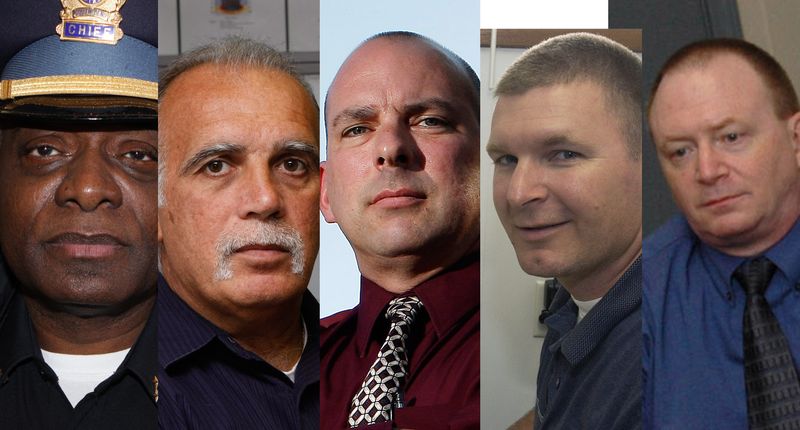
SOUTH BEND — The South Bend Police Department’s 15-year court battle to release tapes containing alleged racist comments and discussions of illegal activities between officers was ruled to have been obtained illegally by the St. Joseph Superior Court on Thursday, May 28.
The South Bend Common Council had sued the city’s administration for disclosure of the tapes and won in 2020, but years of appeals followed, and the content of the tapes remained undisclosed.

At-large Common Council member Oliver Davis told The Tribune he was the first person on the council to suggest a subpoena of the records back when the case was first brought to the public’s attention.
“We heard about these tapes and I said, ‘Well we can subpoena them.’” Davis told The Tribune. “I am calling for our council, and I’ve already sent them a note, and I’ve already made it public, that we should appeal this case.
“If they do not move forward to appeal this case then the council will accept the recommendations, which from that judge is another attempt to squash information and I am tired of a judge who, I don’t care if they’re Democrat or Republican , whatever, to squash information to release that,” Davis said. “It was done on public phones, and they need to [release] public information.”
In a statement by Common Council President Canneth Lee, he said he is working on setting up an executive session with council members and city attorneys to discuss “possible next steps to this long process.”
These tapes first came to light in winter 2011 after former SBPD communications director Karen DePaepe came across the voice of former captain Brian Young on phone line 6031 on the Voice Logger recording system while she was troubleshooting the system.
According to previous Tribune reporting, a general order by the SBPD Office of Professional Standards states employees do not have a right to privacy on assigned equipment. In his ruling, Judge Jamie Woods said that order is contrary to the longstanding practice of the department.
According to the court order, previous Chief Thomas Fautz established an ongoing practice that, other than certain dispatch and front desk numbers, no individual officer’s line would be recorded without their request and consent.
Recording of line 6031 had been occurring since 2005, when an officer requested his line to be recorded due to receiving threating calls, according to Woods’ ruling. That officer moved buildings in 2010, leaving the line behind. Young inherited the 6031-line but was unaware the line had continued to be recorded.
Each year, the chief of police is to perform a review of the recorded lines and according to the order, 6031 remained on that list.
“The [police] department had continuous knowledge that line 6031 was being recorded,” The court order said. “The recording of line 6031 was an annual, intentional, decision of the acting Chief of Police. The recording of line 6031 was, accordingly, never forgotten.”
When DePaepe came across the recording of line 6031, which contained conversations of something “potentially illegal,” the order said, she did not inform the late then-Chief of Police Darryl Boykins. According to the order, she kept the discovery to herself.
In early March 2011, DePaepe told Chief Boykins. He permitted the recording to continue, did not mention the recording to Young, nor did he initiate an Internal Affairs investigation, the order said.
According to the order, because line 6031 was being recorded even after the assignment to Young, it violates the Chief of Police directive to only record individual lines with officer knowledge and consent. Neither Young nor any “senders or receivers” had consented to being recorded, according to the order.
SBPD’s “failure to adopt written policies regarding individually assigned lines, and the department’s failure to notify officers, resulted in officers having legitimate and reasonable expectation of privacy in their assigned telephone lines,” The order said. “There was no written policy, unwritten practice, directive, or warrant authorizing the recording of Captain Young’s assigned line during the period it was recorded while assigned to him.”
Because SBPD “never adopted procedure, practice or routine” of recording phone activity and it explicitly distinguished general use lines as routinely recorded and individually assigned lines (like 6031) as consent-based, the recording of line 6031 and the connected officers’ conversations were “unlawful” under the Federal Wiretap Act, the 2026 order said.
Over a decade of legal proceedings have followed the case.
“They said there were racial words about it and everything else. Others have said there are other things, which I cannot repeat.” Davis told The Tribune. “That there were some derogatory terms with some people.
“The thing about it is, even if there were, people have a right to hear.”
The officers who had been recorded, Young, Tim Corbett, Steve Richmond and David Wells, have fought to block the release of the tapes and denied DePaepe’s allegations, according to previous Tribune reporting.
“If you play the police tapes, if they say bad words on it, whatever the words are, it would have been a one-week story, maybe two,” Davis said. “It would not have been a 14-year story.”
Davis believes that South Bend has a longer history of suppression and what he calls “squash.”
“It’s not a Black issue or [a] white issue. It’s not the police versus this. The whole issue, if you really want to put it together with the data center issue, with the farm issue, with the reparations issue,” Davis said. “It’s just transparency. Let’s talk about it. Let’s put it on the table. Let’s have a discussion.”
Though calling the allegations of the tapes’ content “troubling,” Judge Woods ruled the information was obtained illegally and cannot be disclosed or used in any proceeding or investigation against the officers.
Tribune Staff Writer Jessica Velez contributed to this report.
Email Tribune staff writer Juliane Balog at jbalog@usatodayco.com.
This article originally appeared on South Bend Tribune: Update: Judge orders South Bend police tapes illegal, to be destroyed
Reporting by Juliane Balog , South Bend Tribune / South Bend Tribune
USA TODAY Network via Reuters Connect