When I moved to Indiana in 2015, I spent an inordinate amount of time staring at the Wabash River, mesmerized by how it changed depending on where I stood. From my vantage point as I walked on a pedestrian bridge in Tippecanoe County, the body of water appeared calm, a mighty giant that didn’t need to flex but could if it so desired. When I hiked a trail near Delphi’s Wabash and Erie Canal Park, the river seemed moodier, its undercurrents powering around bends.
At the time, I didn’t know the origin of the word Wabash — that it was derived from the Miami name waapaahšiki, meaning bright and shiny. Indigenous words for towns and rivers often reflect their natural attributes, offering the perspective of the land’s original inhabitants.

“The language is preserving that lens,” Daryl Baldwin, a citizen of the Miami Tribe of Oklahoma, told me in an interview. “With that language, you’re suddenly looking at that river differently based on the meaning of it.”
I spoke with Baldwin, executive director of the Myaamia Center at Miami University in Ohio, for my story about the revitalization of two Indigenous languages spoken daily in the land that now comprises Indiana around the time of the United States’ founding.
One of those languages, myaamiaataweenki, is spoken by the Miami, who count what’s now the Hoosier state among their homelands. The other language, Lënapei èlixsuwakàn, belongs to the Lenape, who lived in Indiana for a time after they were forced from their East Coast home. After the two nations endured decades of forced assimilation and relocations, their languages have faded from everyday use, leaving descendants without a key part of their cultural identity.
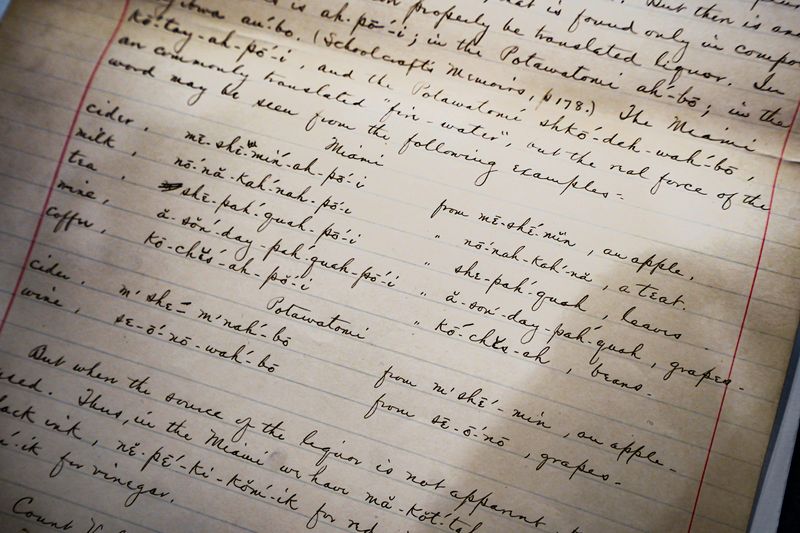
But that’s changing. The Myaamia, as the Miami call themselves, and the Lenape, whom the U.S. government refers to as the Delaware, have been revitalizing their languages for new generations, in part by drawing from archival translation manuscripts that Jesuits, Moravians and other early European settlers wrote.
As I interviewed descendants, we talked about the ties between language reclamation and landmarks in their homelands. For instance, Jeremy Johnson, cultural education director for the Delaware Tribe of Indians based in Bartlesville, Oklahoma, told me Punxsutawney, Pennsylvania, is a derivative of the Lenape name Punkwsutènay, which translates to “Mosquito Town.”
“It helps me understand what the land was like when it was named or understand a place even before I visit,” Johnson said.
Baldwin and Johnson also look for ways to grow their languages. At times, that means coming up with new words. The Miami, for example, used their research to put together a word for computer — kiinteelintaakani, or “instrument for thinking fast” — since the devices became popular after their last native speakers died.
Learning these types of language nuances is a privilege for a reporter. Given the pace of daily journalism, I typically focus on deploying words accurately and quickly. But this story invited me to slow down and examine concepts from multiple angles. I know Miami words will be on my mind the next time I’m out gazing at the Wabash River.
This Indy newsletter has the best shows, art and eats
Contact IndyStar reporter Domenica Bongiovanni at 317-444-7339 or d.bongiovanni@indystar.com. Sign up here for the newsletter she curates about things to do and ways to explore Indianapolis.
This article originally appeared on Indianapolis Star: These native languages capture the wonder of Indiana and U.S. landmarks
Reporting by Domenica Bongiovanni, Indianapolis Star / Indianapolis Star
USA TODAY Network via Reuters Connect
By Domenica Bongiovanni, Indianapolis Star | USA TODAY Network