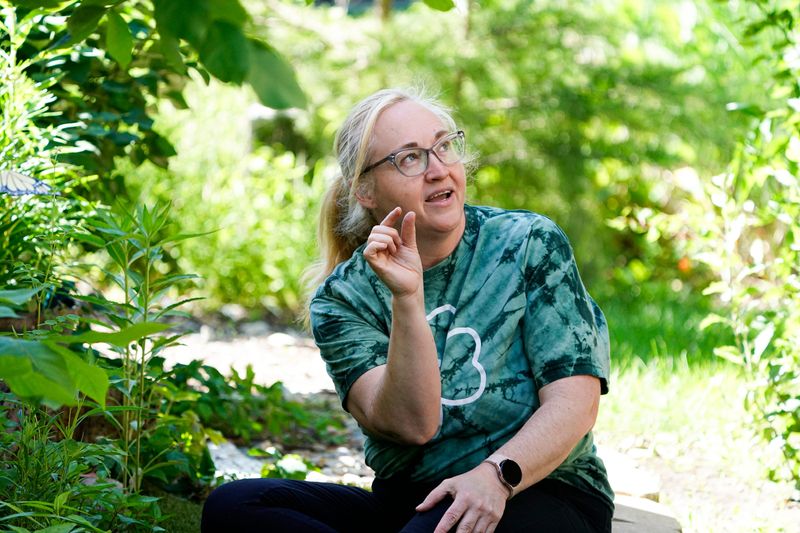
At first glance, Bobby Jean Avery-Kimball’s property almost blends in to her manicured Westfield neighborhood, a modern subdivision with beige two-story homes and three-car garages.
But past the tidy front garden, Avery-Kimball’s backyard opens into a lush and slightly unruly native oasis. Planted to attract butterflies, wooly pipevine winds around a fence trellis. The red and orange flowers of trumpet vine act as hummingbird magnets, and an artificial water feature mimicking a wetland habitat provides respite to frogs and dragonflies.

Avery-Kimball, the president of the Indiana Native Plant Society’s Central Chapter, estimates she’s growing more than 200 native species on her property. Once an average turf grass lawn, this slice of suburbia is now an active, native ecosystem — if you overlook the lilac bush out front, planted to appease her husband.
“Biodiversity is the best way that I can make the most out of my 0.2 acres here to help promote wildlife, insects, butterflies and birds,” Avery-Kimball said.
Avery-Kimball is far from the only Central Indiana resident converting her lawn into a wildlife habitat.
Some disapproving glances and occasional neighbor trouble aside, the local movement is growing. Homeowners and renters are building a network of tiny native ecosystems to protect shrinking wildlife populations and improve the quality of the region’s air and water — a couple of plants at a time, right outside their front doors.
The case for going native
Because so many birds and insects are specialized eaters, the loss of habitats studded with native species has been a pain point for many wildlife enthusiasts.
Consider the pipevine swallowtail (Battus philenor), a striking blue-black butterfly that pollinates plants across Indiana and much of the southern United States, The species can’t survive without access to certain plants, like wooly pipevine, the primary food source for the species’s pre-metamorphized life form: hungry pipevine caterpillars.
There are more than 750 unique species of butterflies across the United States and thousands more birds, bugs and critter species, each with an appetite. As the country loses native habitats, animals struggle to find the resources they rely on to survive.
In 1970, the continent was home to almost 3 billion more birds than today, including hundreds more millions of Dark-eyed juncos, White-throated sparrows, meadowlarks and red-winged blackbirds. Insect populations are also shrinking in some parts of North America, though in others they may be on the rise.
“We’ve lost insects, we’ve lost birds, all because we’re removing the plants that they need,” said Aaron Stump, the habitat programs manager of the Indiana Wildlife Federation. “It’s not just that native plants are cool or we like them. [Animals] need them. We have to have native plants.”
Backyards can be the perfect homes for those native plants.
Turf grass lawns, which a 2005 NASA study estimated cover about 40 million acres of the United States, provide next to no ecological benefit for wildlife native to Indiana.
Maintaining them is like putting a plastic plant outside your house, Avery-Kimball said. And when homeowners zhuzh up grass with invasive ornamental species like Callery pear or Amur honeysuckle, hungry and oblivious birds spread the seeds far and wide.
But native landscaping enthusiasts are trying to fight back against the invasion of non-native species. Many look to the work of an entomologist from Delaware.
Over the last five years, Doug Tallamy’s homegrown national park movement has inspired landscapers across the country, like Stump and Avery-Kimball, to embrace native species. Tallamy argues the biodiversity crisis can be solved by individuals transforming their own lawns into a patchwork of tiny native habitats.
“You do what you can with what you have with where you are. And you can do that in your home,” Stump said.
Bringing nature to central Indiana
Homes that have ditched the grass lawn in favor of bushy native ecosystems can be found in central Indiana from the heart of Fountain Square to Westfield.
Even a tiny patch can make a difference, Avery-Kimball said.
“Don’t discount what that little garden box might do. That might be the last hope of some insect that’s flying by,” Avery-Kimball said. “The more patches of ground that have even a little pocket of native plants will help pollinators have a crisis stop.”
Still, the movement has not taken root everywhere. Ingrained landscaping norms can make it tricky for some neighbors to appreciate a next-door native lawn conversion.
“Native plants can be… tall statured, I guess?” John Hazlett, the Marion County Soil and Water Conservation district manager, said. “For the most part, they grow pretty big. They grow pretty wild. They do their thing, they move around a lot, which, I think confuses and upsets a lot of traditional gardening folks.”
During the growing season, Stump fields about a call a week at the Indiana Wildlife Federation from native landscapers who have run into trouble reconciling their ecological vision with the neighbors’ aesthetic preferences.
“If you’re doing urban or suburban gardening and you’re looking into doing native plants, I think your HOA is probably the biggest hurdle,” he said.
The 87,000 person Indiana Native Plant Society Facebook group is littered with testimonials from Hoosiers struggling to deal with neighbors.
In 2024, Noblesville resident Giada Ingram received a policy violation notice from her HOA that cited “weeds” in her yard after she intentionally planted a native garden. After negotiations and some minor alterations, she was able to keep the area.
City ordinances may restrict some native landscaping choices: Indianapolis, for instance, prohibits weeds taller than 12 inches.
The city has received reports of more than 37,000 violations of that ordinance since Jan. 2022. But weeds are tricky to define, so Indianapolis encourages native landscapers to register their yards, free of charge, as native planting areas. If property owners targeted for inspection successfully register, the open violation will be closed.
The program currently has 62 enrolled properties and another 21 waiting for inspection, Kyle Bloyd, a spokesperson for the Department of Public Works, told IndyStar in an email. About 40 properties were removed from the list last year when they didn’t renew, or in a few cases, failed to maintain the requirements.
Indianapolis residents can start the registration process by emailing nativeplants@indy.gov.
To avoid this kind of trouble, Stump encourages native gardeners to mimic traditional gardening.
“There’s a big difference between letting something go, and being intentional with your native gardening,” he said.
IndyStar’s environmental reporting is made possible through the generous support of the nonprofit Nina Mason Pulliam Charitable Trust.
Sophie Hartley is an IndyStar environment reporter. You can reach her at sophie.hartley@indystar.com or on X at @sophienhartley.
This article originally appeared on Indianapolis Star: Ditching grass and dodging HOAs, some homeowners opt for native lawns
Reporting by Sophie Hartley, Indianapolis Star / Indianapolis Star
USA TODAY Network via Reuters Connect
By Sophie Hartley, Indianapolis Star | USA TODAY Network