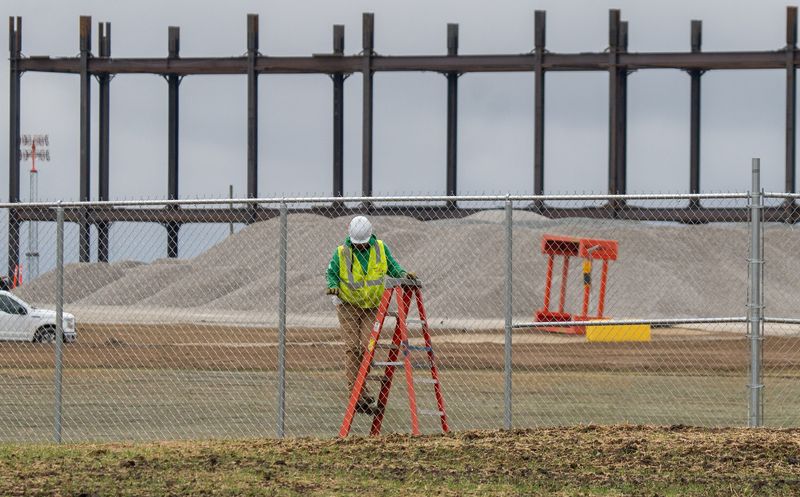
When Indiana decided to build a water-intensive tech park in Lebanon — a city unable to provide the resource itself — the question of how the area would get water was inevitable.
Plans remained in flux for years as the state conducted water studies and counties like Tippecanoe fought back against ideas to pump water from their nearby reserves. But now, construction seems to be finally moving forward.

Citizens Energy Group plans to supply Lebanon Utilities with 25 million gallons of water a day from Central Indiana water sources, like the Eagle Creek Reservoir. From there, the water will help support the Limitless Exploration/Advanced Pace (LEAP) Innovation District before Lebanon Utilities treats the water and returns it south.
Residents of Central Indiana have rallied against the project over the last several months, expressing frustration about transparency, environmental impact and cost. Some hope remains that plans for the project could shift, but for now, the two utilities are moving ahead.
The amount of infrastructure required to move so much water is enormous, and the project’s total cost could exceed a billion dollars, according to estimates from Citizens and Lebanon Utilities officials. Both utilities emphasized that the infrastructure projects won’t impact residential rates, but questions about who will end up footing the bill linger.
Costs are adding up
The program to supply water to and from the LEAP district is comprised of several projects that Citizens and Lebanon Utilities will undertake.
Citizens plans to build about 52 miles of new transmission mains, seven storage tanks and four booster stations to pipe water to Lebanon. Plus, Citizens plans to expand two of their water treatment plants in Marion County. After the water nears Lebanon, the local utility will take over.
“Our projects handshake with theirs,” said Ed Basquill, the general manager of Lebanon Utilities. “They’re going to take it to a certain point, we’re going to take it to the rest of the way.”
Lebanon Utilities is planning to build a pipeline that will connect Citizen’s infrastructure with their own and bring the water into the city and LEAP district. A booster station and storage tanks are also in the works. After companies and residents in the area use the water, Lebanon will treat it. The city’s wastewater treatment plant is scheduled for an expansion that will raise daily capacity from five million gallons to 15.
Lebanon Utilities also plans to build treated lines to transport the wastewater back south to Eagle Creek Reservoir — a plan that has frustrated local residents who worry about potential water contamination.
Hefty loans, low interest rates
The projects, which will be completed in phases over the next several years, are financed through loans from the Indiana Finance Authority’s State Revolving Fund (SRF).
Citizens officials said their portion of the completed project could cost upwards of $700 million, but the current estimate is closer to $550 million. Citizens so far has closed on one loan through the IFA, in the amount of $104,834,000 with a 4% interest rate.
Lebanon Utilities’ water supply project is estimated to cost $255,175,000 and the wastewater project is estimated to come in around $214.9 million, according to Basquill. So far, the utility has also closed one loan through the IFA, totaling $78,675,000. The IFA plans to close more loans with Citizens and Lebanon Utilities this spring, according to Jim McGoff, IFA’s director of environmental programs.
The SRF receives dollars from the United States Environmental Protection Agency (EPA), which annually grants the IFA about $50 million to support wastewater and drinking water projects in communities across Indiana. Some states, like Indiana, leverage these grants by selling bonds to the municipal debt market, pledging the EPA grants to the bonds’ repayment to increase the amount of funding available for infrastructure projects.
The IFA issues an average of $200 million worth of bond debt annually, which the agency combines with a state match in order to loan to communities at reduced interest rates. As the SRF loans are repaid, often through local utility rates, the funds are used to repay the IFA’s debt service and loaned to additional borrowers.
IFA officials explained in an email that the LEAP water project works slightly differently. Last year, the IFA issued over $400 million of debt in the municipal bond market for the SRF program. The first $200 million or so was loaned to the high-priority SRF projects with discounted interest rates, supported by the EPA funding. Funding for the projects to support water in Lebanon and the LEAP district was sourced from the second IFA debt issuance, which the agency refers to as its pooled-loan program because borrowers, like Citizens and Lebanon Utilities, are required to repay their loan with the same interest rate the IFA received — there is no discounted interest rate, according to McGoff.
But by using the IFA as a conduit, the utilities are getting a better rate than they would by borrowing privately.
From the perspective of Kerwin Olson, executive director of the utility watchdog group Citizens Action Coalition, the IFA loaning money to support the LEAP water project contradicts the spirit of the SRF, which was designed to support the health and wellbeing of communities across the United States.
He said he understands the technicalities that allow IFA to loan to LEAP-related projects but it doesn’t soften his critique.
“There are still communities in need that have significant water and wastewater needs,” Olson said.
Ratepayers off the hook
One of the biggest concerns of Hoosiers and consumer advocacy organizations is whether residential ratepayers will bear any brunt of the program’s cost.
Lebanon Utilities, Citizens and the IFA say residential ratepayers will be protected. A new rate district in Lebanon, specifically for the LEAP district, will insulate the rest of the city from rates designed to repay the loans, Basquill said. Last month, Citizens officials told reporters that keeping the program’s cost off of residential bills was a requirement for their involvement in the program.
Instead, the loans will be repaid solely from revenue generated by new commercial, business and residential customers within the LEAP district, IFA officials wrote in an email to IndyStar.
Only Eli Lilly has broken ground on manufacturing facilities in the district. A Meta data center will likely soon follow suit according to Basquill. However, some have expressed confusion as to how businesses with buildings that don’t yet exist and aren’t using water will pay back the loans through their utility rates.
The IFA has a plan for that. The Indiana Economic Development Corporation, which is spearheading the LEAP project, went to the state for an appropriation and deposited $50 million into a trust for the IFA. The IFA plans to use the money to cover the first five years of loan payments until more LEAP district utility customers move in and generate revenue that will repay SRF loan and the IFA issued bonds.
Olson said he is still skeptical of the LEAP district, but hesitantly reassured by the plan to finance the projects after talking to officials from the utilities.
“As President Reagan once said,” he said, “trust, but verify.”
IndyStar’s environmental reporting is made possible through the generous support of the nonprofit Nina Mason Pulliam Charitable Trust.
Sophie Hartley is an IndyStar environment reporter. You can reach her at sophie.hartley@indystar.com or on X at @sophienhartley.
This article originally appeared on Indianapolis Star: Supplying water to LEAP district may cost $1B. Who will foot the bill?
Reporting by Sophie Hartley, Indianapolis Star / Indianapolis Star
USA TODAY Network via Reuters Connect