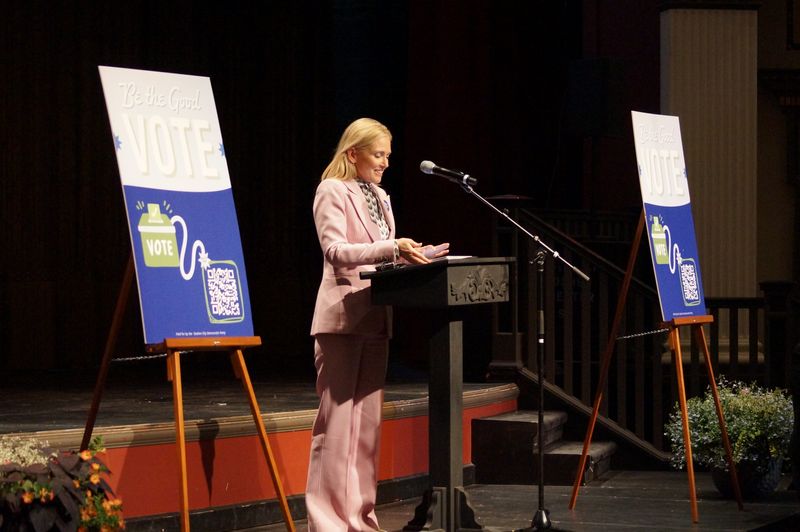
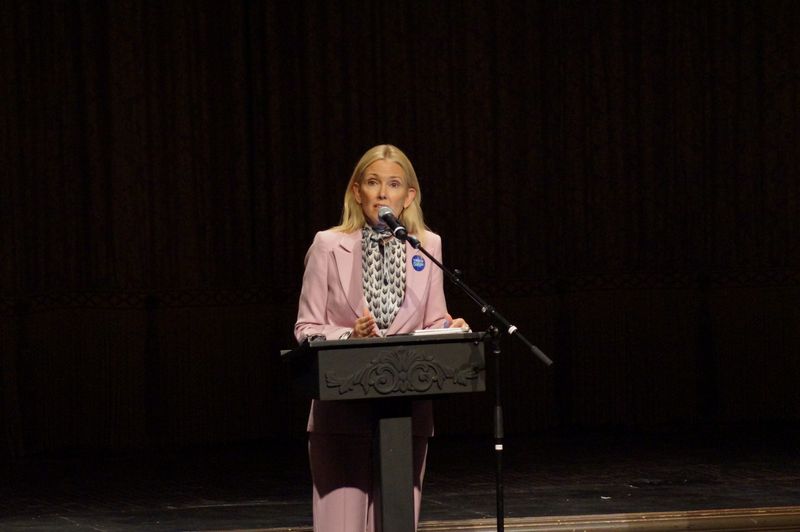
GOSHEN — What does being a Democrat mean to you? What does being a Hoosier mean to you? Indiana Senate Minority Leader Shelli Yoder believes that Hoosier values are Democratic values.

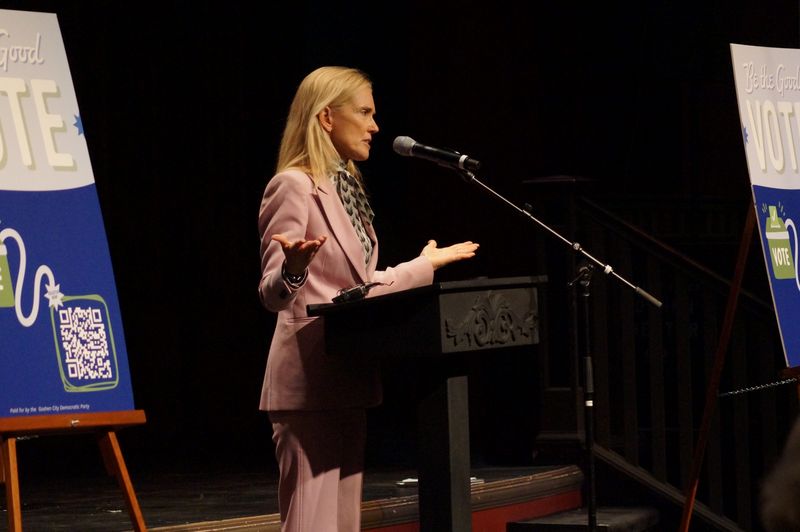
During a “State Law, Local Impact” community discussion Thursday, April 23, at the Goshen Theater the Bloomington Democrat led the discussion to inform the community about bills passed during Indiana’s legislative session this year that, she said, will hurt or help Hoosiers.
“What does it mean to be a Democrat?” Yoder said. “What are those values? It means that you believe in supporting working people. It means that government shouldn’t be about controlling our lives. It should be about making possible that people can have a life. And it really comes down to whether or not you believe in the power of community.”
During an interview with The Tribune, Yoder, a native of Shipshewana, said her identity as a Hoosier comes from her northern and southern Indiana roots. When she got the invitation to come speak, she said “of course I’m going to say yes.”
“If you know anything about growing up in Shipshi or Goshen, you get a good taste of what it means to be an underdog, and let me tell you, I wouldn’t trade that for anything,” Yoder said during her speech. “There is grit. There is very hard work. There is being practical.
“That’s the spirit of being an underdog, and in every way, that is the Hoosier way. So why isn’t everybody a Democrat?”
SNAP and Medicaid
The first bill Yoder spoke about, Senate Enrolled Act 1: Human Services Matters, makes changes to the Supplemental Nutrition Assistance Program (SNAP) and Medicaid. Yoder said the bill adds more “red tape” to what is already known to be complex forms.
“It was framed as tightening the system. It was framed as getting serious on fraud. It was framed as making sure these programs are there for the people who truly need them,” Yoder said. “But there is a moral difference between protecting a system and making it harder to survive.”
Yoder argues that the current administration in Indiana didn’t just tighten the rules, it added layers of confusion, delay and risk to those who are already in vulnerable positions.
“So, the healthy Hoosier plan is targeted for those Hoosiers who cannot afford health care and have medical needs,” Yoder said. “Now, they are having to reapply or prove their eligibility twice a year, semi-annually, and then after that requires ongoing verification at least quarterly, just verification. It also bars the state from using a broader, medically frail standard than the already narrow federal definition.”
To be defined as medically frail in Indiana, one qualification a person must meet is to have three months of working eligibility.
“I don’t know about you, but if you are matching a definition of being medically frail, chances are you probably haven’t had a very successful three-month work record to be able to receive Medicaid,” Yoder said.
Childcare and Education
Indiana has a Child Care and Development Fund that provides money for childcare through vouchers to low-income families. In 2024, the Office of Early Childhood and Out-of-School Learning implemented a waitlist for new families applying to the program.
“We don’t have a family leave infrastructure. We do not have a pre-k infrastructure in the state of Indiana,” Yoder said. “We are a state where too many mothers and fathers are told by policy and by price to somehow do the impossible and still make ends meet.”
While on the waitlist, a family has to reconfirm its address, income and contact information every 90 days. According to Yoder, there are 35,000 children currently on the waitlist.
“Thank goodness, our governor has decided in the last 10 days that he is going to reduce that,” Yoder said. “He has put a commitment of $200 million to our childcare.
“And let me tell you that we’ll get 14,000 kiddos off that wait list. That is not small, though we are not done.”
In House Enrolled Act 1004: Various Education Matters, it removes or repeals various education and higher education provisions and weakens protections for teacher contracts and collective bargaining.
“Teachers should be trusted to teach, supported as professionals and given the freedom to focus on students’ access, instead of being dragged into one political fight after another,” Yoder said.
Utilities
House Enrolled Act 1002: Electric Utility Affordability “does do a couple of really important things,” Yoder said. “One, it does provide an opportunity for every Hoosier to receive a payment plan.
“Second of all, just like we do in the winter months where we don’t turn off your heat, that same rule will apply during the summer months and hot weather.”
Yoder calls this a win, but she believes that just changing the way a bill is paid does not lower bills.
“Stretching paying out over time is not relief, and families do not need a more elegant payment system when their costs are skyrocketing,” Yoder said. “They need utility rates they can actually afford.”
Housing
While the priority of the Senate may have been “let’s cut people off Medicaid and SNAP benefits,” Yoder applauded the House for taking on housing.
The House Enrolled Act 1001, according to Yoder “came in like a lion, had a lot of promise, and went out like a lamb.”
“In the end, what it was, was sort of residential permitting language, but no guarantees on building the affordable housing and that was a failure on our part,” Yoder said.
Another housing bill, Senate Enrolled Act 285: Housing Matters, criminalizes homelessness and warrants officers to determine if “emergency detention” conditions are met. If these emergency detention conditions aren’t met, someone who “knowingly or intentionally uses land owned by the state or a political subdivision for unauthorized camping, sleeping, or long-term shelter,” commits a Class C Misdemeanor.
Immigration
Senate Enrolled Act 76: Immigration Matters expands current Indiana immigration laws by requiring schools, pre-k centers, libraries, hospitals and local governments to cooperate with Immigration and Customs Enforcement officers.
“These are spaces where historically, as a country, we said we value spaces that are important to keep safe,” Yoder said. “Where every person feels like they belong, and our schools are at the top of our list.
“Senate Enrolled Act 76 will require our teachers to play this role as having to turn in their students if asked upon.”
Yoder reminded the audience that the country can have order, humanity and security without cruelty.
“The loudest voices in politics kind of forget that a community is not weakened by families who come here, work here, worship here, raise their children here, open businesses here, stake their futures here,” Yoder said. “We are strengthened by them.”
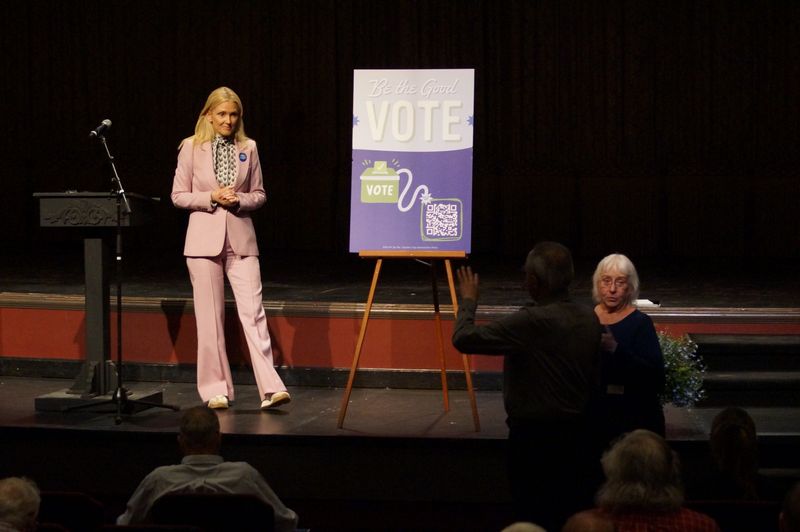
What did the audience want to know?
Due to a time constraint, there was time for Yoder to answer only a few questions.
● Would you support a two-year moratorium on data centers?
Yoder said a moratorium opens up another opportunity for people not to pay attention.
“We have to start paying attention. We need to get to our public meetings,” Yoder said. “People need to hear what is going on with data centers and not every data center is the same. … Asking the right questions is critical.”
She offers up two questions the community needs to ask and consider regarding data centers. She said that often it is talked about in how many jobs the data center will bring, but Yoder asks, “What kind of jobs will be there after it’s built?”
Her second question centers around water usage and electricity: “How are you going to use our water? We need to know how will you be getting your energy?”
● Do you have any suggestions on where to go to seek out good information about what is happening in the statehouse and how it affects us in our communities?
In “the good ole days” Yoder and her parents read the Goshen News, The Tribune’s very own “South Bend Trib” and the LaGrange Standard News. She put in a plug for WVPE and the Indiana Capitol Chronicle.
“I mean even in Bloomington, we had a local paper, and now it’s just a reprint or a smaller version of the Indianapolis Star,” Yoder said. “But I think what is critical is find out who’s doing local government.”
Voting
By now, most people likely know Indiana is in the process of holding its primary election. Early voting opened April 7 and Election Day is May 5.
Yoder has a message and a reminder for the non-voter or the neutral voter.
Her first reminder, you can bring your phone into the polling booth. Yoder said that if you need to look up a candidate or language you don’t understand, take the moment to use your phone and look it up.
“Use the information that’s out there to help guide you, and yes, it does take time,” Yoder said. “I know parents in Indiana are struggling with raising kids and childcare and paying the bills and working multiple jobs and making rent, making utility costs, so [people asking], ‘I also have to get myself educated and vote?’ Yes, you do.
“It’s a privilege, and we talk a lot about patriotism in our country and that is the top of that list of what it means to practice love of country,” Yoder said.
Email Tribune staff writer Juliane Balog at jbalog@usatodayco.com.
This article originally appeared on South Bend Tribune: Senate Minority Leader speaks in Goshen about impact of new state laws
Reporting by Juliane Balog , South Bend Tribune / South Bend Tribune
USA TODAY Network via Reuters Connect