This story has been updated with new information.
EVANSVILLE — Max Engling feels good about the reception he’s getting across the state of Indiana.

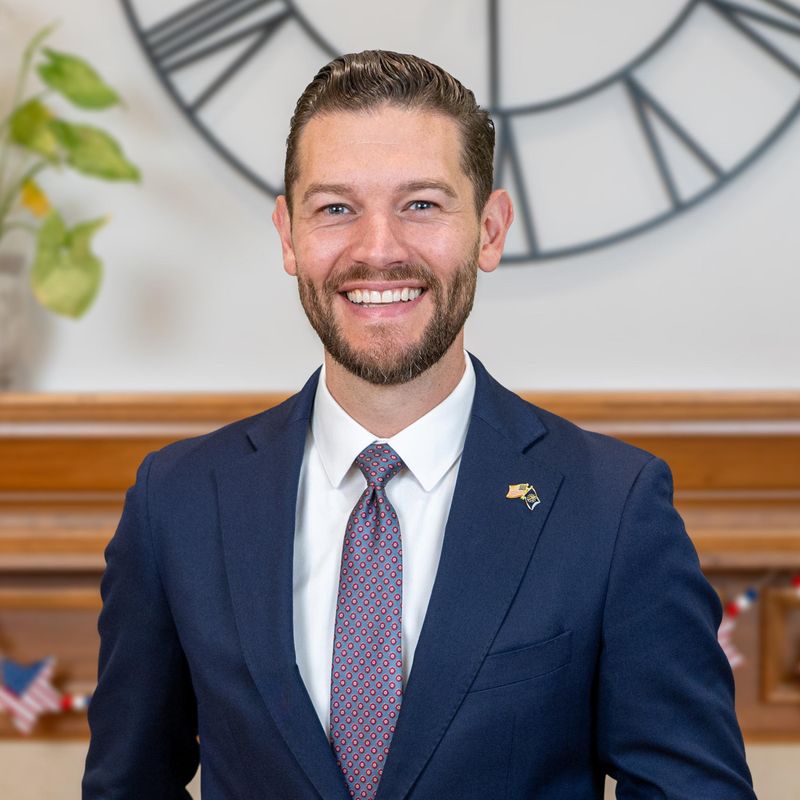
June 20, Indiana Republican Party delegates selected Engling at their convention to be party’s secretary of state candidate in November. Engling, a staffer for U.S. Sen. Jim Banks, ousted incumbent Diego Morales for his place on the ballot.
“Coming out as a candidate that the party had to coalesce around and move forward, has been encouraging from the party unity perspective,” Engling said. “We are moving in the same direction on the Republican side. I’ve seen that around the state. Folks that are looking for somebody to take this role, run well, operate well, push for conservative policy.”
Engling faces Democrat Beau Bayh, Independent Greg Ballard and Libertarian Lauri Shillings. Engling previously ran for U.S. House Indiana District 5 and lost in the primary.
Engling spoke with the Courier & Press on Wednesday in Evansville before heading to the Vanderburgh County Fair. The conversation covered his reason for seeking elected office, his work with Banks and his desire to talk policy with voters.
The C&P’s questions are in bold. The interview has been lightly edited for space and clarity.
What made you want to run for Secretary of State?
I’m a Christian, husband, father and I’m running because I want to make sure we defend our election integrity, and that we uphold the shared conservative values we see across the state. Folks came to me directly in that pre-convention time and asked me if I would consider running for this seat. At first, I rebuffed that, and said I’m not considering that right now. Part of that was my working with Sen. Banks. But it was continual. Folks kept coming back to me. The more we considered it, and thought there’s an opportunity. Instead of being someone who has for 20 years pushed to help other candidates across the finish line, pushed to get good policy across the finish line, to say I can uniquely step up to run for this position with the goal of ensuring we have strong conservative policy on the other side. Sometimes I think you can get lost in winning for the sake of winning, and winning for the goal of how do you run an office well and set good policy. I’m very dedicated to that side of it.
Do you feel working with Sen. Banks has aided your ability to run this office if elected?
For the last three years, I’ve been driving around the state of Indiana working directly with Hoosiers to hear what’s going really well, what do we need to work on and then also how do you take government out of your life, which often times is the answer. So whether I was doing that with Sen. Banks or working for Beck’s Hybrids, it has been a great experience. To then transition that, both relationships and understanding of what folks need and want in the state, to say, how do we do this job particularly well. That’s been a wonderful baseline.
Of all the candidates in the race, I have the direct experience for this role. Whether that’s working for a number of small businesses across the state over my career or filing my own small business with the secretary of state’s office. Or whether that’s getting elections experience when I worked for the chief elections committee in the U.S. House. They oversee their own elections constitutionally, and I had an excellent opportunity to dive in there. Or whether it’s working with legislative experience. You know if you’ve got priorities here, a lot of what the secretary of state’s office does is given to it by the state house, by the legislature. Being able to work with them and have a history of working with legislatures to build a coalition around priorities could be very important for this role. All of that experience combined together has been really, really beneficial as we look forward to say, if the voters give me this responsibility how do you do this job well.
How do you feel about the election system currently in place in Indiana?
I give credit to the current secretary of state for the work he has done alongside the state house on election integrity. I think we’re number seven in the country on that front and when we see things happening like the announcement from (Department of Homeland Security) Secretary (Markwayne) Mullin recently on 250,000 people across four states that were registered when they shouldn’t have been registered, or what we saw in New Jersey with the 6,600 folks that were registered when they shouldn’t have been. We know that there are challenges out there and me makes me even more thankful for the work that’s been done already in the state. But that doesn’t mean that it ends there. It means we have to continue to build from there. We saw in a report from 2025 that there were 165 registered when they shouldn’t have been, and 21 of those folks that actually voted. We need to continue to push further into election security. Part of that that I’ve been pushing for on the priority side is if you are here legally but ineligible to vote that when you get your drivers license it’s a separate color from what other folks would get. So, if they did attempt to vote it’s very apparent that they are ineligible. So, a more proactive approach to that process.
What are other campaign priorities you have?
Number one, election integrity. Ensuring that only citizens are voting in our elections. It’s also cleaning up the voter rolls. Making sure we’re very proactive in the approach to ensuring that if folks have moved or if they’re no longer eligible to vote or any other provisions like that, that we’re taking them off the rolls or updating the rolls. You want people to vote. You want to make sure they’re voting properly when they’re eligible.
The second thing, transparency. A big part of transparency is that right now there’s not a great way to say, I’ve seen something at the county level. A citizen sees something where it’s either fraudulent or an issue with the election, so it allows for a direct pipeline to the secretary of state’s office. We’re calling it Eyes on Elections. It’s a transparency portal so that folks can report that information directly up to the secretary of states office.
Another piece is the business filing fraud that’s happened around some of these trucking companies. The chameleon carriers, where they’ll file an LLC and then have folks driving and operating with licenses they shouldn’t have. Across Indiana we’ve seen Hoosiers that have either been killed or seriously injured from drivers like this…The front door to that is the secretary of state’s office. All these businesses will register with the secretary of state in the business registration division. It’s important to capture that data and if there are anomalies, like say 14 identical LLCs at one home address, that there’s likely problem there that needs to be further investigated and potentially prosecuted working directly with the attorney general’s office. Essentially being aware of and compiling that data at the secretary of state’s office to ensure we don’t allow these dangerous drivers to drive on the road.
How do you feel about working with county clerks around the state on priorities you may put into place?
So first, I’ll say I’m very thankful for our clerks across the state. It is a challenging job that only gets harder when you’re inside the election season. I’ve had many good conversations with our clerks across the state. I’ve had great conversations with my own county clerk, and I know the importance of that. I have committed to the Clerks Association as well that I will work directly with them as we put these priorities into place. I’ve said this often, and I believe this wholeheartedly, if you build the coalition that doesn’t include working with the folks that will implement it, then you can put as much good policy forward as you want but if it can’t be implemented, it’s not going to matter. So working directly, both with the folks at the state house on policy and with the clerks on implementation, to make sure the priorities we have actually can be put into effect is very key. I think in addition to that, one of the ways the secretary of state’s office can work with our clerks closely is to offer additional resources. You don’t want the secretary of state to mandate down, here’s how you have to do things. I 100% agree. But you do want to offer off-the-shelf resources that you’ve built in the secretary of state’s office for clerks. Whether that’s onboarding for clerks or training for poll workers, so you don’t have to build everything yourself at the clerk level. If you would like to, you can use a resource from the secretary of state’s office to help train those folks. As somebody who’s been a poll worker myself, gone through the training, appreciated what my clerk has put together that’s outstanding, but shouldn’t have to be solely up to them.
Do you see the secretary of state’s office as a political one?
There’s kind of two major elements to that question, in my opinion. One, there is the secretary of state’s role which is a constitutionally elected statewide office. You do run with a party, and you say I’m going to work with the other statewide leaders at the state house to move our state forward. That is a big element of this position. The second part is that there are divisions in the office that must be run very well, regardless of your partisan affiliation. In the election division, that role has partisan on each side, so essentially nonpartisan, because you’ve got Republicans and Democrats operating there. So that does not have a partisan effect. That’s very clear. But then you look at the other divisions. It’s business registration, so that is not a partisan operation. You want that to be run well so our Hoosiers can employee more people in Indiana and continue to build on the infrastructure we have on the business side in Indiana. Then when you look at auto dealers or securities divisions, those are consumer protection divisions. So again, your primary role is to make sure folks like you and I are no defrauded. Those are not partisan objectives. But I do think you have to be able to say, I’m running as a conservative or pushing for the conservative policy across the statewide level, but that each of the divisions need to be run professionally and very well, to the benefit of all Hoosiers.
Is there anything you’ve heard consistently from voters around the state?
They talk very often about election security. Part of that is because it’s what you see most broadly in the news. It’s top of mind. I think some of the things in the secretary of state’s office can potentially get lost to some folks. That’s not even critical. i think folks should live their lives. But I do think election integrity is probably the biggest thing because it pops up in the news broadly. And it’s because as secretary of state you have a responsibility to do this well. But you also have a responsibility to build the confidence of a normal voter across the state in the office and in their elections. So being able to both enact good policy and project that confidence to a normal voter is really important so that it’s not something they’re saying, hey we have a problem down here. It’s something they say we’re doing well in that front.
This article originally appeared on Evansville Courier & Press: Q&A: Max Engling’s top campaign priority is ‘election integrity’
Reporting by Sarah Loesch, Evansville Courier & Press / Evansville Courier & Press
USA TODAY Network via Reuters Connect
By Sarah Loesch, Evansville Courier & Press | USA TODAY Network