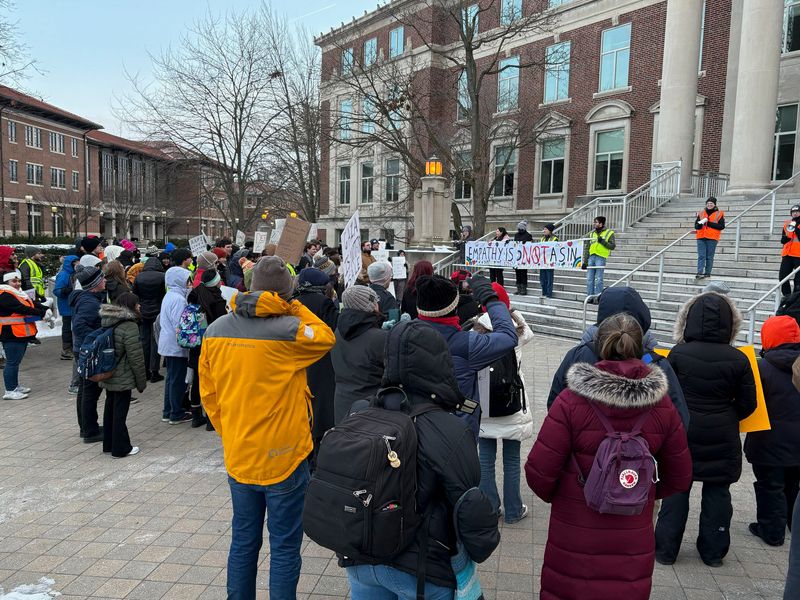
WEST LAFAYETTE, IN — Purdue administrators are pressuring faculty into rejecting the applications of prospective graduate students from China and several other countries, four faculty members told the Journal & Courier independently last week.
The move would effectively freeze enrollment in a number of the university’s graduate programs for international students from a handful of countries, the faculty members said.

The faculty, who represent a wide range of departments — including in the colleges of Education, Engineering and Science — asked the Journal & Courier not to publish their names. They say they fear retribution from Purdue administration for speaking to the media.
Typically, departmental committees review candidates for their graduate programs and then advance their applications to Purdue administrators for final approval.
But according to faculty and departmental leaders, Purdue administrators told them between October and November that, in most cases, even if departments offer admission to graduate students from these countries during the upcoming enrollment season, Purdue administrators will be “highly unlikely” to sign off on the offer letters.
“They more or less demanded that we don’t extend offers or we don’t consider Chinese students,” one faculty member who oversees graduate admissions said last week. “In some sense, they want us to reject these students outright without consideration.”
The apparent ban affects graduate students from China, Russia, Iran, Venezuela, Cuba and North Korea — all countries designated as “adversary nations” to the United States under federal regulation.
Faculty members described the change as an “unwritten policy” passed along to departments’ graduate admissions committees through in-person meetings and private conversations. Administrators have apparently been careful not to put the effective policy change in writing.
No clear reason was ever given for the change, faculty said, and it’s unclear how many colleges, departments and programs are affected by the freeze.
“Because there’s nothing in writing, there’s no policy I can point to to explain why I can’t admit (students),” another faculty member said. “It’s all just orally in the air. This is how you create de facto policies without making it official.”
A request to Purdue spokespeople for more information last week was not returned.
‘Giving us the sword’
When applicants from China and other “adversary nations” are told later this year that they aren’t being accepted into Purdue’s graduate programs, the rejection letters will come from the university’s administration.
But as administrators quietly pressure departments to automatically turn away students at the door — based on where those students come from — the onus of actually rejecting them falls on the shoulders of departments’ graduate admissions committees.
Administrators have been careful not to formally say Purdue as an institution will turn away students from China and other countries, faculty said. Instead, the policy change has been presented to faculty as an impossible choice: Either departments reject the applicants outright, or Purdue administration will do it for them.
For faculty who sit on these committees, that burden feels more like they’re being forced to be the ones to discriminate, they said.
“The final decision does rest with the university,” one faculty member said. “I’ve been told in multiple settings that it is highly unlikely that we are going to admit students from these countries. But no one is explicitly stating, ‘We’re not going to do it.’”
Some departments have decided to balk at the new directions, choosing to continue offering admissions just as they had in the past. Others, scared of invoking the ire of Purdue administrators, are toeing the line. But most, faculty say, are just confused as to what they’re supposed to do.
“I’m going to look at these candidates, and I don’t know what I’m going to say to them,” one faculty member said. “I don’t want them to put down $65 to apply for something that isn’t going to happen.”
Typically, in the graduate school application process, nationality isn’t considered as part of a candidate’s merit. Title VI of the 1964 Civil Rights Act establishes country of origin as a protected class free from discrimination.
In a mid-October meeting, the Department of Statistics’ graduate adviser suggested to faculty that they might have to begin turning away a large number of students at the door, one professor in the department said.
“They said we shouldn’t tell Chinese students they wouldn’t be admitted,” they said. “We were just encouraged to find anybody else from anywhere except China.”
And as the deadline to begin admitting graduate students looms, the reality of having to automatically reject droves of potentially qualified candidates — without telling them why — is beginning to set in.
“We’re getting ready to decide in December, and we’re going to look at all of our candidates, and I know there’s a lot of Chinese applicants in there,” one faculty member in the College of Education said. “But I suspect a big part of that meeting is just going to be that conversation where we’re asking, ‘What are we going to do?’”
The faculty member said they feel administrators are trying to shift responsibility for potentially discriminating against applicants.
“It’s like they’re giving us the sword so we can take care of ourselves,” they said.
Pressure on Purdue
The effective admissions freeze comes eight months after federal legislators began pressing Purdue over its enrollment of Chinese students, a move that has stoked fear among international students on campus.
In March, the U.S. House Select Committee on the Chinese Communist Party demanded that Purdue hand over information on Chinese students enrolled at the university, calling student visas a “Trojan horse for Beijing” and suggesting Chinese students could steal sensitive research secrets for the Chinese government.
Purdue administrators complied just less than two weeks later, sharing rates of Chinese enrollment at Purdue and details on research being conducted by Chinese students — but they stopped short of sharing specific information about individual Chinese students.
In the letter, Purdue Provost Patrick Wolfe agreed with the House Select Committee, acknowledging that China posed “increasing risks” and was attempting to “exploit American universities for technological and military advancements.”
By June, Purdue adopted a formal policy on “adversary nations” such as China, according to the university’s policies page, banning faculty from establishing financial and recruitment ties with such countries.
But the policy doesn’t say anything about barring admissions from China or similar countries.
Graduate student Kieran Hilmer, a leader of Graduate Rights and Our Wellbeing — a graduate students advocacy group at Purdue — said he thinks Purdue is starting to feel the pressure.
“Purdue is acting out of fear of either getting federal or state funding rescinded,” Hilmer said last week. “It’s part of a larger pattern that we see of academics being pressured to comply with the current federal and state administrations.”
Since the Trump administration’s return to office in January, international students at American universities have increasingly become the target of federal scrutiny.
Earlier this year, the State Department announced it had ramped up the revocation of thousands of student visas. Then in May, federal officials raised the bar for applying for visas and restricted foreign access, lowering international enrollment across the country by 17% — a statistic the Trump administration touted in November as a success.
University administrations themselves have also become targets of the federal government. In May, Trump officials attempted to revoke Harvard’s right to enroll international students and launched a slew of investigations into American universities, including Columbia and NYU, over admissions and DEI policies.
With increasing attention from Congress now coming down on Purdue, Hilmer said he thinks Purdue is trying to avoid the same fate.
“Trump is very willing to threaten the tax status or the federal funding of a university if they don’t comply with his policies,” he said. “Purdue has decided it’s easier, or more economically viable, or more in line with their political ideology to just comply.”
In times of political pressure, staying out of the fight has become something of Purdue’s M.O.
In April, Purdue trustee Gary Lehman said the university has tried to stay “under the radar” to avoid funding cuts, not taking public stances or drawing attention to itself.
Multiple federal agencies including NASA, the Department of Energy, the Centers for Disease Control and Prevention and the Department of Labor have threatened Purdue with funding cuts, according to the university’s website.
“We don’t want to stick our heads up too high,” Lehman said at a board of trustees meeting at the time, “because when you do that, you’re a target.”
Admissions rescinded
It’s not clear when exactly Purdue administrators began suggesting to faculty that they should be turning away some international students. But for some applicants from China, the effect of increasing skepticism may have been felt as early as this summer.
Hilmer said that in late May, more than 100 Chinese graduate students who had already been accepted into various Purdue graduate programs were suddenly told that their offers for the fall semester were being rescinded.
Sent from the Office of the Vice Provost for Graduate Students and Postdoctoral Scholars, the notices told applicants that they were being rejected from programs they had already been accepted into three months earlier, without providing clear reasons, Hilmer said.
“The (OGSPS) must approve all graduate admissions and funding offers at Purdue,” the letters read. “Unfortunately, your application was not approved for admission by OGSPS.”
Many of these students had already signed leases in West Lafayette, turned down offers from other universities and moved across the country to attend Purdue, Hilmer said.
With many of them on student visas, they could face deportation without enrolling somewhere else.
“Given the fact that they were all Chinese, we suspected that there was some kind of discrimination at play,” Hilmer said.
OGSPS approval has largely been a formality for years, multiple faculty members in different departments said. But soon after federal lawmakers raised questions about Chinese enrollment at Purdue, administrators in May began taking a closer look at the candidates departments had offered admission to for the coming school year.
Some faculty members said their departments were forced by Purdue administrators to rescind offer letters to graduate students who hadn’t been pre-approved by OGSPS.
The bulk of these, they said, were international students.
In the Department of Physics and Astronomy, Purdue rescinded seven acceptances, a faculty member who sits on the department’s graduate admissions committee said last week.
“It was the first time ever we had made an offer to a student, the student accepted and then they never got accepted by Purdue,” the faculty member said. “It was a disgrace for our department.”
International enrollment drops
On the rest of campus, international student enrollment at Purdue — both graduate and undergraduate — has collapsed, according to university enrollment data. This year, Purdue enrolled its lowest number of international freshmen since 2004, making up only 5% of the incoming class.
The drop follows nationwide trends, but Purdue has been considerably more selective: The university accepted only 23% of applications from foreign students this year, according to the data, despite receiving more such applications than any other year since 2015.
It’s not clear how many of these newly enrolled students are from countries that administrators apparently want to restrict, such as China. A per-country breakdown of enrolled international students this year is blocked from public view on Purdue’s data website.
A notice on the website cites federal student privacy laws.
The Journal & Courier filed public record requests early in November seeking that data but hasn’t received a response as of Dec. 3.
Hilmer said collapsing international enrollment at Purdue is another symptom of federal pressure on the university.
“International students form a big part of Purdue’s ecosystem, both in terms of workers and students,” he said. “But Purdue needs state or federal funding to exist. … Purdue is so terrified of standing up to the government, they are instantly willing to do whatever they think would put them on the side of the administration.”
Contact Seth Nelson at sethnelson916@gmail.com or 574-315-8649.
This article originally appeared on Lafayette Journal & Courier: Purdue effectively bans grad students from China, other countries, faculty say
Reporting by Seth Nelson, Lafayette Journal & Courier / Lafayette Journal & Courier
USA TODAY Network via Reuters Connect