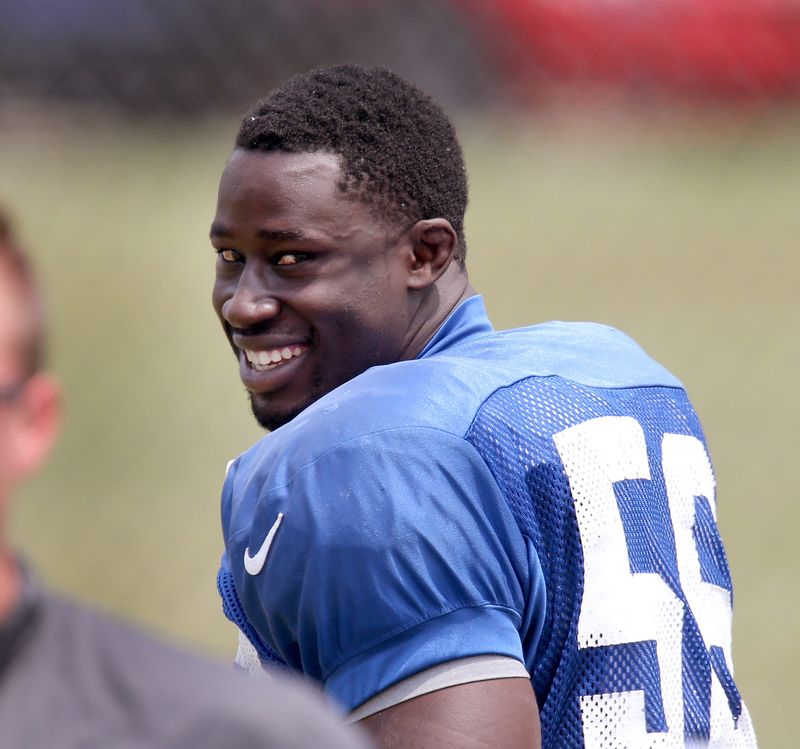
When Daniel Adongo came to the United States 13 years ago, he left behind an established career as an African rugby star to become the first Kenyan to join the NFL. He was recruited by the Indianapolis Colts, having never played football a day in his life.
“I think you’re gonna be a Hoosier and a Colt for a long time,” then-Colts punter Pat McAfee told Adongo during an appearance on The Pat McAfee Show in 2013.

But Adongo, 36, has spent the last several months living in a prison cell, detained by the U.S. Immigration & Customs Enforcement at Miami Correctional Facility, one of the largest ICE detention centers in the Midwest.
The former Colts linebacker’s detention shows the sweeping nature of President Donald Trump’s immigration crackdown. Although administration officials have often touted detention centers as a place for the worst of the worst criminals, they have also detained scores of undocumented immigrants with little to no criminal history. Adongo has only a Class A misdemeanor conviction from six years ago, and his detention raises questions about how ICE facilities are dealing with detainees who have mental illnesses.
Adongo — once dubbed the “Kenyan Hercules” who became his country’s pride — has a long documented history of mental illness that appears to have started as his NFL career ended in 2015, two years after he arrived in America. The last decade has been marked by a series of arrests, psychiatric hospitalizations and mental health challenges. His family, as well as medical and social work professionals who have interacted with him, believe his mental illness is tied to brain injuries he sustained from his years as an athlete.
Nationally, jails and prisons have become de-facto mental health facilities in the United States, raising concerns among experts and advocacy groups about the lasting harms incarceration has on people with mental illness.
Adongo’s mother declined an interview, only saying that her son, who began playing in high school, had planned to study medicine but was scouted to join professional sports, first rugby then American football.
A Colts spokesperson declined to comment on Adongo’s situation.
ICE has not provided answers to questions about Adongo’s immigration status or detention. It’s also unclear what mental health treatment, if any, Adongo is receiving. An Indiana Department of Correction spokeswoman declined to comment, citing health privacy rules.
ICE began housing detainees at Miami Correctional Facility, which Trump administration officials nicknamed the “Speedway Slammer,” in October. The state has made up to 1,000 beds available for ICE as part of an agreement that could bring in up to $213 million in federal dollars over the course of two years.
The facility, located about an hour north of Indianapolis, is one of the most violent and deadliest prisons in the state and has long been plagued with killings, drug use and gang activities. Last month, IDOC agreed to pay more than $1.2 million to settle allegations that Miami prison officials abused inmates by keeping them in dark cells for months.
‘I want to become a Hoosier’
Adongo was a remarkable story when he first signed with the Colts in 2013 at age 23, described at that time as the team’s most ambitious experiment. Then-Colts General Manager Ryan Grigson gave the newcomer, who had only seen highlights of the NFL, a spot on the roster, betting that with his raw athleticism and massive build — 6 feet 5 inches and 250 pounds — he could become a decent linebacker.
Indianapolis tried out Adongo in July of 2013, coming off a season with the Southern Kings of Super Rugby, and signed him to a contract for training camp. When he first arrived, he didn’t even know how to strap on his helmet and shoulder pads.
But Adongo bucked the odds, playing in five games over three seasons from 2013 to 2015, mostly on special teams.
During his appearance on McAfee’s show in November 2013, Adongo called being part of the Colts team a “blessing.” Building a career with the Colts — and eventually, becoming an American — was his goal, he said. McAfee, who didn’t immediately respond to a request for comment, even quizzed Adongo on several questions asked during a U.S. citizenship test. Adongo answered each question correctly.
“I love Indy. I love the people of Indy. I want to become a Hoosier,” Adongo told a cheering crowd inside Kilroy’s Bar & Grill in downtown Indianapolis, then the venue of McAfee’s show. “It’s been great so far. You guys have made the transition that much smoother, and I’m enjoying it.”
A biceps injury suffered in the preseason opener in 2014 cost Adongo his entire second season. But he seemed to be back on track the following year. Then-Colts coach Chuck Pagano told IndyStar in 2015 that Adongo was already a rugby superstar in Africa when he “took a huge leap of faith” and gave it all up to play American football.
“My heart says I’m a football player, my mind says I’m a football player, my body says I’m a football player,” Adongo told IndyStar in 2015. “I’ve put in all the work and time and effort not just for myself, but for the team.”
But later that year, his time as a Colt came to an abrupt halt.
Indianapolis waived Adongo in December of 2015, one week after police were called to his Fishers home for a domestic violence investigation. It was the second time in that season that police had been called to Adongo’s home on suspicion of domestic violence. No charges were filed after either call. The NFL investigated and, in 2016, suspended Adongo.
He never played in the NFL again.
More arrests and a mental health diagnosis
A year after the domestic abuse allegations, Adongo was arrested in Indianapolis for threatening an Uber driver with a hatchet. He was charged with intimidation and criminal mischief.
In a letter his mother wrote to the judge, Betty Adongo described her son as an “intelligent young man” who was recruited to join the NFL because of his “sheer hard work, self discipline and a great determination to excel and exceed expectation(s).” Betty Adongo ended the letter with a request that her son be released from jail so he could be medically evaluated, citing some “mental anguish” he was going through and the possibility of neurological injuries.
In 2017, then-Marion Superior Court Judge Lisa Borges ordered a psychiatric examination to determine if Adongo was mentally competent to stand trial. He was deemed incompetent and was sent to Logansport State Hospital, a psychiatric facility.
His criminal case resumed in 2018 after he was deemed competent. But in 2019, as his trial was rescheduled multiple times, Adongo was arrested again after he failed to appear for a court hearing. The judge ordered another competency evaluation while Adongo was held at Marion County Jail.
Attorneys for Marion County Sheriff Kerry Forestal later asked that Adongo be moved to the custody of the Indiana Department of Correction for safekeeping, which generally means the jail was unable to ensure an inmate’s safety or meet his medical needs. The attorneys wrote that Adongo had been diagnosed with schizophrenia and was refusing to take his medicine, to bathe and “is in need of competency restoration.”
At some point later, Adongo was, again, found incompetent to stand trial and was taken back to Logansport State Hospital. At the end of 2019, Adongo was deemed competent again and his case resumed. He pleaded guilty to criminal mischief, a Class A misdemeanor, and was sentenced to a year in jail, although court records show he was ordered to serve only six months.
He later appears to have settled in St. Joseph County in northern Indiana, where his mother also lives. She petitioned for guardianship twice, first in 2020 and again in 2021. Both petitions were granted.
‘Punitive measures will only cause more harm’
Adongo was charged a few more times in the following years, including for battery, disorderly conduct and intimidation, all of which were dismissed.
The most recent charges, filed last summer in St. Joseph County, stemmed from an incident outside a Kroger store in Mishawaka, where police said he threatened an officer.
Adongo’s lawyer attributed his arrest to his mental illness and argued he didn’t fully comprehend the charges against him. In a motion asking for the dismissal of the charges, his defense attorney cited a 2020 report in which Dr. Jason Jaronik, who examined Adongo at the St. Joseph Regional Medical Center, described the former athlete as “acutely psychotic” with traumatic brain injury.
The defense attorney also cited an email that a county social worker sent to prosecutors last summer.
Henry Mudari, a mental health social worker for the St. Joseph County Police Department Crisis Services Unit who had dealt with Adongo for years, wrote that he was suffering from an “undisclosed mental illness which is highly speculated to be Chronic Traumatic Encephalopathy, or CTE,” an untreatable degenerative brain disease common among athletes and caused by repetitive head impacts. Mudari said the injury may have been tied to his years of playing rugby or football.
Adango’s NFL injury report includes only injuries to his biceps in 2014 and his hamstring in 2013. Symptoms of CTE develop years, even decades, after repeated head trauma, and the only way to definitively diagnose it is after death during a brain autopsy, according to the Mayo Clinic. Among those who have been confirmed to have CTE at autopsy, symptoms included emotional instability, depression, aggressive and impulsive behavior and memory loss.
Mudari wrote that in all his interactions with Adongo, “he would not remember me after each visit and would be highly suspicious of our intentions and would ask us to leave his property.” He added that Adongo needed treatment in an in-patient facility.
“I do believe punitive measures,” he wrote to prosecutors on June 3, 2025, “will only cause more harm to him.”
Still, Adongo was placed in jail. Online records show he was booked at St. Joseph County Jail on July 27, 2025. The following day, St. Joseph County prosecutors asked the judge to keep Adongo in jail until a bail hearing, saying he’s a “substantial danger” to himself and to others. He was later transferred to ICE custody, first at the Clay County Jail, an ICE detention center just outside of Terre Haute, and later at the Miami Correctional Facility.
The charges were dismissed late last year. The St. Joseph County Prosecutor’s Office did not respond when asked for reasons behind the dismissal.
Reached by IndyStar, Mudari, the county social worker, declined to comment about Adongo, only saying that he interacted with the former linebacker over a period of three years. He said that placing mentally ill people in jail or prison, where treatment is either limited or nonexistent and where they’re under the supervision of workers who are often not trained to handle mental health crises, only worsens their condition.
“We need to find better solutions,” Mudari said. “We need treatment as opposed to jail.”
Contact IndyStar reporter Kristine Phillips at (317) 444-3026 or at kphillips@indystar.com.
This article originally appeared on Indianapolis Star: From ‘Kenyan Hercules’ to detainee: Ex-Colts player is in ICE custody
Reporting by Kristine Phillips and Joel A. Erickson, Indianapolis Star / Indianapolis Star
USA TODAY Network via Reuters Connect