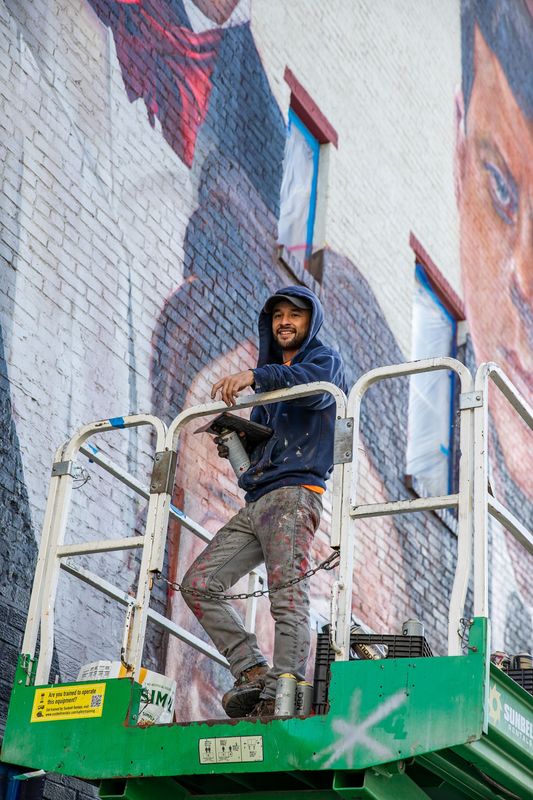
LAFAYETTE, IN — For the past week, pedestrians walking along the sidewalks near the corner of 7th and Main streets in downtown Lafayette have been doubling back, gawking in open-mouthed admiration.
There on the brick wall between Rose and Wick and Teragraphics Ink, Detroit-based artist Zach Curtis has been hard at work painting Lafayette’s next full-length wall mural: three massive portraits of Frederick Douglass, Abraham Lincoln and John F. Kennedy.

The mural was officially unveiled on Wednesday, Oct. 22.
Why these men specifically? Each one made trips to Lafayette during their lifetimes and “not only visited, but made history,” Diana Vice said.
As the honorary regent of the General de Lafayette chapter of the Daughters of the American Revolution, Vice and the other members of the DAR were responsible for the commissioning of Curtis’s mural that helps preserve Lafayette’s place in American history. The DAR is a volunteer women’s service organization focused on promoting historic preservation, education and patriotism within the Lafayette community, with more than 3,000 chapters nationwide.
“Lafayette’s early pioneers were well connected to Washington, D.C.,” Vice said. “They were connected to presidents, to Supreme Court justices. Because Lafayette had a lot of high-profile business-type people, it drew these types of historical figures here. Lafayette was an important hub with the canal and the railroads, and a lot of people don’t realize how important this city was to the growth of our country.”
The three men depicted in the mural visited for different but important purposes.
In 1867, Douglass spoke at a local Baptist church to help the Lafayette African American community at the time to raise money to buy the current Bethel A.M.E. church, a building that remains a prominent historical marker on Ferry Street in Lafayette.
Lincoln visited Lafayette twice, once to speak during a whistle-stop tour on Feb. 11, 1861, and the other after his assassination, when his funeral train came through on May 1, 1865.
Kennedy visited Lafayette four times. Once was during his tenure as a Massachusetts senator before his presidency. He came back on April 13, 1959, when he spoke at Purdue and attended a political reception. Kennedy returned to attend a private reception hosted by Purdue’s then-President Frederick Hovde, and he cheered on the Boilermaker football team when it played the Notre Dame Fighting Irish on Oct. 3, 1959. His last stop included speaking at Central Catholic High School on April 7, 1960, during his campaign.
A mural depicting these three influential American men was important to Vice and the DAR because it creatively brings prominent points of Lafayette’s history to the general public and memorializes titans of U.S. history.
“(The mural) brings history and art together, which is one thing we really like to do,” Vice said. “A lot of people in the community weren’t aware that these three famous men visited, especially Frederick Douglass, and that the Bethel A.M.E. Church would not be here if it weren’t for him. I thought this mural would be a great way to start a conversation and to bring that history forward.”
Once the idea was hatched, the DAR had to find its artist.
After another artist — Cobre, a muralist known for his work on The Arts Federation Wabash Walls project — was not able to make the trip because of a visa issue, Vice and her team were left scrambling to find another artist before the project was closeted.
They found Zach Curtis.
“So, when we thought the project might die on the vine, my husband, who had been following (Curtis) for a few years on Facebook, said, ‘Hey, check this guy out,” Vice said. “As I started looking through his Facebook page, I’m thinking, ‘He’s better than Cobre.’”
Curtis, whose trademark realistic mural style was perfect for portraiture, gladly accepted the commission to come paint for seven days.
“I love traveling and I love paying my bills,” Curtis said. He has painted murals in Taiwan, France and Quebec. “So of course, I was very happy to come out and paint the mural.”
Despite an outward calm and somewhat shy demeanor, Curtis lights up when talking about his work. His smile doesn’t require much coaxing, especially when talking about his experience working on the Lafayette mural.
“I love coming to these types of towns, because everyone is so receptive,” Curtis said. “They love art themselves. And when you go to these big cities, you’re just a drop in a bucket. But here, everyone’s so appreciative. I really do appreciate all of the love, the praise and the compliments.”
As he wrapped up posing for photos at the wall, a young girl — Rylyn Baker — and her father, Ryan, began unobtrusively taking some photos from down the street. Curtis leaned in and mused that he would love to bring her up and close to the artwork.
So he did. After coming down and speaking to the pair, all three went 20 feet up to inspect the mural up close. Rylyn exited Curtis’s scissor lift happier after painting highlights on a section of JFK’s neck, with Curtis supervising.
Curtis said hers was his favorite interaction of the whole week.
“A lot of times, art is inaccessible to a lot of people,” Curtis said. “If it’s in a gallery or it’s in a private collection, you’re really kind of limiting yourself to the eyes (of the public). That’s very powerful to me, just bringing art to people who may not be used to seeing it.”
This may not be the last time Curtis comes to Lafayette. The DAR has plans in the works for a storytelling mural series that may bring him back sooner rather than later.
“A lot of his murals have a lot of different backgrounds that tell a story,” Vice said. “We had to use our money wisely and just have the three murals, but we really want to have him come back to do the storytelling about local history: about the trains, the canals, the canal boats, all that. So, we’ve got some big things coming.”
This article originally appeared on Lafayette Journal & Courier: Newly unveiled Main Street historical mural chronicles men who ‘made history’ in Lafayette
Reporting by Elijah Greene / Lafayette Journal & Courier
USA TODAY Network via Reuters Connect