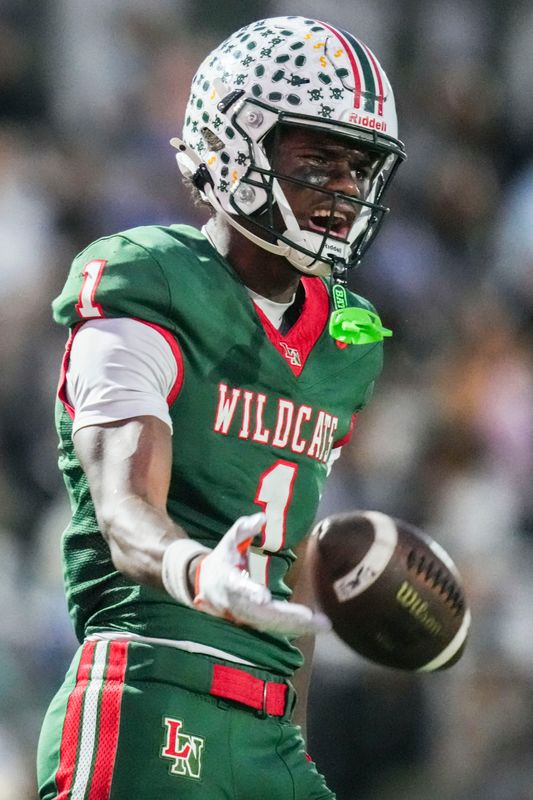
Indiana high school athletes will now be allowed to monetize their own name, image and likeness.
The Indiana High School Athletic Association board of directors voted through a proposal on Monday to allow “Personal Branding Activity.” The proposal will allow high school athletes to benefit monetarily from their NIL with specific guidelines.

Indiana is one of the last states to allow NIL to high school athletes. Michigan became the 46th state to allow NIL in January. The board of directors voted 13-5 in favor of the PBA.
“It fits within our amateur rule we currently have,” IHSAA commissioner Paul Neidig said last month. “You own your own name. I think people understand that. (The proposal) is very similar to what a lot of states do.”
Neidig and the IHSAA made eight visits around the state the past two weeks to discuss the upcoming proposals, including the potential to allow NIL. The PBA proposal gained support from about half of the administrators, Neidig said.
As previously reported, an athlete could utilize their NIL as long they are not depicting any affiliation with a member school – or using school facilities or property – in association with receiving PBA compensation. For example, an athlete could rep a sporting goods company that sells athletic apparel as long as they do not represent the school.
“If I’m an athlete and an apparel company comes to me and asks me to use my social media to promote our product and an athlete does that, that would be fine as long as they don’t say, ‘I’m the point guard at this school’ and I’m in uniform,” Neidig said. “You own your name. You don’t own the school’s name. But if you go to the YMCA and teach somebody how to hit a baseball or softball, you could do that under your own name.”
Lawrence North five-star wide receiver Monshun Sales, the type of unique athlete who could benefit from the new NIL rule, said last week that it is only fair that Indiana offers the same opportunities as other states.
“I think it should happen,” said Sales, who is considering Indiana, Alabama, Miami (Fla.), Ohio State and Texas. “The only way it wouldn’t be fair is if we were the only state with it. But right now, we’re one of the only states without it so it’s kind of unfair, if anything. Kids like me have opportunities to go do things and we are kind of being held back because of the (rule). If it happens, it happens but I think it should.”
There are several prohibited PBA activities in the proposal, including activities organized or sponsored by a member school. An athlete may provide the following activities if not associated with member school representation:
>>>Instruction services: individual or group instruction, lessons, clinics or camps.
>>>Appearances and demonstrations: Participation in events, exhibitions, or promotional activities that may involve athletic skill, provided such participation is not tied to member schools or competitions.
>>>Private training and coaching: Providing training or coaching services to individuals or teams not affiliated with the member school.
Neidig said a collective, which has been used in college sports through athletic department boosters, would be strictly prohibited.
“I don’t believe we can ever be in the business of collectives,” Neidig said. “It has the potential to separate the haves and have nots like we have never seen before in education-based athletics. I think that’s the biggest concern (from administrators). There’s some fear of the unknown. I don’t think it will be a big deal (as constructed) but with the college connotation and four major universities in our state involved in the NIL space, you can see how it has the ability to affect balance, especially at schools that are more affluent.”
In contrast to the legislative pressure that eventually led to the IHSAA passing the one-time transfer rule last spring, Neidig said that has not been the case with NIL. Ohio did face pressure after a lawsuit filed by the mother of an athlete who claimed her son lost more than $100,000 in potential NIL deals because of the state’s ban on monetizing NIL.
In an emergency referendum last November, Ohio’s state association passed a rule allowing high school athletes to make money off NIL. Alabama, Hawaii and Mississippi are currently the other states that do not allow high school athletes to profit off NIL.
Under the proposal, athletes must notify the school athletic director within 48 hours of entering into a PBA agreement. Schools may review PBA agreements to ensure compliance but may not prohibit complaint activities.
“The college connotation of NIL is no longer NIL,” Neidig said. “It’s using university dollars to pay for performance. The philosophy behind this is basically that we all own our name and our ability to make money based upon our name.”
Neidig added in a statement on Monday:
“Unlike the current college system, where schools often play a direct role in NIL compensation, the new rule keeps high schools out of arranging or funding deals for student-athletes. Instead, it allows students to benefit independently form their school, without using school branding or representing school-sponsored endorsements. It creates a clear distinction between the college model and the educational mission of high school athletics.
“We believe it is far better to be proactive and create thoughtful, education-based guidelines ourselves than to have policies forced upon high school athletics. This approach allows us to protect the values of high school sports while adapting responsibly to a changing landscape.”
Call Star reporter Kyle Neddenriep at (317) 444-6649. Get IndyStar’s high school coverage sent directly to your inbox with the High School Sports newsletter. And be sure to subscribe to our new IndyStarTV: Preps YouTube channel.
This article originally appeared on Indianapolis Star: New IHSAA rule will allow Indiana high school athletes to monetize NIL
Reporting by Kyle Neddenriep, Indianapolis Star / Indianapolis Star
USA TODAY Network via Reuters Connect