By Marcela Ayres
BRASILIA, May 4 (Reuters) – Brazil relaunched on Monday a consumer debt relief program first introduced in 2023, aiming to cut interest burdens and boost disposable income ahead of President Luiz Inacio Lula da Silva’s re-election bid in October.

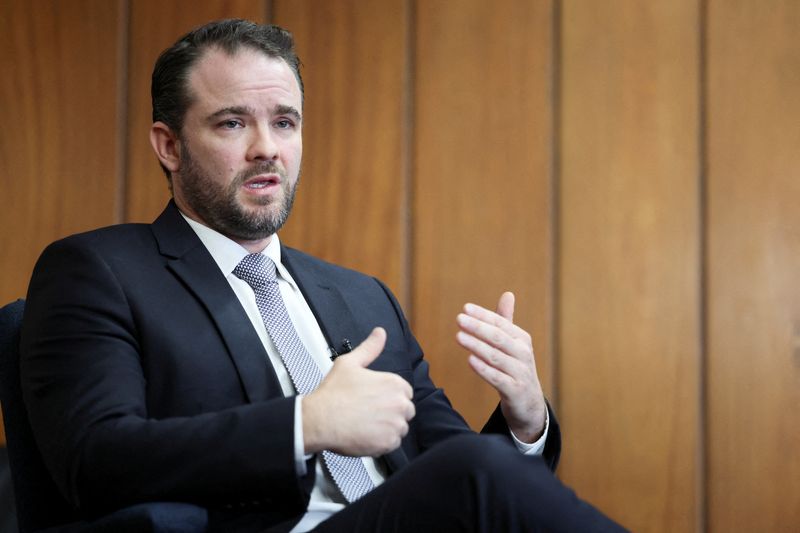
The revamped “Desenrola” program targets earners of up to five times the minimum wage, offering discounts of 30% to 90% on renegotiated debts, Finance Minister Dario Durigan said.
Lower interest rates will be enabled by a government guarantee backed by its Operations Guarantee Fund (FGO), which will provide up to 15 billion reais ($3.0 billion) for the program.
“The first Desenrola program absorbed about 1.8 billion reais from the FGO, so we are now talking about a program on a significantly larger scale,” Planning Minister Bruno Moretti told a press conference.
The initial scheme applied to borrowers earning up to two minimum wages and helped about 15 million Brazilians. The government now expects up to 20 million beneficiaries as the income ceiling rises.
JPMorgan said banks should be able to recover guaranteed amounts from the fund, flagging digital lender Nubank as a key beneficiary, as it accounts for about 15% of borrowers earning up to the threshold of 8,105 reais ($1,631) per month.
The leftist Lula has stepped up efforts to court middle-income voters, including by exempting those earning up to 5,000 reais a month from income tax and cutting levies for earners up to 7,350 reais, as he looks to ease pressure on household budgets ahead of the presidential race.
Many in that income bracket shifted right in recent years, becoming a key support base for former President Jair Bolsonaro, whom Lula narrowly defeated in 2022.
Lula’s lead in this year’s election has recently vanished, with recent runoff polls showing him statistically tied with Senator Flavio Bolsonaro, son of the former president.
“Debt renegotiation should narrow the interest-rate wedge and monthly payments that currently absorb nearly 30% of household income, based on the latest central bank data,” said Felipe Salto, chief economist at Warren.
“Over time, the added breathing room could lead to new borrowing decisions, but elevated interest rates tend to limit that risk,” he added.
Brazil’s benchmark interest rate stands at 14.5% after recent cuts, as the central bank seeks to steer annual inflation, currently at 4.37% , back to its 3% target.
FISCAL IMPACT
Durigan said the program’s primary fiscal cost will total up to 5 billion reais, injected by the Treasury into the FGO, with additional resources coming from existing fund balances and unclaimed bank deposits.
“What we are doing is mobilizing resources that are poorly used and inefficiently parked in the financial system through a private fund to improve the system itself, benefiting account holders and people with debts,” Durigan said.
Brazil’s central bank estimates that so-called forgotten funds currently total about 10.6 billion reais.
Durigan said the government will publish a public notice setting a deadline for individuals to reclaim their money and will maintain 10% of the forgotten funds to cover any court rulings in favor of claimants, “ensuring no one is harmed.”
Participants in the new program will also be allowed to withdraw up to 20% of their balance in the FGTS severance fund – or up to 1,000 reais, whichever is higher – to pay down debts. Total withdrawals will be capped at 8.2 billion reais.
Those who sign up for Desenrola will be barred from gambling for 12 months.
($1 = 4.9680 reais)
(Reporting by Marcela Ayres; Editing by Gabriel Araujo, Bill Berkrot, Aurora Ellis and Sanjeev Miglani)