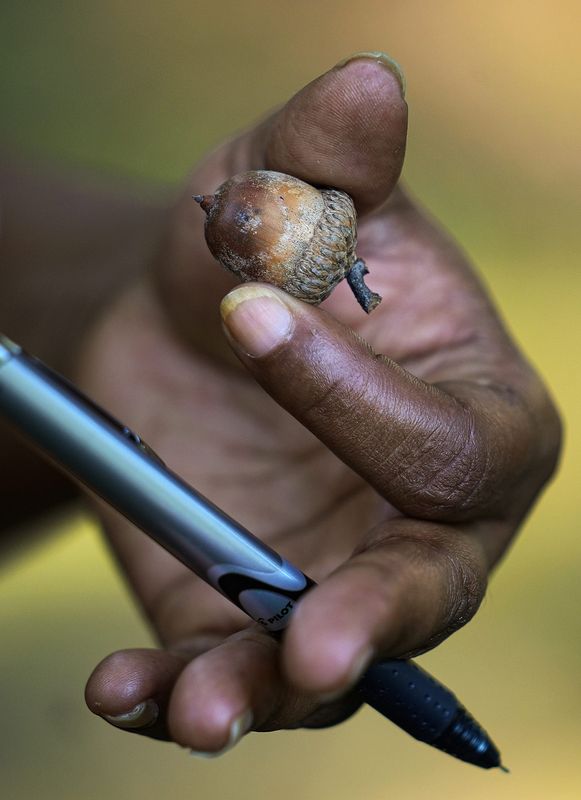
In addition to beautiful vistas and opportunities to explore nature, Indiana’s land offers an abundance of gifts for the dinner plate.
As the cold weather breaks and parks and trails become more enticing, various plants produce leaves and flowers and roots that can be ethically and legally harvested and taken home to be eaten or used in other ways.

Morels and other mushrooms, wild raspberries and hickory nuts are just the start. Several Indiana plants that you might not even think of as food can become a part of a meal.
Foraging, however, can mean different things for different people.
Emmitt Bog started foraging in high school. Now 25, Bog recently started offering group foraging tours in his hometown of Fort Wayne. Bog works with mutual aid groups to share his foraging knowledge.
“I feel like the origins of foraging have been food sovereignty or access to food in areas like food deserts,” Bog said. “That is especially important because it really comes from community and survival and mutual aid, which is the communal practice I appreciate.”
How to forage thoughtfully in Indiana
Foraging novices should start out slowly, says Carrie Vrabel who has taught for the Indiana Master Naturalist program and is writing a book about foraging in Indiana.
“[Beginners should] just take it one plant at a time,” Vrabel said. “Really understand you are learning a new skill and being able to identify plants without help from a phone is a skill.”
Before Hoosiers set out to forage, however, Julia Angstmann, executive director of Butler University’s office of sustainability, said people should understand the careful balance required when harvesting. Foragers should also ensure they are knowledgeable about the state and local laws governing foraging.
Because Indiana’s industrial history has left pollution in some soil, Angstmann recommends choosing a foraging location away from potential contamination. This means avoiding areas near heavily trafficked roads as well as former Brownfield or industrial sites.
After finding a clean foraging area, make sure to correctly identify the plants. One of the most toxic plants in North America, poison hemlock, looks deceptively similar to Queen Anne’s Lace, noted Angstmann, who has a background in plant ecology.
“I always tell people to go out with someone experienced at first so they can learn,” Angstmann said.
Indiana’s abundant plant life provides sustenance for diverse wildlife populations, so Angstmann and Vrabel ask foragers to be mindful of how much they harvest.
Take only about 10 to 20 percent of the plant’s population where you are harvesting, Angstmann suggests — unless you’re taking nonnative and invasive species in which case you should indulge freely.
What plants to forage this spring
Here are some recommendations from Bogs and Vrabel for what to forage now.
One of Bog’s favorite springtime delicacies is a nice raspberry or blackberry (Rubus spp).
“They’re prolific here, easy to identify and the fruits and leaves distinct,” Bog said. “It’s one thing I like to help people learn first.”
Springing up in yards and meadows, common violets (Viola sororia) also crop up on Bog’s list. The leaves can be cooked or eaten raw and added to salads or even pesto. The plant’s flowers are great for making teas, syrups or jelly, Bog said.
Cleavers (Galium aparine), a harbinger of spring, are great to crush up and add to water for a cucumber-like flavor, Bog said. The plants are only found in the early spring, since they don’t do well in temperatures above 80 degrees.
Shagbark hickory trees (Carya ovata) yield hickory nuts in the fall. In the spring the distinct bark of these trees can be harvested and boiled into syrup with an oaky flavor almost like brown sugar or molasses, Bog said.
Morels and more
While spring may be synonymous with morels for Indiana’s mushroom hunters, the dryad’s saddle (Cerioporus squamosus) is a tasty consolation prize, Vrabel said. The best time to harvest these is when the fungi is young and tender and the pores tiny.
Indiana also has a lot of young mustards popping up, Vrabel said. Hairy bittercress (Cardamine hirsute) is a nonnative mustard that tastes like Dijon that’s good as a salad green or on a sandwich. Other native mustard varieties like Pennsylvania bittercress (Cardamine pensylvanica) and limestone cress (Cardamine douglassii) are also popping up now.
Spring ephemerals, flowering plants that appear for a short period after winter, can also be tasty, Vrabel said. The two most common are spring beauties (Claytonia virginica) and cutleaf toothwort (Cardamine concatenate).
Spring beauties, sometimes called fairy spuds, have grasslike leaves with pinkish flowers. Foragers can dig up the root and eat it raw or cooked. Cutleaf toothwart, a native mustard, is found all over the woods and everything about it is edible, just like the spring beauty.
How to forage legally in Indiana
Indiana has laws governing what can be harvested from state-owned land, such as state parks, reservoirs or fish and wildlife areas.
One of the best ways to determine if a property will allow foraging is to simply call and ask the park office. State park maps will often tell you where foraging is prohibited to help protect habitats that are nature preserves.
Local laws and ordinances differ from location to location so reach out to a city or county park office to determine what is allowed on those locally owned properties.
Karl Schneider is an IndyStar environment reporter. You can reach him at karl.schneider@indystar.com. Follow him on Twitter @karlstartswithk or BlueSky @karlstartswithk.bsky.social
IndyStar’s environmental reporting project is made possible through the generous support of the nonprofit Nina Mason Pulliam Charitable Trust.
This article originally appeared on Indianapolis Star: Morels, wild raspberries and other plants you can forage for now
Reporting by Karl Schneider, Indianapolis Star / Indianapolis Star
USA TODAY Network via Reuters Connect