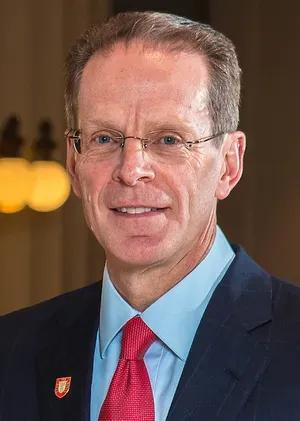
MUNCIE, IN — Ball State University President Geoffrey S. Mearns is standing by his decision to fire a campus official over her Facebook comments about the assassination of Charlie Kirk.
Those comments came hours after Kirk, a conservative activist, was fatally shot as he spoke to students on the Utah Valley University campus on Sept. 10.

In a posting on her personal Facebook account, Suzanne Swierc, Ball State’s director of health promotion and advocacy, said, “If you think Charlie Kirk was a wonderful person, we can’t be friends.”
A week after the Kirk slaying, Swierc was fired from her university job.
In a release at that time, Ball State officials said they “determined the post was inconsistent with the distinctive nature and trust of Ms. Swierc’s leadership position at Ball State University and the post caused significant disruption to the university.”
The American Civil Liberties Union of Indiana then filed a U.S. District Court lawsuit against Mearns on behalf of Swierc, contending her online comments were “fully protected by the First Amendment” and that her firing was “unconstitutional.”
This week, the ACLU of Indiana announced a settlement of the lawsuit will result in a $225,000 payment to Swierc.
In an email issued to university colleagues on Tuesday, May 26, Mearns said he stands by his decision to fire Swierc, calling the $225,000 “a modest monetary payment.”
“I authorized that payment, because it is substantially less than the anticipated amount of our university’s legal fees to defend the case,” the Ball State president wrote.
Mearns maintained the settlement did not “vindicate” Swierc’s claims that her firing violated her First Amendment rights.
In her online commentary after the assassination, Swierc called Kirk’s death “a tragedy” and said she “can and do feel for his wife and children.” She also said that based on her religious beliefs, she would “pray for (Kirk’s) soul.”
She also referred to Kirk’s strong opposition to gun control efforts, and his stance on other issues.
“Charlie Kirk’s death is a reflection of the violence, fear and hatred he sowed,” Swierc wrote. “It does not excuse his death, AND it’s a sad truth.”
In his email, Mearns said Ball State received “hundreds of critical communications, including more than 130 emails,” in the five days after the posting.
“Some people indicated their intent to withhold donations to our university,” Mearns wrote. “One person claimed to be the parent of three current students, and the person’s social media post indicated that the students would not be re-enrolling at our university.”
‘Tarnishing our university’s reputation’
The Ball State president said within eight hours of Swierc’s comments being posted on X (previously known as Twitter), “it had been reposted more than 9,000 times, along with thousands of comments, almost all of which were critical of Ms. Swierc and our university.”
“By Sept. 16, 2025, the day before I decided to terminate Ms. Swierc’s employment, approximately 3.2 million people had viewed her public statement and were aware of her employment at our university,” he said. “I was advised that this social media activity was tarnishing our university’s reputation, thereby adversely affecting our student enrollment and impeding our efforts to generate private philanthropy from our alumni and our benefactors.”
Mearns also reported “the most disruptive and disturbing responses to Ms. Swierc’s statement were the many calls that were made to offices all across our campus,” some of them threatening.
“I personally witnessed the strain and anxiety that my assistants who answer those calls for me were experiencing,” the Ball State president recalled. “And I knew that our colleagues all across our campus were having to endure these verbal assaults as a result of Ms. Swierc’s public statement.”
Mearns also suggested Swierc’s comments had “damaged her credibility with students who do not share her views.”
A supervisor reported that before the Kirk assassination, she had told “the directors in her division, including Ms. Swierc, that even their personal social media statements could impede their ability to serve all of our students and, as a result, adversely impact our university.”
Mearns also said before terminating Swiec, he had reviewed a recent opinion by a federal appeals court that found the dismissal of “an employee of a public educational institution whose employment was terminated for posting an inflammatory statement on her Facebook page” had not violated the employee’s First Amendment rights.
The Ball State president said that when he “considered the extensive and ongoing disruption to our mission and the sustained, adverse impact on the well-being of our employees, I decided that I had the professional obligation to terminate (Swiec’s) employment in order to stop that disruption and that harm.”
In a Tuesday news release, Stevie Pactor, senior staff attorney at the ACLU of Indiana, said, “Suzanne was speaking as a private citizen on a matter of public concern when Ball State fired her over a private social media post.
“The First Amendment does not allow government institutions to retaliate in those circumstances, and this settlement reflects that.”
Douglas Walker is a news reporter at The Star Press. Contact him at 765-213-5851 or at dwalker@muncie.gannett.com.
This article originally appeared on Muncie Star Press: Mearns stands by decision to fire Ball State employee over Kirk remarks
Reporting by Douglas Walker, Muncie Star Press / Muncie Star Press
USA TODAY Network via Reuters Connect