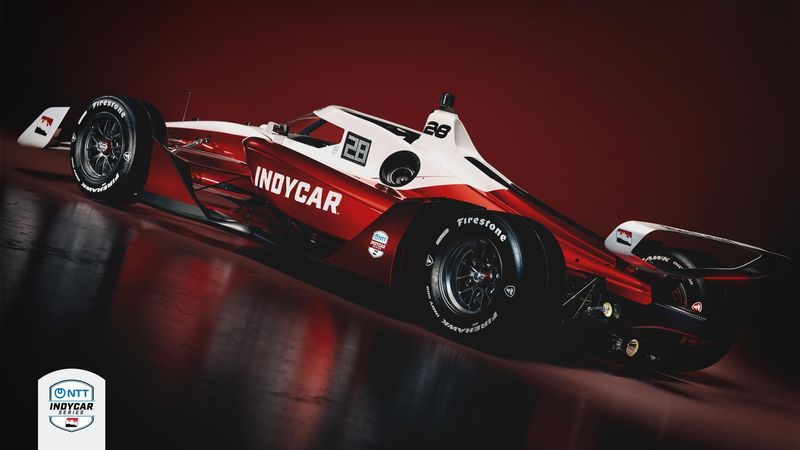
IndyCar has unveiled the new Dallara IR28 chassis that is set to debut in 2028. The car was revealed online via a video narrated by actor Matt Damon, who most recently starred in the box office hit “The Odyssey.”
“This isn’t a refresh; it’s a reset,” Damon said to lead off the 45-second video.

The IR28 will come after 16 seasons with the DW12 chassis, which has seen key changes in its time like the aeroscreen (2020) and hybrid power unit (2024). The IR28 will weigh approximately 100 pounds less than the DW12. According to a news release, the car is set to provide additional power capable of breaking track records, including at Indianapolis Motor Speedway.
“We are pleased to unveil renderings of the new NTT IndyCar Series chassis that will take our sport into an exciting new era,” IndyCar president Doug Boles said in a news release. “As you can imagine, a project of this magnitude takes an incredible amount of planning, collaboration and execution. I would like to thank all of our partners including Dallara, Chevrolet, Honda, Firestone and Shell, who have worked tirelessly to create a package that will enhance IndyCar’s already incredible competition and industry-leading growth.
“With initial testing to begin this week, there is still plenty of work to do before 2028, but we are well on our way to showcasing a new era of IndyCar, which will include enhanced wheel-to-wheel competition, track records, standards in raceability and new benchmarks in safety. We are confident the IR-28 is the ideal package to move IndyCar forward for our teams, drivers, partners and fans.”
The new chassis has experienced various delays, but it has now been officially developed. IndyCar will soon release a testing schedule for the chassis that includes the oval and road course at Indianapolis Motor Speedway and the Sebring International Raceway road course. Dallara will continue to be IndyCar’s lone chassis supplier, as it has been since 2008.
“We are honored that IndyCar has chosen Dallara once again,” Dallara USA CEO Stefano dePonti said. “After more than a decade of partnership, their continued trust is the greatest recognition of our team’s efforts. This achievement demonstrates the dedication, expertise and collaboration of many individuals who worked tirelessly to create a car that meets today’s needs while looking toward the future. It also reflects Dallara’s ongoing commitment to investing in innovation and education, sharing the knowledge developed in motorsport with academia and beyond.”
With the new car, IndyCar is reintroducing the digital car display that shows viewers a car’s track position during a race or qualifying. Originally introduced in 2015, the LED panels showed viewers at the track or at home what position a car was on track. The system was found to be technically unreliable, causing vibration issues, and the display was officially removed from cars in the middle of the 2019 season. Now, the series is bringing the display back for the IR28.
The car will feature a new suspension system, the Custom AXIS Inertance Control. The AXIS platform is built to expand spring, damper and inerter tuning options. IndyCar will become the only major motorsports championship to permit both front and rear third-element inertance systems.
Honda and Chevrolet, IndyCar’s two engine manufacturers that re-signed in February, are still working to develop the new 2.4-liter twin-turbocharged V6 engine that will debut in 2028. In the meantime, a hybrid power unit more reliable than the current one is being developed. The 2028 hybrid will have greater power storage and be approximately 20 pounds lighter than the current powertrain. The new hybrid units will be provided through a partnership with Helix, a UK-based company focused on building and delivering electric drive systems. Helix has worked with the FIA in Formula One for the increased electrification of F1 engines this year.
The new hybrid unit will feature a battery-based Energy Storage System (ESS), which will be supplied by BOLD Technology, which develops F1 battery systems. The IR28’s ESS will deliver approximately 14 times the energy storage capacity of the hybrid in the DW12. The goal of the new ESS is to provide drivers and teams “greater flexibility in when and how they deploy hybrid power.” IndyCar has had to reduce hybrid power inside the DW12 amid failures and questions whether the current unit is built to be inside the current chassis. With this new hybrid unit, which will remain located between the combustion engine and gearbox, the hope is to limit hybrid failures despite increasing power.
IndyCar and Dallara have also aimed to make safety enhancements with the IR28. The cockpit will be wider to accommodate a greater range of driver heights and body types while also enhancing internal airflow and driver cooling. The car will have a stronger side-structure design to increase energy absorption in high-impact crashes, plus improved stability to remain grounded during nose-up incidents.
As IndyCar’s popularity and viewership experiences a resurgence, the functionality and safety of the IR28 will be vital. As the car goes through tests (and is eventually joined in testing by the new engines and power units), the series and Dallara must fine-tune it to produce the best racing possible. But for the first time, the chassis has publicly come to life.
Zion Brown is IndyStar’s motorsports reporter. Follow him at @z10nbr0wn. Get IndyStar’s motor sports coverage sent directly to your inbox with our Motor Sports newsletter. Subscribe to the YouTube channel IndyStar TV: IndyCar for a behind-the-scenes look at IndyCar and expert analysis.
This article originally appeared on Indianapolis Star: IndyCar unveils 2028 car with help from movie star Matt Damon
Reporting by Zion Brown, Indianapolis Star / Indianapolis Star
USA TODAY Network via Reuters Connect
By Zion Brown, Indianapolis Star | USA TODAY Network