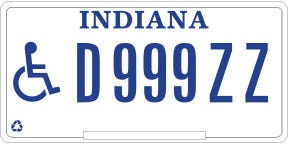
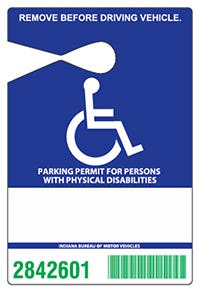
EVANSVILLE — Parents and caregivers of children or adults with more severe forms of autism spectrum disorder can now apply for a disability parking placard, the Indiana Bureau of Motor Vehicles announced Wednesday.

The change covers caregivers of people diagnosed with Level 2 autism spectrum disorder, described as requiring substantial support, or Level 3, described as requiring very substantial support.
“Having access to disability parking will help these caregivers,” Indiana Gov. Mike Braun said in a statement. “Something as simple as parking closer to a building entrance can reduce risk and make outings safer and more manageable.”
The reforms, which follow 2025’s “blue envelope program” — an initiative aimed at improving interactions between law enforcement and people with autism — arrives as diagnoses of the disorder have climbed precipitously nationwide. The Centers for Disease Control and Prevention’s most recent surveillance data, published in April 2025, found autism spectrum disorder identified in about 1 in 31 8-year-olds in 2022, up from 1 in 36 two years earlier and 1 in 150 in 2000.
Indiana is one of 16 sites nationally where the CDC tracks autism prevalence through its Autism and Developmental Disabilities Monitoring Network.
Nationally, nearly 40% of 8-year-olds identified with autism in the CDC’s latest count also had a co-occurring intellectual disability — a population overlap relevant to Indiana’s new policy, since it’s aimed specifically at caregivers of people whose autism diagnosis comes with substantial or very substantial support needs.
What does top-level research say about autism and driving?
Research on autism and driving has focused overwhelmingly on people without intellectual disabilities — the population clinicians once commonly labeled “high functioning” — a term that has increasingly fallen out of favor with disability advocates who lambast it as reductive and offensive.
A 2019 meta-analysis found autism research broadly oversamples people with average or above-average IQ and undersamples those with intellectual disabilities. One of the few large studies specifically on autism and driver’s licensure — a Children’s Hospital of Philadelphia study tracking more than 52,000 New Jersey health records — explicitly excluded participants with intellectual disabilities from its sample. That leaves comparatively little research on driving-related needs for people with more significant support requirements, which is sthe very population the Indiana policy is built around.
“There clearly was a need,” BMV spokesman Greg Dunn told the Courier & Press. He voiced optimism that the rollout would be smooth, that any questions from Hoosier motorists would be promptly answered by BMV staff, who have been briefed on the ins and outs of the program.
Fitness-to-drive researchers and occupational therapists who evaluate driving safety generally caution against treating any autism severity label as a predictor of driving risk on its own. Assessments instead focus on an individual’s functional abilities — executive function, hazard perception, sensory processing — rather than a diagnosis or a support-needs level. That distinction helps explain why Indiana’s new policy places the parking accommodation on the caregiver rather than attaching any driving restriction to the person with autism: the state is responding to a support need, not making a judgment about anyone’s ability to drive.
The new form: where to get it, how to fill it out and how to submit
To apply for the new disability parking placard, caregivers must complete an Application for Disability License Plate or Parking Placard — a form that predates the new policy but has been modified to specifically accommodate Hoosiers with autism.
The person with autism’s information is entered in Section 1 of the application; the caregiver’s in Section 2, and a health care provider must complete Section 4. The BMV says physicians, advanced practice registered nurses and physician assistants with valid, unrestricted licenses can complete that certification.
Applications can be submitted at any BMV branch or by mail. The BMV recommends caregivers who choose to apply by mail to download its mail-in checklist, which details required documents and mailing instructions.
Houston Harwood may be contacted with questions and feedback at houston.harwood@courierpress.com.
This article originally appeared on Evansville Courier & Press: Indiana BMV lets caregivers of autistic Hoosiers get parking placards
Reporting by Houston Harwood, Evansville Courier & Press / Evansville Courier & Press
USA TODAY Network via Reuters Connect
By Houston Harwood, Evansville Courier & Press | USA TODAY Network