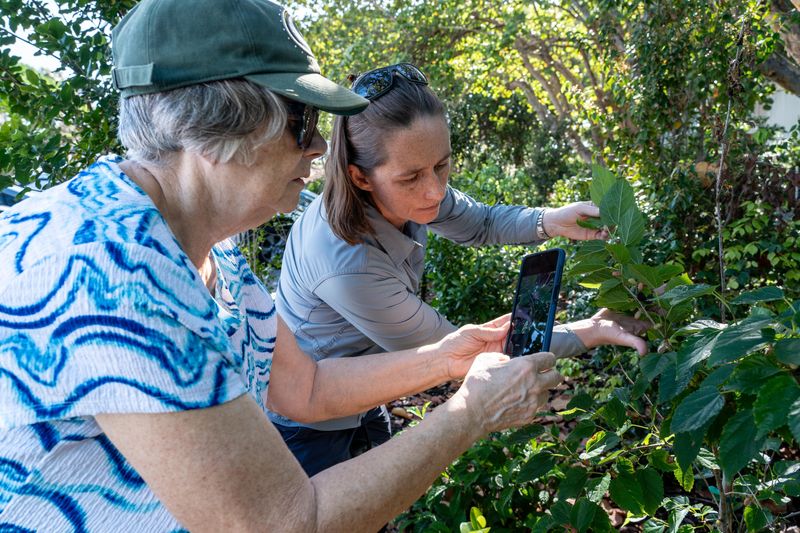
Hundreds of people dedicated a weekend this spring to follow bird calls and slosh through Central Indiana streams. They trekked into wooded preserves and scoured city streets, finding orchids, salamanders, white-tailed deer and so much more.
The battalion of citizen scientists devoted four days of their lives to help document the breadth of biodiversity in Indianapolis and surrounding counties, part of the local 2026 City Nature Challenge.

Participants then uploaded their findings to iNaturalist, an online-community science platform, where hobby taxonomists, bug experts and naturalists spent the following weeks poring through them to confirm or tweak species identifications.
The results are in: The effort stamped almost half of the 7,894 observations as “research grade,” boosting their credibility as data points for researchers around the globe. The Challenge, now in its ninth year in Indianapolis, identified 1,519 distinct species across thousands of submitted observations that have helped demystify the bustling world of non-human life in Central Indiana.
“That’s a lot of life,” said Amanda Wanlass, the founder and executive director of Indiana Phenology, a non-profit supporting and using local citizen science, and a Challenge organizer. But, she added, “there’s a lot more species out there than we probably observed.”
Invasive species and unfriendly finds
This year’s effort to document what is growing wild and free in Central Indiana revealed an uncomfortable truth: Invasive species are everywhere.
“If you go into any of our natural areas in Indianapolis, Central Indiana, really anywhere in Indiana, you’re going to find honeysuckle,” Wanlass said.
Participants logged more sightings of Amur honeysuckle, a non-native shrub crowding out native forest ecosystems, than any other plant, fungus or animal; they uploaded 66 sightings from four days of observation.
Wanlass wasn’t surprised that honeysuckle led the list.
“You’d hope that it was something that belongs here,” she said, but “it just speaks to how common invasives are and how much they’ve taken over our natural areas.”
Gnarly invasive plants were photographed repeatedly across the region. Garlic mustard had 27 observations, and wintercreeper 23. The two most commonly found mollusks were invasive species that degrade local aquatic ecosystems, Asian clams and Leopard slugs, Wanlass said.
Not all native species encounters were ideal, either. Jack Bennett, a naturalist in Lebanon, was sitting in their living room on the last day of the challenge and looked down to find an American Dog Tick crawling up their leg. Bennett uploaded four photos of the creature.
In all, that tick species, which can transmit Rocky Mountain spotted fever and tularemia, was logged eight times during the challenge.
“They’re active right now,” Wanlass said of ticks. “Be warned.”
Memorable sightings and scientific momentum
Still, Bennett said the 20 or so hours they spent searching for and cataloging biodiversity during the four-day challenge was a memorable experience. The highlight was a species that had been an elusive nemesis for the avid birder.
The day before the challenge began, an online birding site alerted Bennett to a recent report of a Blue-gray Gnatcatcher at the Ritchey Woods Nature Preserve in Fishers. Bennett studied up on the tiny bird’s nasally wheeze of a song and set out the next day to find it.
It didn’t take long. Once Bennett heard the gnatcatcher, they followed the call through a clearing to the base of an eastern juniper tree.
“I just stood there for a minute watching the tree. And there it was, kinda hopping about in the branches,” Bennett said. “It was a really great start to the day and to the challenge.”
Juggling a job and rainy weather, Bennett went on to catalog 145 distinct species.
Wanlass, who has been digging through the trove of iNaturalist data, said that about 65% of the Challenge observations documented plants. But she was also excited to see reports of fireflies, including a species she has never encountered herself, and spiders, coyote droppings, raccoon prints, muskrats, salamanders, frogs and more than 97 species of birds. Then there were the unsightly fungi with evocative monikers — dog vomit slime mold, deer vomit, dead man’s fingers.
“I like to tell people that iNaturalist is for when something catches your eye, that’s your cue to make an observation,” Wanlass said.
Participants logged and identified 66 different threatened species, like chimney swifts and various types of elm trees, according to City Nature Challenge’s Indianapolis results. They documented 32 endemic species, like star chickweed and Northern catalpas. Coming in right below Amur honeysuckle, the native Jack-in-the-pulpit was observed by participants 53 times.
Researchers from across the globe use this data to inform their research: iNaturalist uploads have been used in thousands of peer-reviewed scientific papers. The massive database can clue scientists in to species experiencing geographical shifts in range or behavior changes possibly due to a shifting climate. Citizen scientists have even uploaded long-lost species, thought to be lost.
The purpose of the City Nature Challenge is to improve the quality of data for scientists, said Angela Herrmann, a program manager at Indiana University Indianapolis who co-organized Challenge.
“Some people say the data’s not good enough because it wasn’t done by a professional,” she said. “That is not entirely true.”
Wanlass incorporates local iNaturalist data into her own research, where she studies how plants and animals respond to seasonal changes.
Beyond the research, Wanlass sees iNaturalist and the Challenge as a way to connect with the natural world. She challenges folks to take iNaturalist, a small outdoor area and five minutes to catalog what they find.
“You’ll go five minutes and you’re like, ‘Okay, I’ve seen everything there is.’ But if you stay another five you’ll see that no, you were wrong,” she said. “All this life is happening right under our very noses and we don’t even see it.”
IndyStar’s environmental reporting is made possible through the generous support of the nonprofit Nina Mason Pulliam Charitable Trust.
Sophie Hartley is an IndyStar environment reporter. You can reach her at sophie.hartley@indystar.com or on X at @sophienhartley.
This article originally appeared on Indianapolis Star: Indy-area nature challenge reveals what plants and animals live nearby
Reporting by Sophie Hartley, Indianapolis Star / Indianapolis Star
USA TODAY Network via Reuters Connect