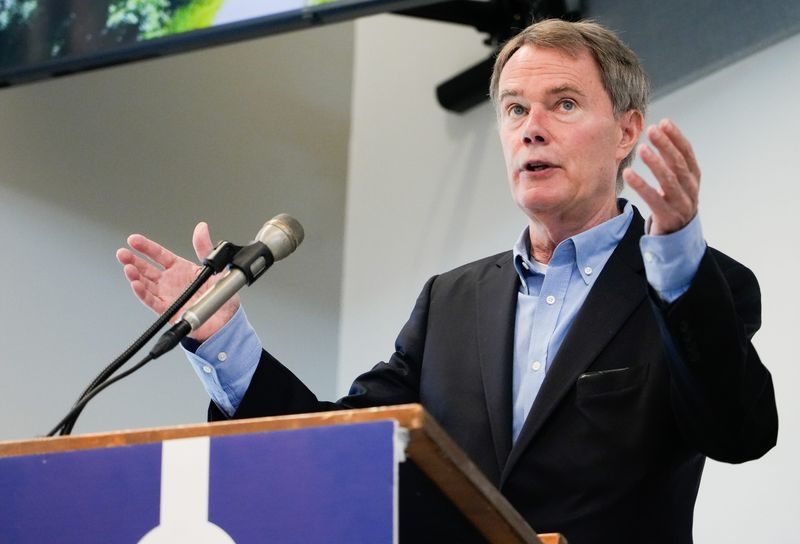
To stop vehicle tax hikes, Indianapolis Mayor Joe Hogsett issued his first-ever veto July 16, setting up a tightly contested debate among Indy councilors over whether to override the mayor.
With household budgets already stretched to the limit, Hogsett said it’s wrong to impose additional costs on them in a video posted to social media Thursday. It’s the first time Hogsett has vetoed a council ordinance, a council spokesperson said.

“Over the course of the last month, my office has heard from older adults on fixed incomes who say this increase is simply not doable,” Hogsett said. “When neighbors tell me rising costs are forcing hard decisions, it is my responsibility to listen.”
The Indianapolis City-County Council approved the vehicle tax hikes 14-10 in a July 6 vote, with Democrats saying they’re essential to a long-term plan to fix the city’s many decrepit roads. The narrow margin, however, means the legislative body may lack the votes it needs to override the city’s top executive, a fellow Democrat.
The 25-person council needs a two-thirds majority, or 17 votes, to override a mayoral veto. Fifteen Democratic councilors support the tax increases — including Dan Boots, who was absent for the July 6 vote — while the remaining four Democrats and all six Republican councilors voted no.
The council will conduct a vote on whether to override the veto, although an exact date remains unclear, Council President Maggie Lewis said in a July 16 statement. The next regular council meeting is Aug. 10.
“[W]e look forward to receiving the mayor’s plan to fund the city’s infrastructure improvements, as required to obtain the state matching grant,” Lewis said. Hogsett said he has already shared the plan.
The new tax hikes would increase the Marion County excise surtax to $100 for passenger vehicles, and bump the wheel tax to $240 for large vehicles like buses, recreational vehicles and semi-trailers. The fees are paid once a year when a vehicle is registered with the Bureau of Motor Vehicles.
Council Democrats estimate the higher taxes would generate more than $70 million a year for road funding. Supporters say the reforms will ensure Indianapolis secures an annual match of $50 million in state road funding, starting in 2027.
But Hogsett says their plan puts an unnecessary burden on residents at a time when other costs have risen steeply.
The Hogsett administration says growth in local income tax revenue could largely fund the city’s $50 million match in 2027. Hogsett’s plan is to allot $20 million in the 2027 budget, allocate $5 million from stormwater fees and direct $25 million more from a 2027 spring spending package, spokesperson Emily Kaufmann has previously said.
“Let me be clear: This administration will meet the state’s match,” Hogsett said in the video. “Meeting this moment has never been an afterthought. Over my tenure as mayor, our infrastructure budget has more than tripled.”
Council Democrats who support the tax hikes have criticized the mayor’s plan as a stop-gap solution that may not work. They say the city needs a long-term plan to secure state funding for years to come. The city’s contribution must increase to $100 million by 2031 in order to continue receiving the state’s $50 million.
“People in our positions in the past, over decades, have found convenient arguments that now is not the time,” Councilor Andy Nielsen said at the July 6 meeting. “Without a permanent budgetary solution to satisfy the $50 million state contribution, we cannot say we have the funds available.”
Of the council Democrats who voted no — Ron Gibson, Brienne Delaney, Crista Lee Wells and Frank Mascari — only Mascari spoke during the July meeting to say why he opposed the tax increases.
“My issue is equity. I think the 25 districts should get their decent amount of money in return,” Mascari said. “It’s a tough pill to swallow too. I have one neighbor who has three daughters … so it’s five cars, that’s $500.”
Before the vote, Wells told Mirror Indy she thought the tax hikes would hurt small businesses, families and low-income drivers. Gibson said he doesn’t think his northeast side constituents, namely working-class folks and seniors, should have to pay more.
Proposed spending increases have been a sticking point for the mayor. While Hogsett hasn’t actually issued a veto in the past, he’s threatened multiple during debates about city pay raises.
Councilors withdrew a proposal to raise their own pay in 2019 after Hogsett said he would veto the plan. After Hogsett threatened to veto a proposed pay increase for himself in 2024, the council approved a 57% pay bump for the future mayors that won’t take effect until 2028.
(This story was updated to add a statement from the Indianapolis City-County Council.)
Download the free IndyStar app and turn on notifications to get breaking news and sports alerts.
Email Indianapolis City Hall Reporter Jordan Smith at JTSmith@indystar.com. Follow him on X @jordantsmith09 and Bluesky @jordanaccidentally.bsky.social.
This article originally appeared on Indianapolis Star: Hogsett vetoes vehicle tax hikes in unprecedented move. What happens now?
Reporting by Jordan Smith, Indianapolis Star / Indianapolis Star
USA TODAY Network via Reuters Connect
By Jordan Smith, Indianapolis Star | USA TODAY Network