The government shutdown will become the longest-running shutdown in modern American history if the Senate fails to reopen it by the evening of Nov. 4, continuing a long period of uncertainty for Indiana’s 24,000 civilian federal workers and the hundreds of thousands of Hoosiers who won’t receive full Supplemental Nutrition Assistance Program benefits this month.
For 35 days, most federal workers have gone without pay as money dries up across critical agencies.

Even if the shutdown ends, it’s unlikely funding would return in time for Hoosiers to receive full SNAP benefits by Nov. 5, when the first group of recipients was supposed to get its monthly allotment. It marks the first time the program has lapsed in recent history even under previous government shutdowns.
Still, recipients can expect to receive partial benefits after President Donald Trump’s administration complied with a judge who ruled it was legally obligated to fund the program. The administration said it had enough funding for 50% of eligible households’ current allotments.
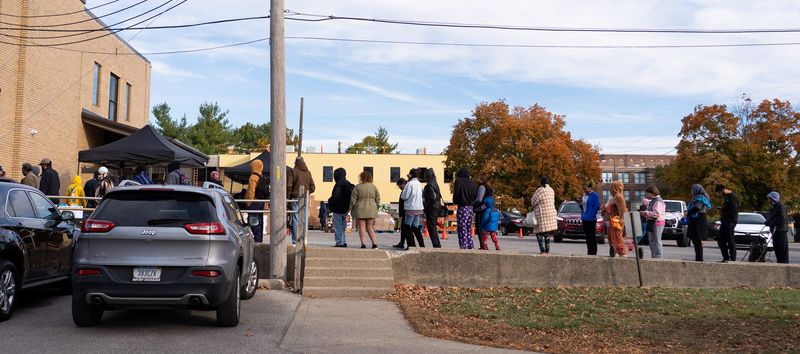
It’s unclear when recipients will receive benefits, so the nearly 600,000 Hoosiers who rely on SNAP may have to turn to Indianapolis’ food pantries to keep their families fed. But food pantries are already facing record high demand, advocates told IndyStar. Though numbers were elevated before the shutdown, high rents and utility costs have collided with shutdown impacts to create a perfect storm.
Why is the government shut down?
For more than a month, U.S. Senate Democrats and Republicans have been at an impasse. The chamber needs bipartisan support to pass a spending measure because 60 votes are required to end a filibuster and advance to a final vote, but neither party has that much of a majority.
Democrats have said they won’t vote to reopen the government until Republicans meet their demands, namely an extension of enhanced Affordable Care Act health insurance premium subsidies that would keep costs lower for millions of Americans, including more than 300,000 Hoosiers. But GOP members are split in their support for the idea, and overall don’t think it belongs in a spending bill.
The previous record-holder for the longest shutdown was for a full 34 days between 2018 and 2019, when President Donald Trump refused to sign the spending bill until Congress included funding for a wall on the southern U.S. border.
Trump suggested the Senate invoke the “nuclear option” by eliminating the filibuster. That would give Republicans the ability to pass the spending measure without Democratic support, though GOP leaders in Congress are so far unenthusiastic about the idea.
There may be light at the end of the tunnel, however. The parties are expected to reach a deal as early as mid-week, as heightened shutdown pain and the promise of future negotiations on health insurance subsidies drive some Democrats to relent.
Will Indiana fund the rest of SNAP?
Indiana officials have not yet announced plans to help Hoosiers on SNAP or support food banks.
A spokesperson for the Indiana Family and Social Services Administration said it is not possible for the agency to fund SNAP directly.
“There is no money we can use,” spokesperson Marcus Barlow wrote in an email to IndyStar, “and even if there was, we wouldn’t be able to use that money to fund the EBT cards.”
SNAP is funded by a contract between the U.S. Treasury and the state’s EBT, or electronic benefit transfer, vendor, Barlow said. When someone uses an EBT card, money flows from the federal government to retailers for reimbursement.
Lt. Gov. Micah Beckwith recently said he and the governor were looking at multiple avenues to help Hoosiers on SNAP but did not specify what those options might be. A spokesperson for Gov. Mike Braun referred IndyStar to FSSA.
Still, other states have found ways to help residents facing a benefits lapse. Republican Gov. Glenn Youngkin of Virginia announced the state would transfer funding to benefit cards on a weekly basis until the shutdown ends. Additional states have disbursed emergency funds to food banks.
The federal government had previously declined to use contingency funds, but two federal judges ruled on Oct. 31 that the Trump administration was obligated by law to fund SNAP benefits. One judge left it up to the administration’s discretion on whether it would use emergency funds to pay partial benefits or transfer money to fund the program in full.
On. Nov. 3, the administration said it intended to fund the program partially, though it’s not clear when money will be disbursed.
How can I help?
Even with partial funding, food banks will still face strain if the government does not reopen.
There are local efforts to ease the burden, including a community-funded initiative to help food banks.
The Central Indiana Food Relief Fund, created with an initial $1 million collected from an anonymous donor, The Indianapolis Foundation, Lilly Endowment Inc. and the Eli Lilly and Company Foundation, will use donations to support local food banks. People can contribute to that effort at uwci.org/central-indiana-food-relief-fund, according to a press release from United Way of Central Indiana.
It’s critical aid for food pantries already stretched thin. Still, advocates fear it won’t be enough.
“If this happens next month, then you’ll see more and more kiddos whose only meal is their free school lunch,” Mark Lynch, director of advocacy for Indy Hunger Network, told IndyStar last month.
Meanwhile, grocery stores are expecting a drop in revenue as SNAP recipients will have less money to purchase food. Since even the largest stores operate on thin margins, said Joe Lackey, president of the Indiana Grocery & Convenience Store Association, some smaller shops may be forced to close.
“Everything is interrelated,” he said. “You start pulling those strings and…the sweater unravels.”
FSSA had not received guidance on the infusion of partial funding as of Nov. 3.
Another government program, the Special Supplemental Nutrition Program for Women, Infants and Children, also received more funding after the National WIC Association warned in October funds would run out Nov. 1.
Contact Marissa Meador at mmeador@gannett.com or find her on X at @marissa_meador.
This article originally appeared on Indianapolis Star: Government shutdown set to become longest in modern history amid Indiana SNAP uncertainty
Reporting by Marissa Meador, Indianapolis Star / Indianapolis Star
USA TODAY Network via Reuters Connect