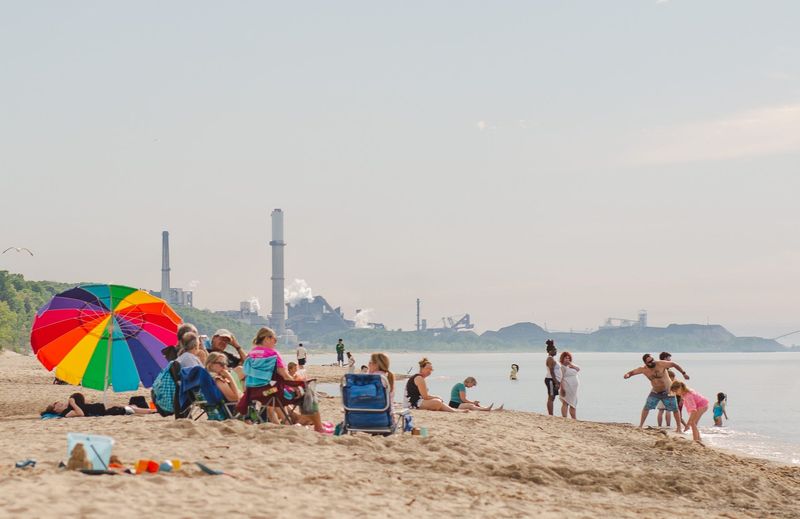
On a breezy evening in late May, Rutul and Namrata Dalal, tourists from the Washington D.C. suburbs, found their way down to a beach on the Lake Michigan shoreline, their dog in tow. Then they noticed smokestacks.
Locals, tourists and seagulls share Indiana’s dunes – a web of sandy beaches, savannahs and wetlands protected by the state and federal governments – with northwest Indiana’s heavy industry. Steel mills abut hiking trails. Lake water laps at the feet of families building sandcastles while a nearby refinery processes crude oil.

And the Dalals, who are self described “national park chasers,” could not quite fathom what they found in Indiana’s lone national park.
“I’ve never seen a natural park like this, surrounded by industry,” Rutul said.
The Dalals chose this specific beach because it was dog-friendly. But the apocalyptic, industrial silhouettes on the horizon made Rutul nervous.
“The first thought that came into my mind was, ‘Is this going to be safe for my pup to play in the water?'” he said.
Indiana Dunes is one of the nation’s most urban, industrial and, oddly, biodiverse national parks. A growing coalition of regional stakeholders is trying to capitalize on these contrasts by promoting Sand + Steel, a campaign from Indiana Dunes Tourism that highlights the sometimes uneasy coexistence between the region’s nature and industry.
Lawsuits, compliance violations and biodiversity loss suggest the tortured history between the dunes and encroachment might not resolve soon or ever. Despite new regulations and environmental protections, advocates of the dunes say they’re still fighting to protect the area against environmental degradation – and sometimes, they say, they feel like the last line of defense for the natural landscape.
New park, old tensions
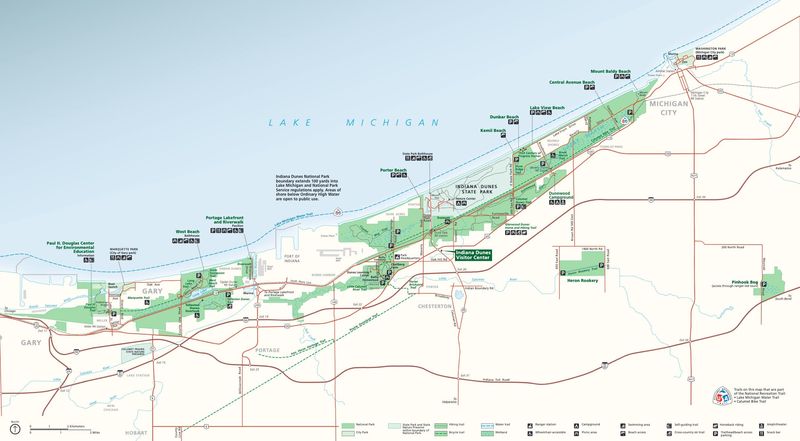
Modern day Indiana’s 45 miles of shoreline – the fewest of any Great Lakes State – is cramped by three counties, a slew of municipalities and hundreds of thousands of Hoosiers. Much of this traces back to the area’s 20th century industrial boom.
“Everybody knows somebody who’s worked in the steel mills,” said Christine Livingston, president and CEO of Indiana Dunes Tourism, whose father worked at U.S. Steel.
The whirlwind of Northwest Indiana’s economic heyday had consequences. Sand miners leveled out beaches, the steel industry developed chunks of duneland, loggers plowed through white pine forests.
Scientists, outdoor enthusiasts and plucky homeowners fought back. In 1925, a state park designation across a roughly 2,000-acre stretch helped with the preservation effort. As companies turned delicate dune shoreline into coal-burning power plants and factories, locals mounted a protest to preserve the land.
In 1966, Congress finally conceded. The federal government designated more than 15,000 thousand acres of habitat as a National Lakeshore, a classification that brought protection and hope for the future.
Seven years ago, the preserve entered a new era when it was designated a national park.
The name change didn’t bring much in the way of new federal funding or regulation, said Paul Labovitz, the now-retired superintendent of Indiana Dunes National Park. But the status pushed the dunes onto bucket lists and elevated the landscape into a widely sought after tourist destination, alongside bucket list locales like Acadia’s rocky Atlantic shore and the towering mountains of the Grand Tetons.
The ecosystem behind the fight
Despite Indiana’s notoriously humble aesthetic reputation for natural landscapes, Indiana Dunes National Park outpaces most other national parks in one of the categories that matters most to scientists: The park’s ecosystems are hotbeds of biodiversity.
Lake Michigan’s southern shore, which encompasses Indiana Dunes National Park, is the convergence point for disparate biomes from different reaches of the continent. The collision of boreal and hardwood forests, prairies and wetlands has created a tiny region rife with species diversity. On the same day a hiker might stumble across a carnivorous purple pitcher plant, he or she could also find arctic bearberries, relic species of the chill that once smothered the region.
“You can’t swing a stick around here without hitting 10 botanists getting excited about herbaceous plant life,” Labovitz said.
The park’s native flora offerings lay underneath a wildlife aerial highway that electrifies in the spring and fall with seasonal migrations of thousands of birds; birdwatchers have documented more than 350 unique species.
The area just 45 minutes from Chicago draws hordes each year; almost 3 million visitors entered the national park in 2024, and nearly 2 million visited the state park.
The proximity to urban life changes the national park experience from a trip someone plans for months to a place one can drive to on a whim on a Tuesday afternoon, Livingston said.
The Sand + Steel initiative, driven by Livingston and Indiana Dunes Tourism, is an effort to capitalize on this. The campaign, still in the process of launching, has captured the attention of stakeholders from across the lower Lake Michigan shore.
Both the national and state parks, a steel manufacturer, the Ports of Indiana, the regional planning commission and at least eight communities, from Gary to Michigan City, are partners on the project. The project will involve museum exhibits, trail education, storytelling and merchandise.
Livingston said she is focused on telling the region’s whole history even when industry has been at odds with nature.
“We’re not trying to say we haven’t had bumps along the road. We aren’t trying to say there haven’t been spills and there haven’t been problems,” she said. “We’ve been struggling with these issues for decades, and we’ve figured it out.”
What does it take to coexist?
Not every conservationist believes the tension between industry, development and conservation has simmered into a coexistence. Many environmental advocates still see a precarious future – and present – for the park, despite stricter environmental protections. And many are still fighting to save it.
“Every year, every month there’s some industrial leak, there’s some environmental insult that is perpetrated,” said David Van Gilder, the senior policy and legal director of Hoosier Environmental Council. “It’s a constant, constant battle to keep what we have.”
In an emailed statement to IndyStar, bp, which operates the oil refinery in Whiting, affirmed its commitment to protecting Lake Michigan and operating within permit limits.
“We’ve invested hundreds of millions of dollars in water treatment technology to support water quality in Lake Michigan,” said Cesar Rodriguez, a bp spokesperson, in an email.
Andrew Fulton, a spokesperson for U.S. Steel, said in an email his company is engaged in extensive monitoring efforts for the Lake Michigan mill.
“U. S. Steel contributed an estimated $154,000 to community programs and events across Indiana, including support for Save the Dunes to restore wetlands and protect the Indiana Dunes National Park habitat,” he wrote.
Labovitz, who retired from Indiana Dunes in 2023 after nearly 35 years in the park service, still worries about the slow hand of bureaucracy and recent funding cuts that have constrained park operations. But the former forester, who spends some of his free time hiking park trails and pulling out invasive species, is hopeful about the ongoing conservation work across the region.
The park is “not Olympic athlete healthy,” he said, “but it’s not on life support.”
A broad community of environmental and public health advocates play a key role in the ecosystem’s survival, Van Gilder said, and they keep a close eye on the interplay between sand and industry.
“Some industry is improving their standards and they have a better culture and things are generally better than they used to be,” said Katie Hobgood, the program director at Save the Dunes, a nonprofit that helped establish Indiana’s national park. “But there is still always the possibility that something could happen.”
In 2020, Ogden Dunes, a coastal town in Porter County, began a project to prevent erosion in residential areas threatened by Lake Michigan’s high water levels. Constructing a wall could have disrupted the region’s natural flow of sand and blocked public beach access, so the Conservation Law Center, representing Save the Dunes, fought back against the state, which issued the permit.
Just Transition Northwest Indiana, another watchdog group, has been pushing for heavy industry to clean up emissions.
Ingrained in a region that has been shaped by industrial forces, many of which loom to the not-so-distant west of the beach, Indiana Dunes National Park cannot escape a future of continued cohabitation.
On that mild Tuesday May evening, after other beachgoers entered the water, the Dalals decided it would be safe for Zambi, too.
But as the small dog frolicked in the water, Rutul kept peering up at the smokestacks.
IndyStar’s environmental reporting is made possible through the generous support of the nonprofit Nina Mason Pulliam Charitable Trust.
Sophie Hartley is an IndyStar environment reporter. You can reach her at sophie.hartley@indystar.com or on X at @sophienhartley.
This article originally appeared on Indianapolis Star: Can the Indiana Dunes & heavy industry coexist? It’s complicated
Reporting by Sophie Hartley, Indianapolis Star / Indianapolis Star
USA TODAY Network via Reuters Connect
By Sophie Hartley, Indianapolis Star | USA TODAY Network