MISHAWAKA — Artificial Intelligence and online algorithms can be used by property managers to screen tenants. But according to Myra Reid, civil law attorney with AAK Law, these tools can unintentionally perpetuate bias when making housing decisions.
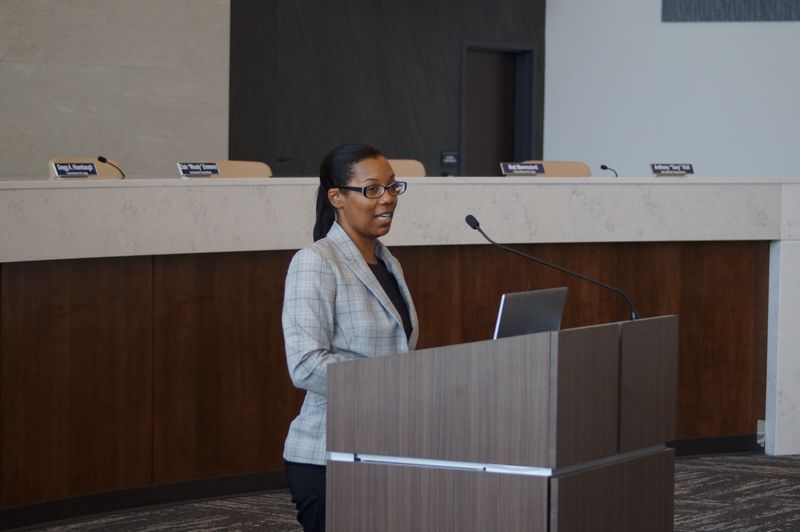
The South Bend Human Rights Commission hosted a Fair Housing in the Age of AI and Algorithms event Thursday, June 4, with Reid and Monica Brazier, the owner of Monica Knows Ai and Monica Brazier Photography.

“There’s so many uses for AI, and there are so many ways that companies, landlords, property managers can use this in a responsible manner,” Reid said.
How some property managers use AI
Brazier has owned Monica Brazier Photography for the last 12 years and recently completed a certification in AI consulting. She explained the different uses AI can have for property management.
“AI does not have to be this scary technology that is coming to take all of our jobs,” Brazier said. “It can actually be very beneficial and useful and help us all do our jobs more efficiently.”
She said different AI platforms like ChatGPT, Claude, Microsoft CoPilot and Google Gemini can be used for analyzing information, identifying patterns, generating content, organizing data and automating repetitive tasks.
“But in relation to … housing, I would recommend you use these tools responsibly,” Brazier said. “Use them to organize the data, use them to summarize the data, and then, ultimately, a human would have to make the decision on whether or not a person gets housing or not.”
She said property owners and managers are using AI for online chatbots, to create virtual tours, flyers, screen applicants and even answer phone calls.
Discrimination in housing decisions
Despite the efficiency AI may pose to property managers, AI can perpetuate bias through advertisements and built in algorithms, according to Reid.
Brazier explained that the best practice when utilizing AI for work efficiency is to train it for one’s own personal needs. But if AI is trained with bias, it will make biased decisions.
Reid used a fictional example of a landlord who wants to evict a tenant if police are called more than three times. This landlord trained AI to automatically send an eviction notice once a tenant has met the three-call limit. She explained that this is discrimination and illegal.
According to Reid, it is discriminatory to print or publish an advertisement with indication of preferences or limitations.
Her example was of a fictional landlord who wants to only rent to those who currently live on the south side of South Bend. This landlord’s advertisement was only posted on the south side and included language like “a 700 or higher credit score” and “four times the monthly rent.” She said this is discrimination and illegal.
Housing Laws
According to Reid, the Fair Housing Act ensures fair housing opportunities, protects vulnerable communities, promotes inclusive and diverse neighborhoods and reduces legal risk for housing providers by prohibiting discrimination.
Reid believes the law reduces legal risk for housing providers because “If you know what you need to stay away from, hopefully you’ll stay away from it,” she said.
Under the federal Fair Housing Act, protected classes include race, color, religion, familial status, sex, national origin and disability.
But as another layer of protection, Indiana included ancestry to the list of protected classes in the Indiana Fair Housing Act.
According to Reid, there are also local ordinances in South Bend and Mishawaka that “mirror” the federal and state law, but some language may differ.
Ultimately, the message both Reid and Brazier aimed to convey was that AI is a tool and when used in best practice, a human makes all final decisions.
To file a housing complaint contact:
● United States Department of Housing and Urban Development online at https://www.hud.gov/reporthousingdiscrimination
● South Bend Human Rights Commission — Call 574-235-9355 or email humanrights@southbendin.gov
● Indiana Civil Rights Commission online at https://icrc.powerappsportals.us/
Email Tribune staff writer Juliane Balog at jbalog@usatodayco.com.
This article originally appeared on South Bend Tribune: AI and algorithms can influence biased housing decisions
Reporting by Juliane Balog , South Bend Tribune / South Bend Tribune
USA TODAY Network via Reuters Connect


By Juliane Balog , South Bend Tribune | USA TODAY Network