At first glance, Cheyenne Mountain State Park may not seem any more special than any other state park, but you have to go and visit to find out how special it is.
I stayed there recently on my road trip to Colorado.

The mountain itself is part of the front range of the Rocky Mountains. It’s located just south of Colorado Springs.
I had been there before, but I decided it was worth another look and I was very glad that I came back.
I went there to camp for a couple of nights and to hike more of the trails.
I saw lots of animals while on the trails including Whitetail prairie dogs, wild turkeys, several deer, and heard and saw many Western Meadowlarks.
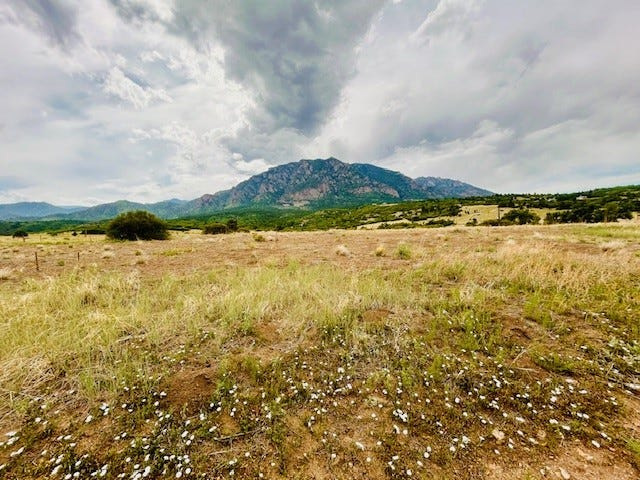
It’s a beautiful park and the mountain itself is big and ominous. It sits at 9,565 ft in elevation. During sunrise and sunset, the mountain takes on a reddish glow, called Alpenglow. It’s a scientific term and in plain English it basically means the sunlight reacting to the particles of the of the mountain and the light. I have actually seen this on occasion. It’s really a beautiful sight.
There are lots of hiking trails and they intersect with one another.
The history behind the park is a long one. The park was established to preserve one the last large spaces along the Colorado Front range. Today the park spans over 3200 acres.
The park became an official Colorado State Park in 2006.
For centuries, the area served as hunting grounds and a cultural touchstone for the Ute, Cheyenne, and the Arapaho tribes.
Perhaps one of the well known things about Cheyenne mountain is the famous bunker under the mountain. It was formally known as the Cheyenne Mountain complex.
It was built during the Cold War in response to the Soviet Union’s nuclear advancement to serve as a command and control center for NORAD.
The park is completely separate from the facility.
I camped at Cheyenne Mountain State Park for two days. I was determined to get a lot of hiking in and cover more trails in than I had in the past.
The first day I was there, I hiked two trails, Raccoon Ridge and Boulder Run. Both were moderate to hike and were a lot of fun. They were very scenic with a lot of Ponderosa pine trees growing along the trail and big rocks and boulders scattered along the way. This was right up my alley.
The campground was very nice.
I set up my tent and made myself at home.
On the second day, I was able to hike three trails. It seems like a lot, but I was trying to hike as many as I could.
The trails that I hiked were: the Zook trail, the Coyote Run trail, and the Sundance trail. These were all very scenic and were a bit more challenging. I enjoyed them very much.
There is so much more I could say
about this wonderful park, but it’s better if you see it yourself. So if you ever find yourself in Colorado Springs, make sure to visit Cheyenne Mountain State Park.
They offer other recreational opportunities as well, such as mountain bike trails, equestrian trails, archery, and nature programs, to name a few. They offer many campsites for campers and a few for tents. They have showers and laundry services.
The park is open daily. Seasonal fees apply.
To get to this place: the address is 410 JL Ranch Heights, Colorado Springs, Colorado.
A quote for your week:
“Twenty years from now you will be more disappointed by the things you didn’t do than by the ones you did do.” – Mark Twain – (The pen name of Samuel Clemons). – American writer, Humorist, Inventor. – 1835-1910.
Until the next trail,
Susan Anderson is a resident of Owen County who enjoys hiking and backpacking and writes a weekly column about her experiences. Readers can reach her via email at saanders@hotmail.com or on Instagram @farsideoftheedge.
This article originally appeared on Evening World: A second look at Cheyenne Mountain State Park
Reporting by Susan Anderson, For the Evening World / Evening World
USA TODAY Network via Reuters Connect
By Susan Anderson, For the Evening World | USA TODAY Network