It’s summer in Illinois, which means people are getting outside, but it’s important to remember that ticks, too, are most active in the warm months.
The SJ-R reached out to the Illinois Department of Public Health to ask about the latest information and anything the public should know before trekking into the woods.

Here’s what we found out.
When is tick season?
Ticks are most active during warmer months, or April through September.
What are some general concerns with ticks in Illinois?
There has been a long-term increase of reported tickborne diseases in both Illinois and the U.S., which appears to be continuing, a spokesperson for IDPH wrote in an email. That’s mainly because the Land of Lincoln is experiencing warmer winters and warmer warm seasons, allowing ticks to be active in the spring and later into the fall.
Lyme disease
A lot of tick activity is being reported in Illinois earlier in the year, but it is too early gauge whether total Lyme disease diagnoses for 2026 will exceed previous years.
There tend to be more cases of Lyme disease where the blacklegged tick is concentrated, which is in northern and central Illinois. The tick can also be found in southern Illinois.
More information about Lyme disease can be found on IDPH’s Illinois Tickborne Diseases Dashboard.
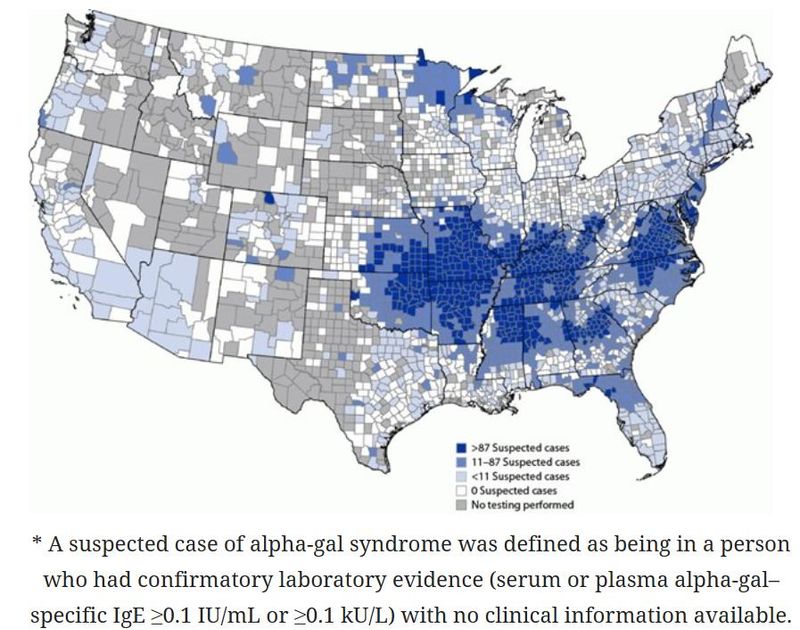
In southern Illinois, more Lone Star ticks are found, which transmit ehrlichiosis and are associated with alpha-gal syndrome, or the red meat allergy. Central Illinois is located where these two tick distributions converge.
What is Alpha-gal syndrome?
Alpha-gal syndrome is a serious, potentially life-threatening allergy that can develop after a tick bite, according to the IDPH’s dashboard. AGS is known as red meat allergy or tick bite meat allergy because symptoms occur after people eat red meat or are exposed to other products made from mammals.
More research is needed to understand the role of ticks in starting AGS, and why certain people develop the allergy, the webpage read.
AGS is not a condition that medical professionals are required to report to state or local public health departments. Still, a graphic on IDPH’s dashboard shows where there are hotspots of “suspected cases.” Those appear prevalent in Missouri and southern Illinois.
AGS is associated with the Lone Star tick.
Lone Star ticks that are typically found in the south are now trickling into central Illinois, a spokesperson for IDPH said.
How to protect yourself from ticks
People who are outside in warm weather in areas where there is higher grass can treat clothing with products containing 0.5% permethrin.
People can also use the EPA’s search tool to find a repellent that is advisable for their needs.
Some helpful products are those containing DEET, picaridin, IR3535 and oil of lemon eucalyptus.
Tom Ackerman covers breaking news and trending news along with general news for the Springfield State Journal-Register. He can be reached at tackerman@usatodayco.com.
This article originally appeared on State Journal-Register: Tick season is getting longer in Illinois, officials say
Reporting by Tom Ackerman, Springfield State Journal-Register / State Journal-Register
USA TODAY Network via Reuters Connect
By Tom Ackerman, Springfield State Journal-Register | USA TODAY Network