More than three weeks after the start of the 2025 Atlantic hurricane season, and as millions in the United States continue to suffer from record-breaking heat, the warnings continue: cutting the budget for the National Oceanic and Atmospheric Administration could put lives at risk.
➤ Weather alerts via text: Sign up to get updates about current storms and weather events by location

In May, former directors of the National Weather Service warned cuts to NOAA could lead to “loss of life.”
More than 880 workers were cut from NOAA in February, which includes the National Weather Service and National Hurricane Center, and another 1,000 employees were later included in President Trump’s plan to cut costs in fiscal 2026.
Here’s what we know.
Proposed NOAA budget cut almost by half
The budget proposed by the White House for the National Oceanic and Atmospheric Administration is almost half of what it was a year ago, $3.5 billion compared to $2.3 billion in the current year.
The budget eliminates all funding for NOAA Research, the division that coordinates and conducts weather and climate research across the United States.
How does NOAA Research affect hurricane forecasts?
NOAA Research’s network of nine laboratories, 16 cooperative institutes and other partnerships with universities collect and share weather data, then use it to develop new forecast models, new tools and better techniques to save lives, said said Alan Gerard, who recently retired from NOAA’s Severe Storms Laboratory.
The division’s work is credited with modeling and forecasting advances that support both the National Hurricane Center and the National Weather Service, including improvements in forecasting hurricane track and intensity.
NOAA has been improving hurricane forecast tracks. Will those improvements stop?
Over the past decade, NOAA has shaved the margin of forecast track error by 27% at 36 hours out and 18% at 72 hours out.
In 2024, the Hurricane Center set a record for the most accurate forecasts in its history, according to a preliminary analysis by the center and the Cooperative Institute for Research in the Atmosphere at Colorado State University.
James Franklin, who retired in 2017 as chief of the National Hurricane Center’s forecast specialists, said he fears the budget cuts would jeopardize those improvements.
Weather balloons in Great Plains affect hurricane forecasts and fewer are being released
Weather balloon launches by the National Weather Service have been cut back or even discontinued at some Weather Service offices as the size of the federal bureaucracy shrinks.
It may be hard to conceive that data collected from balloons launched in the Great Plains could affect hurricane forecasts on the East or Gulf coasts, but they can and do, said both Franklin and Gerard.
The balloon launches provide crucial information about moisture and prevailing winds in large systems crossing the country that could steer or interact with approaching tropical systems, Franklin said.
“If they pass through an area with less balloon coverage, the forecast might change a bit and get degraded.” The larger the area with missing data, he said, the greater the risk of error in a hurricane landfall forecast.
Critics: NOAA cuts will put lives at risk. Commerce secretary defends cuts
“It will stop all progress” in U.S. forecasting, said Franklin said.
Franklin and others working to persuade Congress to save the programs said defunding the research program would put lives at risk when forecasts fall short.
Agency veterans said the administration’s campaign against climate research fails to acknowledge the role climate plays in daily weather, and mischaracterizes how NOAA research supports daily forecasts for all kinds of extreme weather.
In a June 5 hearing on Capitol Hill, Commerce Secretary Howard Lutnick defended the cuts, saying NOAA is “transforming how we track storms and forecast weather with cutting-edge technology.”
White House: NOAA research, grant programs ‘spread environmental alarm’
In a budget document, the White House has said some of NOAA’s research and grant programs “spread environmental alarm.”
In mid-June, a team of at least half a dozen people who wrote and produced Climate.gov, a website that supports science education and explains complicated science and weather to the public, was terminated.
Former NWS directors warn about ‘worst nightmare’
“Our worst nightmare is that weather forecast offices will be so understaffed that there will be needless loss of life,” the five former NWS directors said in an open letter to the American people.
“As former directors of the National Weather Service, we know firsthand what it takes to make accurate forecasts happen and we stand united against the loss of staff and resources at NWS and are deeply concerned about NOAA as a whole.”
Highlights from the letter said impacts and concerns associated with the cuts include:
NOAA predictions for 2025 Atlantic hurricane season
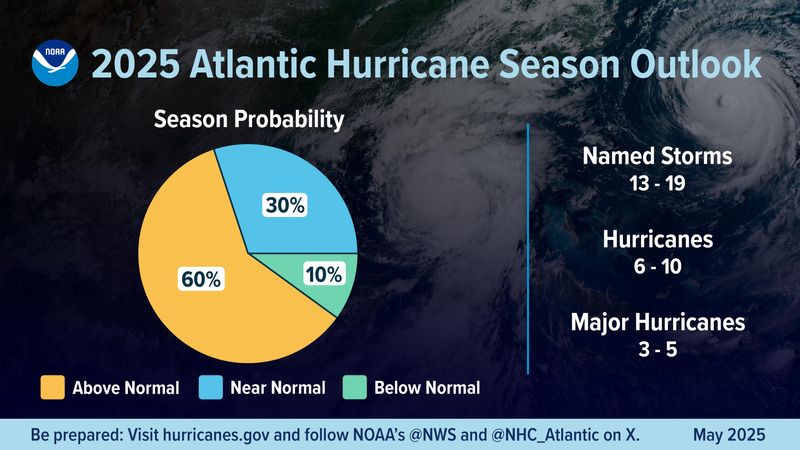
NOAA is predicting there is a 60% chance of an above-normal season, a 30% chance of a near-normal season and a 10% chance for a below-normal season.
Forecasters predict:
A major hurricane is a Category 3 storm or higher, with maximum sustained winds of at least 111 mph.
Stay informed. Get weather alerts via text
What’s next?
We will provide tropical weather coverage daily until Nov. 30 and weather stories as conditions warrant to keep you informed and prepared.
Download your local site’s app to ensure you’re always connected to the news. And look for our special subscription offers here.
This article originally appeared on Fort Myers News-Press: Will NOAA cuts hurt hurricane forecasting in 2025? What Florida residents should know
Reporting by Cheryl McCloud and Dinah Voyles Pulver, USA TODAY NETWORK – Florida / Fort Myers News-Press
USA TODAY Network via Reuters Connect