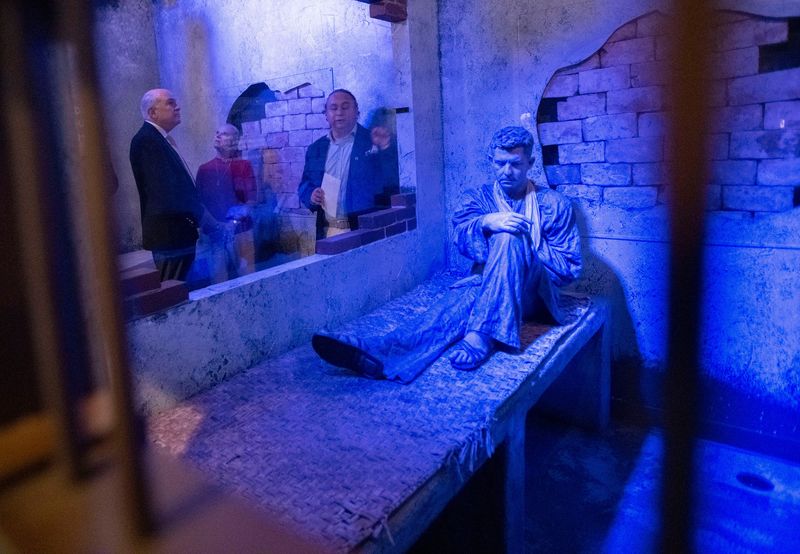
U.S. Navy Lt. Everett Alvarez Jr. was the first American to stay at the infamous Hoa Lo prison in North Vietnam, and when others arrived after they wondered how he managed to snag the best spot in the place.
“You had to come early to get the good room,” quipped Alvarez, who would later retire as a Navy captain after distinguished service.

Of course, there were no “good rooms” at the prison, sarcastically referred to as the “Hanoi Hilton’ by the American prisoners of war who were kept there, most for years. Alvarez was shot down over North Vietnam on Aug. 5, 1964 and was the first U.S. aviator captured during the war. He would not be released until 1973, spending nearly six years in the brutal prison.
On Sept. 19, Alvarez and two other Naval aviators who had been captured, imprisoned and tortured while in captivity spoke at the opening of the “Return with Honor” exhibit at the National Naval Aviation Museum, an exhibit that pays tribute to the brave and continuing legacy of those who endured so much, with many not living through the ordeal.
And if you had trouble hearing Alvarez in the crowded room filled with active-duty military, retirees, family and supporters, that’s OK, he’s talking in the exhibit permanently.
A part of the dark exhibit features an interactive display of an AI-enhanced Alvarez sitting in a chair, with a board that allows visitors to ask a variety of questions about his early life, his military career and more.
That’s just one part of the moving exhibit, which pays tribute to the families left behind, features a miniature replica of the “Hanoi Hilton,” a list of names of those who were held there, various memorabilia including a flight helmet worn by former POW and U.S. Sen. John McCain, the striped prison pajamas and drinking cup worn and used by then Navy Lt. John “Jack” Ensch, as well as much more, including inspirational quotes, recreation of prison cells, timelines of the war and the world while they were in captivity and other biographical material and displays.
“I’m super excited about this ‘Return with Honor’ exhibit,” said retired Navy Rear Adm. Kyle Cozad, president of the National Naval Aviation Museum Foundation. “The 591 prisoners of war who returned represent something that we should all strive to be like. Their sense of duty, their enduring honor, their patriotism is something we really need to see again in our country.”
Ensch was also one of the three former POWs who spoke at the exhibit detailing his excruciating ordeal, from being shot down to his capture and torture.
He was injured when his plane went down, but his captors cared little. He was immediately taken to a nearby hut, stripped down to his underwear by his captors, and then soon after taken to Hanoi prison in the bed of a truck.
“We drove to the Hanoi Hilton,” he said. “My room attendants were waiting for me.”
He underwent three days of intense interrogation, offering nothing but name, rank, serial number and birthdate. The pain, including shrapnel in his body, eventually became too much and he answered a couple of their questions to receive medical attention.
He got it. They amputated his left thumb. He would later retire as a Navy captain.
Retired Navy Capt. Michael McGrath was another POW who spoke, he too saying that he finally answered a few of his captor’s questions to stop the torture and pain. He and other POWS, felt immense guilt for doing so, but were buoyed by superior officers in the camp who told them they did their best in the worst of situations.
McGrath also demonstrated the “tap code” that U.S. POWs developed to communicate with one other through their cells. He said communication was key to living through such unimaginable conditions.
“The brutality of the interrogation, the lack of medical treatment, the physical cruelty,’’ he said. “We all went through this brutal treatment.”
This article originally appeared on Pensacola News Journal: Vietnam POWs receive Return With Honor exhibit, tribute at National Naval Aviation Museum
Reporting by Troy Moon, Pensacola News Journal / Pensacola News Journal
USA TODAY Network via Reuters Connect