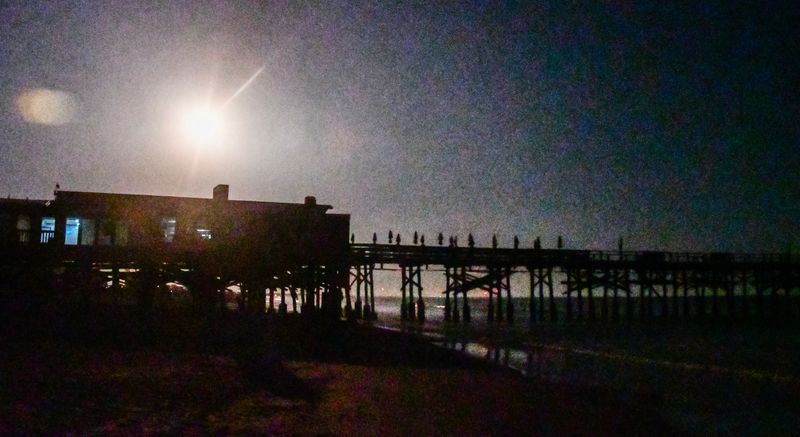
The United Launch Alliance Vulcan rocket took off on the Space Coast from Launch Complex 41 at Cape Canaveral, but what many noticed were the sparks seen coming from the rocket.
After an initial delay, the Vulcan bolted into the sky at 4:22 a.m. Thursday from Launch Complex 41 at Cape Canaveral Space Force Station. Shortly after liftoff, sparks appeared briefly from the area of the solid rocket boosters.

FLORIDA TODAY photographers observed the flash and sparks coming from the rocket shortly into flight. United Launch Alliance said there was “an observation” its team was studying, but it had no impact on the mission being deployed correctly into orbit.
Here’s what we know about the sparks seen during the Vulcan launch and what caused them.
What caused the sparks seen on ULA Vulcan launch from Florida?
The rocket zoomed upward and east under the power of two core BE-4 engines and four side mounted solid rocket boosters. Then, just two and a half minutes into the flight, those four solid engines detached from the rocket’s core stage, appearing as four little points of light falling away from the rocket.
“We had an observation early during flight on one of the four solid rocket motors, the team is currently reviewing the data. The booster, upper stage, and spacecraft continued to perform on a nominal trajectory,” a Feb. 12 update from United Launch Alliance read.
“The integrated U.S. government and contractor team is reviewing the technical data, available imagery, and establishing a recovery team to collect any debris. We will conduct a thorough investigation, identify root cause, and implement any corrective action necessary before the next Vulcan mission,” Gary Wentz, ULA vice president of Atlas and Vulcan Programs, said in an update to the media.
This isn’t the first time the Vulcan rocket has shown sparks
Vulcan has experienced a solid rocket booster mishap before. On its Oct. 2024 test flight, the Vulcan experienced an issue inside the nozzle on the booster, with many witnessing a brief spark coming from the side of the rocket. That payload made it to orbit on that flight without any problems, as well.
About 38 seconds after the Oct. 4 launch, a bright flash, followed by sparks, was seen coming from the side of the rocket. While the flight successfully reached orbit, the issue was investigated by ULA and teams to understand the root cause.
The investigation found that there was an issue inside the nozzle on the solid rocket booster. Unlike SpaceX Falcon 9 — which is fully liquid propellant — ULA’s Vulcan rocket utilizes solid rocket boosters at liftoff.
ULA Vulcan rocket launch from Florida on Space Force mission
Known as USSF-87, the Feb. 12 mission was called a Space Force “neighborhood watch” over geostationary orbit, which are satellites orbiting at the same direction and speed as the Earth.
USSF-87, a Geosynchronous Space Situational Awareness Program (GSSAP) spacecraft developed by Northrop Grumman, is designed to boost the Space Force’s ability to quickly spot, assess, and attribute disruptions impacting geosynchronous orbit spacecraft. This includes identifying the potential threat of satellite collisions.
ULA said this spacecraft was the heaviest Vulcan payload flown to date.
ULA Vulcan rocket payload was successfully deployed, despite sparks, launch anomaly
The Space Force later released a statement on the booster anomaly and successful deployment of the USSF-87 payload. The spacecraft was deployed just over six hours into the flight.
“The Vulcan rocket successfully delivered the mission to the designated orbits despite an observed anomaly early in flight on one of the four solid rocket motors,” a Space Force press statement read. “The USSF SYD 80 team will work closely with ULA per our mission assurance space flightworthiness process before the next Vulcan national security space mission.”
ULA to see more rocket launches from Florida and California
During a Feb. 10 press briefing, company officials said they are expecting an increase in launch cadence this year. While ULA launched a total of six times last year — five Atlas V rockets and one Vulcan — the company plans more launches from the Cape, as well as a debut Vulcan launch from California. These missions will range from national security to Amazon Leo internet satellites.
“We’re well positioned for the future,” said interim CEO John Elbon.
Elbon has served as interim CEO since Tory Bruno’s departure from the company in Dec. 2025 to head Blue Origin’s National Security program. Elbon had a previous career at partner Boeing and has now been with ULA for eight years.
The next ULA mission is not currently on the Cape launch schedule, but it is anticipated to be the launch of a batch of Amazon Leo (formerly known as Project Kuiper) internet satellites atop another Vulcan rocket.
You can get all of Florida’s best content in your inbox each weekday day by signing up for the free newsletter, Florida TODAY, at https://floridatoday.com/newsletters.
This article originally appeared on Florida Today: ULA Vulcan rocket launch: What caused sparks in the Florida launch?
Reporting by Hana Khalyleh and Brooke Edwards, USA TODAY NETWORK – Florida / Florida Today
USA TODAY Network via Reuters Connect