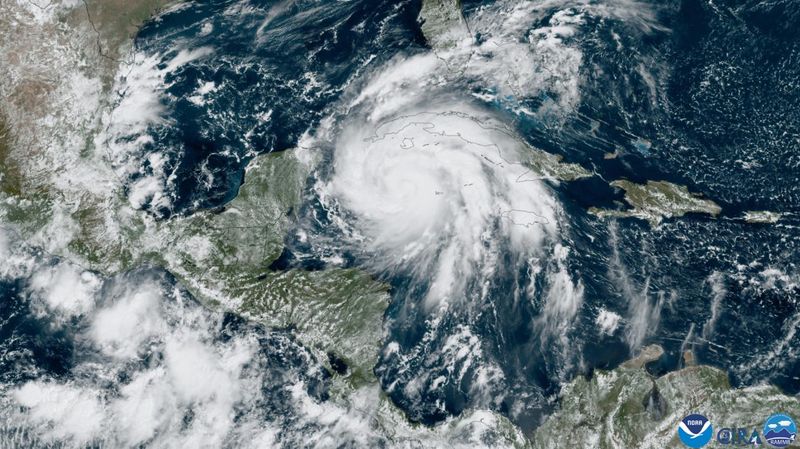
A tropical wave in the forecast is not a reason to panic — but it’s not something to ignore, either.
While it is true that many tropical storms come from tropical waves, most fizzle out and never develop further into tropical storms or hurricanes.

What matters most is the environment they move through — whether conditions support development or prevent it. If conditions are right, a tropical wave can organize and strengthen relatively quickly, sometimes progressing from a broad disturbance to a hurricane within a matter of days. That’s why forecasters continue to monitor them closely and why early awareness matters.
What is a tropical wave?
A tropical wave is a low-pressure disturbance that moves from east to west across the tropics, according to the National Hurricane Center. These systems often bring clusters of showers and thunderstorms as they travel over warm ocean waters.
On satellite imagery, they can appear as an “inverted V” shape or as a subtle kink in the wind and pressure pattern along the trade winds. Forecasters may also see curved cloud structures that reflect this westward-moving disturbance.
The term “tropical wave” comes from how the system travels through the atmosphere and the wave-like pattern it creates in wind and pressure fields, as seen on weather maps and satellite imagery.
How often do tropical waves become storms?
On average, about 60 tropical waves are tracked each year, with relatively little change from season to season — and even though most tropical waves fizzle, they’re worth watching.
According to the National Hurricane Center, about 60% of Atlantic tropical cyclones originate from tropical waves.
Using a typical season with about 14 named storms, that would suggest roughly 8 to 9 storms per year can be traced back to tropical waves. That works out to a probability of about 14% of tropical waves — or one in seven — developing into a named storm.
The connection is even stronger for intense storms. About 85% of major hurricanes (Category 3 or higher) can be traced back to tropical waves. Using the hurricane center’s seasonal average of about 3 major hurricanes, that means about one in 25 tropical waves are associated with a major hurricane.
How does a tropical wave form into a hurricane?
Most tropical waves do not develop further, but they are a common starting point for many Atlantic storms.
For a tropical wave to strengthen, it must move through an environment that supports development. That includes warm ocean water, enough moisture in the atmosphere, and relatively low wind shear — the change in wind speed or direction with height.
As the wave moves westward through the tropics, thunderstorms can begin to organize around an area of low pressure. Rising warm air fuels more storm development, and as water vapor condenses in the clouds, heat is released that helps power the system.
If those conditions persist and the system becomes more organized, it can strengthen from a tropical wave into a tropical depression, then a tropical storm. If winds reach 74 mph, it is classified as a hurricane.
“Whipping up a hurricane calls for a number of ingredients readily available in tropical areas,” the National Hurricane Center wrote. “A pre-existing weather disturbance: A hurricane often starts out as a tropical wave; warm water: Water at least 26.5 degrees Celsius over a depth of 50 meters powers the storm; low wind shear: A large difference in wind speed and direction around or near the storm can weaken it; thunderstorm activity: Thunderstorms turn ocean heat into hurricane fuel.”
Can you predict a tropical wave’s path?
Not exactly.
When a tropical wave is first spotted, forecasters can track its general movement, but its exact path and future strength are still uncertain.
Tropical waves typically move westward across the Atlantic, steered by large-scale wind patterns in the atmosphere, according to the National Oceanic and Atmospheric Administration. In the short term, that gives forecasters a basic idea of direction.
But where a wave ultimately goes — and whether it develops — depends on changing conditions along the way. Warm ocean water, atmospheric moisture and wind shear all influence whether it strengthens, weakens or stays disorganized.
Because those conditions can shift quickly, forecasts for tropical waves become more detailed and more reliable only as the system becomes better organized.
Florida weather watches and warnings
Stay informed. Get weather alerts via text
Brandi D. Addison covers weather across the United States as the Weather Connect Reporter for the USA TO
This article originally appeared on Palm Beach Post: Tropical wave in the forecast? See the odds of it becoming a hurricane
Reporting by Brandi D. Addison, USA TODAY NETWORK / Palm Beach Post
USA TODAY Network via Reuters Connect