As afternoon storms become a regular occurrence, thoughts turn to the trees around our home. You may be wondering if they are safe or if they can hold up against the wind of a thunderstorm, tropical storm, or even a hurricane. While there is no “risk-free” tree, the tree can provide signals, or clues to any defects it may have. A tree does not have to be dead to have structural problems. An observant homeowner with a little knowledge can detect problems in their trees and have them addressed before damage occurs.
Most property damage from trees during storms occurs because of some sort of failure in the structure of the tree. Tree failure can be lumped into three categories: branch failure, trunk failure, and root failure. A periodic tree inspection of the branches, trunk, and root area can reveal problems before they become major ones. To find an ISA Certified Arborist to help with the tree inspection, go to https://www.treesaregood.org/findanarborist/arboristsearch.

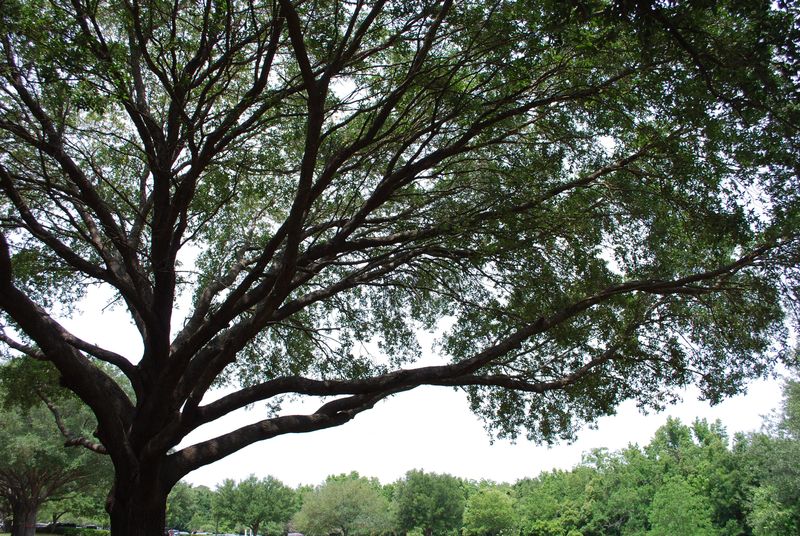
The most common type of tree failure is branch failure. This is also the easiest type of failure to prevent. When you are out in your yard, look up. Take note of any large dead branches. While a small amount of deadwood is to be expected, large dead limbs can cause damage and should be removed.
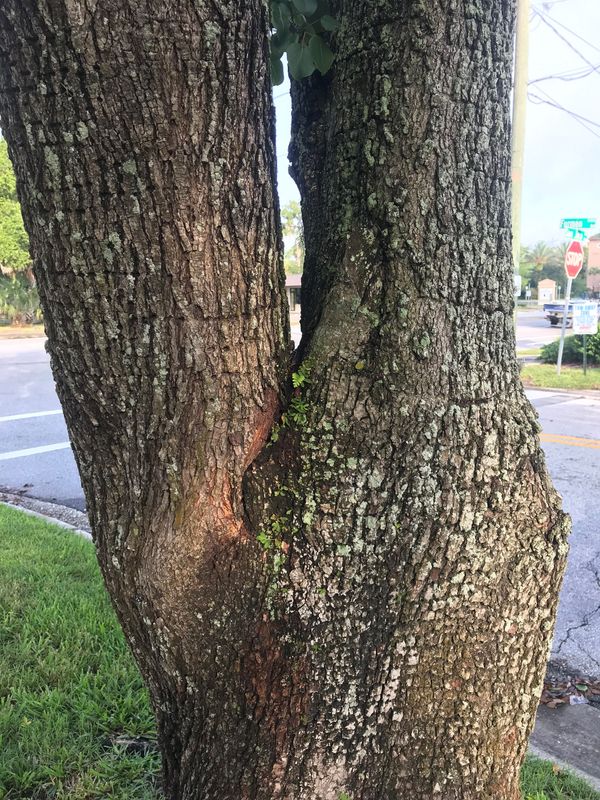
How the branch is attached to the tree is also important. Observe how the major branches are attached to the trunk. If the attachment of the branch looks like a “V” rather than a “U,” it is a weaker branch attachment. The reason V-shaped branch attachments are a problem is that bark gets embedded in the joint as the branches grow together and weakens the attachment.
This condition can be even more of a risk when the tree has more than one trunk. Multi-trunked trees are especially prone to splitting apart because of poor branch attachment.
When maintaining your tree, how your trees are pruned is just as important as whether they are pruned. A myth I often hear is that the tree canopy should be thinned out so that wind blows through the branches instead of against them. While it sounds reasonable, this assumption was proven wrong by research from the University of Florida that examined how trees managed hurricane-force winds. The study showed that improper pruning by thinning out interior branches and raising the crown through the removal of large lower limbs resulted in more damage to the tree during windstorms. Properly pruned trees had considerably less damage than unpruned and improperly pruned trees. Properly pruning trees by using reduction cuts to shorten overextended branches and structural pruning resulted in trees that resisted wind better and therefore received less damage.
Trunk defects are a little harder to detect than branch defects. The most obvious type of trunk defect is a cavity. Large cavities with decay should be inspected. Any vertical crack in the trunk of the tree that goes into the wood of the tree is a warning sign of structural problems, and a horizontal crack is a sign of imminent trunk failure. Any mushroom or mushroom-like fruiting structure coming out of the trunk of the tree is a sign that the tree has internal decay.
If you have cavities, mushrooms, or cracks in the trunk of your tree, the tree should be inspected by a tree professional. Many large, older water oaks and laurel oaks seem to inherently have internal decay. There is no way of knowing how much of the tree structure has been lost to decay without further testing. Some arborists are very good at using a low-tech rubber mallet to figure out the extent of internal defects, while other arborists in our area have specialized equipment such as resistographs and shigometers that can help determine the extent of decay.
At the present time, there is no method to fill cavities or decay in trees that is effective in restoring lost structure to the tree. The arborist inspecting the tree may recommend pruning or cabling to relieve stress on the trunk. However, if the defect in the trunk is serious, removal of the tree may be the only means to solve the problem.
Even though most roots are underground, many root defects can be detected with a little inspection. The part of the root system that bears most of the load in holding the tree up is the root flare. If you picture the tree as a wine glass, the root flare is the base of the wine glass.
The root flare should be readily visible for inspection. Many trees have had their root flares covered by soil during construction or landscape activities. Mulch volcanoes are formed when mulch is piled over the root flare and against the trunk of the tree. Both situations are bad for the tree because it buries the roots and promotes disease. It also makes inspection of the root flare difficult. If the root flare of your tree has been covered by soil, or mulch, it is important to uncover it for a proper inspection.
As with trunk defects, look for any cavities at the base of the tree, or mushrooms originating from the base or roots of the tree as a sign of possible root decay. Any damage to the root flare by construction or other means is a cause for alarm. Recall the wine glass analogy and imagine how unstable the wine glass would be if part of the base were gone.
Finally, the last step in inspecting the roots is to step back away from the tree and look at the uppermost branches of the tree. If they are bare, or not as full as the rest of the tree crown, it may show root problems. A Certified Arborist should be called in to inspect the tree if any problems with the root system are suspected.
There is no way to fully eliminate the risk of a tree falling and causing damage in a storm. Homeowners can significantly reduce the risk with regular inspection of their landscape, by identifying defects in their trees and taking care of them before they become a problem. More information on trees and storms can be found on the University of Florida “Ask IFAS” website at https://ask.ifas.ufl.edu/topics/hurricanes.
Larry Figart is an urban forestry extension agent with the University of Florida/IFAS.
This article originally appeared on Florida Times-Union: Spot dangerous trees in your yard before the next storm hits
Reporting by Larry Figart, For the Jacksonville Florida Times-Union USA TODAY NETWORK / Florida Times-Union
USA TODAY Network via Reuters Connect
By Larry Figart, For the Jacksonville Florida Times-Union USA TODAY NETWORK | USA TODAY Network