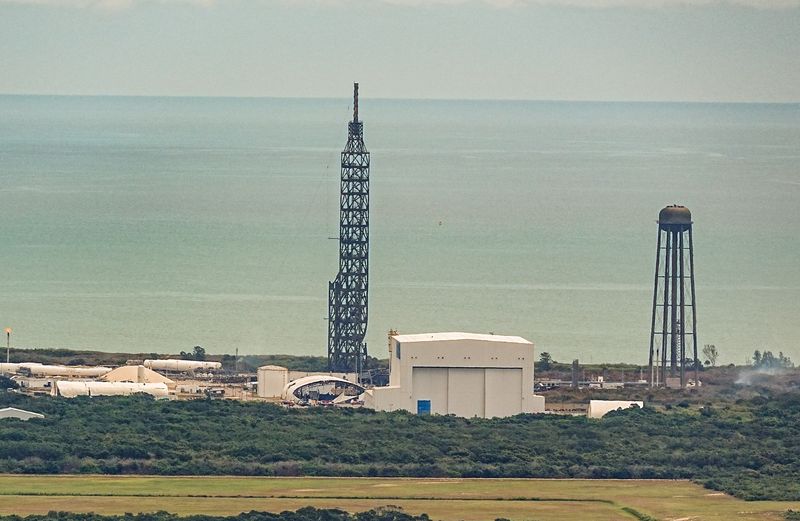
The commander of Space Launch Delta 45 said he was settling in at his Patrick Space Force Base home May 28 with his family when he saw Blue Origin’s New Glenn rocket explode out his window.
He immediately summoned the fire team, activated the county’s Emergency Operations Center and rushed to the Cape to join responders making real-time decisions. No one was injured and officials quickly assured the public there was no threat to them.

“It was spot on across the board,” Chatman said during a June 2 press briefing.
“We’ve got the right safety procedures really laid in to keep personnel safe and to keep the pubic safe when we go through launch operations and we have a major anomaly.”
The May 28 rocket explosion was the largest in Cape Canaveral history. The shockwave so powerful that a seismic activity detector 135 miles away registered activity. The massive New Glenn rocket was undergoing a static fire test ahead of an upcoming planned launch when something went wrong.
The cause still remains under investigation.
Chatman said multiple teams had trained for an event like this and the training paid off.
Blue Origin worked closely with the Space Force from the time the incident occurred until Sunday afternoon, May 31, when the pad was handed back to the company’s control. Blue Origin CEO Jeff Bezos and NASA Administrator Jared Isaacman had inspected the damage via the air over the weekend.
Now Blue Origin will assess destruction, debris removal, and upcoming construction as the pad is rebuilt. Blue Origin CEO Dave Limp said on X that the company plans to launch again by the end of the year.
The blast danger area was canceled on Monday afternoon, June 1, and teams have since been inspecting surrounding areas for damage.
Blue Origin explosion damage to other facilities
The full extent of the damage from the May 28 explosion still remains unknown. Initial inspection found the furthest debris a half mile away from Blue Origin’s pad, Launch Complex 36.
Teams are currently inspecting other surrounding facilities. Windows were blown out in nearby historic Hangar C, which is the oldest assembly facility on Cape Canaveral Space Force Station.
Stoke Space, Vaya Space, and Relativity Space have launch pads nearby. While no damage was reported, Stoke Space officials had said they weren’t back on their pad until Friday, May 29. Their pad is the closest to Blue Origin’s.
Chatman noted that Blue Origin will be responsible for any damage found.
While debris was anticipated to wash up on Brevard beaches, Chatman said he was not aware of any spotted so far. Officials have warned the public to report any debris found, and refrain from handling it, as it may be harmful.
Blue Origin, Space Force move forward
Blue Origin’s launch pad had visible damage. But the company reported that the propellant tanks at the pad were undamaged, as well as the rocket stages stored in a nearby facility.
The Space Force will be on standby support to assist Blue Origin on whether debris is safe to move.
The Space Force will also be responsible for conducting background checks on new personnel the company needs to help rebuild the launch pad.
Cape Canaveral launches to rise in future
Chatman said they continue to expect the number of launches to increase at the Cape. The current estimate: between 500 to 1000 per calendar year by the year 2036. With multiple new rockets launching from the Cape, data gathered from this incident will be useful should a mishap occur again.
“There is some phenomenal data that we collected from the event, and the team will be pulling that together and analyzing that, feeding that into the models that we’ve been working over the last year on LOX methane analysis to give us a much greater perspective on what we expect to see in the future events like this,” Chatman said.
Some of that data is coming internally from Blue Origin.
“Blue Origin also had some sensors and collected data inside their integration facility and is working lockstep with the government, both on the Space Force side and on the NASA side, to help us evaluate and work that data into our models,” Chatman said.
As for now, it remains to be seen how soon the company can rebuild.
Brooke Edwards is a Space Reporter for Florida Today. Contact her at bedwards@floridatoday.com or on X: @brookeofstars.
This article originally appeared on Florida Today: Space Force assesses damage after Blue Origin New Glenn rocket explosion
Reporting by Brooke Edwards, Florida Today / Florida Today
USA TODAY Network via Reuters Connect