MIAMI — A U.S. grand jury has indicted Raúl Castro, among the last surviving comandantes of the 1959 Cuban revolution, for the shooting deaths of four crew members on Brothers to the Rescue aircrafts three decades ago.
Acting Attorney General Todd Blanche and other U.S. Justice Department officials revealed the conspiracy charges against Castro and accomplices he did not identify in his remarks in Miami at an event commemorating Cuba’s independence following the Spanish-American War on Wednesday, May 20.

“For nearly 30 years, 30 years, the families of four murdered Americans have waited for justice,” he said. “The message today is clear: The United States of America and President Trump does not and will not forget its citizens.”
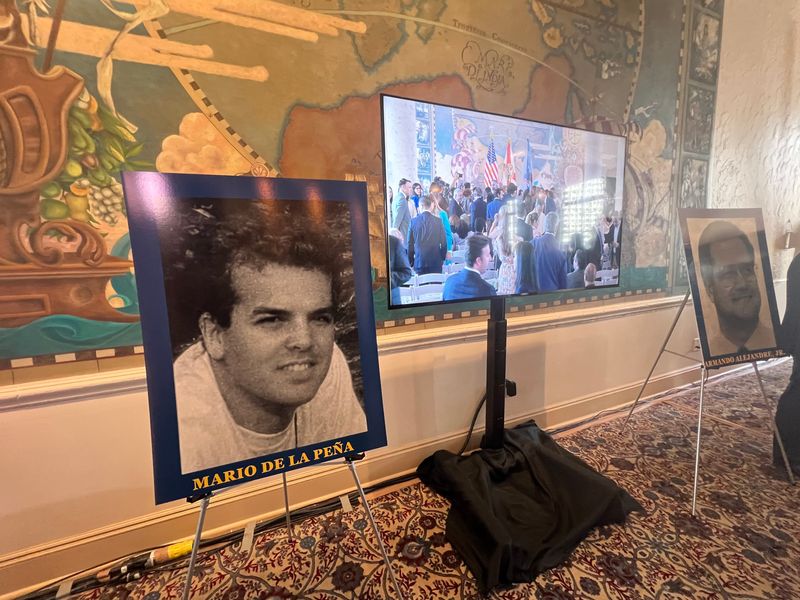
The DOJ’s indictment with conspiracy to kill U.S. nationals, announced by Blanche, was greeted with a standing ovation from the hundreds of people gathered at the Freedom Tower to mark the occasion.
Blanche said the charges also include four counts of murder and destruction of aircraft. The indictment was handed down, he said, by a Miami grand jury on April 23.
The daughter of Armando Alejandre Jr., one of the airmen killed, said the indictment presented a lot of “mixed emotions.”
“Our families, including the families of the other three men, have never stopped looking for justice and for accountability for the crime,” Marlene Alejande-Triane said.
She extolled her father as an American and a Vietnam War veteran who volunteered in joining the U.S. Marines.
“I think about my father every day,” said Alejandre-Triana, who added she learned about his death from a friend while she was a student at the University of Florida. “He volunteered to go into the Marines. And I hope today his country is giving him the justice that he so much deserves, as well as the other three men.”
Why were the Brothers to the Rescue planes attacked?
The gunning down of the two Brothers to the Rescue Cessna propeller planes on Feb. 24, 1996, by sophisticated Soviet-era MIG fighter jets using air-to-air missiles was seen as a barbaric and illegal action.
Video-camera footage shot by passengers on a cruise ship showed plumes of smoke trailing the remains of the planes crashing down into the blue waters.
Four crew members on the aircrafts were killed — Carlos Costa, Armando Alejandre Jr., Mario de la Peña, and Pablo Morales. The action was widely condemned, including by the Clinton administration and global governments and organizations.
Brothers to the Rescue had begun in the early 1990s as a humanitarian aid effort in which volunteer pilots flew routes in the Florida Straits in search of Cuban refugee rafters making the perilous journey to the United States. But soon it ventured into the volatile sphere of the Miami-Havana Cold War.
The group’s pilots ventured into Cuban airspace and territory, where they dropped anti-Castro leaflets. That drew rebukes from Castro’s communist regime and warnings of retaliation. Logistical analysis, however, showed the Brothers to the Rescue Cessnas were plodding along in international airspace on the day of the attack.
But it was most deeply felt in the Cuban-American enclaves of South Florida. The funerals of the four were widely attended. That year’s Carnival Miami events and internationally renown Calle 8 festival, due to be held roughly a week after the attack, were canceled.
Further enraging the Cuban exile and immigrant community was the revelation that one of the Brothers to the Rescue pilots, Cuban Juan Pablo Roque, a former major in the Cuban air force, had disappeared a day before the shooting down of the planes.
Roque was a a Cuban spy who had informed on the Brothers to the Rescue’s plans, and was reportedly also paid by the FBI for information.
After indictment, what’s next for Trump administration, Castro?
The announcement was made during an event at Miami’s iconic Freedom Tower. The ornate, century-old tower stands out in the downtown gleaming bayfront skyline for its role as a resettlement center for Cuban refugees fleeing their homeland after the Havana regime led in part by Castro became a repressive communist state.
Present for the announcement was Sylvia Iriondo, a Cuban-American activist. She had assisted the Brothers to the Rescue organization, and on the day of the attacks was flying in one of the group’s aircrafts, which Cuban fighter pilots did not target.
“Today is a day of hope, a day that marks the beginning of a road for justice, a justice that has eluded the families and our community for 30 years,” Iriondo said. “So we are starting to walk on that path, and we hope that we can, our martyrs can rest in peace. Their families have a resolution, and justice is done, because without justice, there can be no peace.”
Alejandre-Triane said “it would have been nice” for Castro to have been indicted decades ago.
“Justice,” she said when asked what the charges mean to her. “He is one of the main architects of the crime, and if the indictment comes down against him, it’s a piece of the puzzle that we’re looking to solve.”
But when and how the biggest “piece of the puzzle” will be brought before the U.S. judicial system is another unanswered question.
Blanche said the expectation is Castro, 94, will be brought to the United States, voluntarily or not, to face the charges. He noted the the elder Cuban leader has been known to travel, suggesting he could be apprehended elsewhere. He did not specifically comment on the possibility Castro could be seized in a raid by the U.S. military.
Some were reserved in their expectations for justice in this case.
Ahead of the indictment, a former top aide to Trump, John Bolton, agreed the Trump administration telegraphed it was eyeing the Venezuela blueprint. But whether seizing Castro would be equally doable was a different matter, he said.
“Obviously, I think what the administration is thinking of is running the same playbook they ran against Maduro in Venezuela,” said Bolton, who was national security adviser during the Trump’s first term. “And I don’t know that that’s going to work the same. It’s a different situation.”
For starters, Bolton said Cubans on the island and Cuban-American immigrants and exiles outside it have plainly stated their demand that the current Havana regime be ousted. As such, they may not accept a Venezuela-type arrangement where the second in command to Maduro, Delcy Rodríguez, was put in power after U.S. forces captured leader Nicolás Maduro.
Rosa María Payá, founder of the Cuba Decide grassroots initiative, told The Palm Beach Post on May 6 that opposition and pro-democracy groups in Cuba are more than capable of governing after a regime change.
She highlighted the different aspiration for handling “a transition in Cuba and the difference in the way that it is being established in Venezuela.”
Bolton also voiced doubts that either Cuba’s current president, Miguel Díaz-Canel, or Raúl Castro might be inclined to surrender like Maduro did.
“Especially as they look at what happened to Maduro, Miguel Diaz Canal is not going to walk up and say, ‘OK, fine, I’ll be happy to go to the U.S. as a hostage,’ and you can bet Raul Castro isn’t about to do that either,” Bolton said.
Also, unlike Maduro, Bolton said Castro is no longer the head of state, though he remains a symbol of the Cuban Revolution. Bolton also noted the grim state of the Cuban economy, and the presence of what appear to be small but persistent protests across the country.
“It could be they’re really on the verge of a breakthrough,” Bolton said, but he cautioned the Trump government saying, “I just hope, unlike Venezuela, they thought through or carefully exactly how this this is going to work.”
Bolton also said the domestic “political play” in Cuba for Trump is far different than it was in Venezuela, but the president may not have yet recognized that.
“Given the sentiments in the Cuban-American community, he may not realize it, although I assume Marco Rubio is telling him that,” said Bolton, referring to Trump’s secretary of state. “He just may not have gotten through to it.”
Others had voiced legal skepticism about the ability to prosecute the case.
Adolfo Garcia also pointed to another major difference. The indictment of Maduro involved accusations of narco-trafficking, which Garcia said is globally recognized criminal or “illegal conduct.” The case against Castro deals with a military action, he said.
“That makes it a more difficult case, as I understand it,” said Garcia, an international law attorney who specializes in advising multinational corporations on doing commerce with and investing in Cuba. “Not to mention, you don’t have the element of surprise as you did with Maduro.”
Antonio Fins is a politics and business editor at The Palm Beach Post, part of the USA TODAY Florida Network. You can reach him at afins@pbpost.com. Help support our journalism. Subscribe today.
This article originally appeared on Palm Beach Post: Raúl Castro indictments unsealed in Miami at Freedom Tower event
Reporting by Antonio Fins, Palm Beach Post / Palm Beach Post
USA TODAY Network via Reuters Connect