If you’re starting to feel like Florida is auditioning to the next setting for a Jurassic Park movie, you’re not alone.
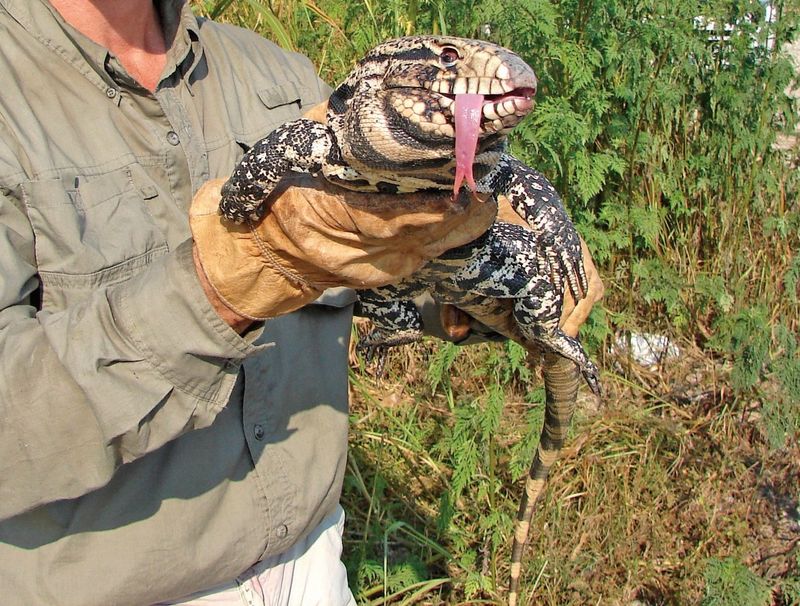
Just when we got used to seeing those large curly-tailed lizards that arrived in Central Florida a few years ago, the orange-headed Peter’s Rock Agama started appearing. Now, there are reports that another lizard, the three-to-five-foot-long Argentine Tegu, are spreading through the Sunshine State.

What? A three-to-five-foot lizard in the backyard? That news comes on the heels of news that the pesky Burmese Pythons are moving north from the Everglades and setting up permanent homes throughout the state.
The Tegu, timid by nature but potentially aggressive if cornered, are scattered as far North as Maryland, according to my colleague Jim Waymer but are spreading quickly ― and thriving ― in Florida.
On June 12, the city of Cape Canaveral urged on its Facebook page for residents to report Tegu sightings to Florida’s Exotic Species Hotline (1-888-483-4681).
As if alligators weren’t enough, right? Now the Tegu are not the only new large predator to worry about spreading throughout Florida.
The 10-day Florida Python Challenge that started July 10 is just about over. Hunters from all over have converged in South Florida to eliminate as many pythons as they can in exchange for cash prizes, including a $10,000 grand prize to the hunter who kills the most snakes.
The apex predator, also an invasive species not native to Florida, has been known to eliminate most mammals once they come into an area. They’ve been known to eat possums, alligators, birds, racoons and even deer and bobcats.
Waymer also reports that scientists with the University of Florida continue finding “python genes in soil and waters farther north.” That means higher latitudes and hard freezes are not stopping the python spread as once believed.
And so that brings me to the Question of the Week.
Just how concerned are you about pythons, Tegu lizards or some other yet-to-be-named reptile calling Florida home?
You can scan the QR code that is on the print edition page or go to https://www.floridatoday.com/opinions-columns/. Please leave a comment telling us why you voted the way you did. In order for your comment or email to be published on our website and in next week’s print edition, you must include your first and last name and please include your town/city of residence in the body of your comment. You can also shoot me an email with “PYTHONS” in the subject line. I look forward to reading your responses.
And as always, thanks for participating.
Contact Torres at jtorres@floridatoday.com. You can follow him on X @johnalbertorres. Florida video editor Rob Landers contributed to this report.Support local journalism and become a subscriber. Visit floridatoday.com/subscribe
This article originally appeared on Florida Today: Pythons aren’t Florida’s only problem. Giant tegus are here
Reporting by John A. Torres, Florida Today / Florida Today
USA TODAY Network via Reuters Connect
By John A. Torres, Florida Today | USA TODAY Network