At the start of the 21st century, the beaches immediately south of Port Canaveral were much thinner than now.
For decades, the port’s jetties blocked the natural flow of sand onto the beaches. By the 1990s, the beach was several feet lower than nature intended and desolate of the grasses and other plants that anchor dunes in place.

Absent enduring dunes, oceanfront owners often relied on the several feet of exposed storm-battered seawall to protect their properties.
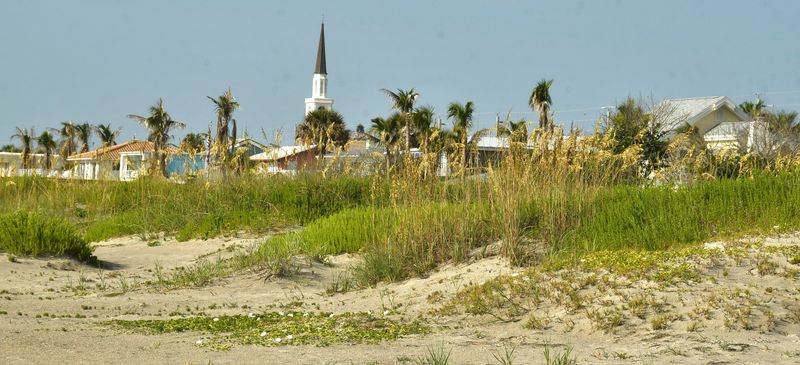
But after a quarter-century of federally funded beach renourishment, the dunes and beach have grown to guard property and wildlife far beyond expectations, to the delight of locals and tourists alike.
“Really impressed with the dunes,” said Laura Scott, who crossed much narrower dunes the first few years she lived in Cocoa Beach in the late 1990s. Walking out now near Lori Wilson Park, she and others find a cornucopia of sea grape canopies, sea oats and other wildlife among rolling mounds — a sandy renaissance that dredges and millions of dollars delivered. “Over the last couple years we haven’t had too many bad storms, so really the (beach) renourishment has been good.”
As hurricane season peaks, more mega-storms form and sea level and insurance rates keep rising, Brevard’s quarter-century mission to bring back healthy dunes is paying dividends for property owners, beachside businesses and wildlife. Massive ongoing efforts to replant sea oats and other native vegetation also helped secure the dunes, as did the chronic stinky sargassum seaweed that laps up to the foot of the dunes, helping plants take root.
Class action sets stage for fatter dunes
This dune revival wasn’t cheap and might not have happened at all, were it not for a class-action lawsuit that secured most of the Space Coast’s shoreline with a 50-year federal commitment to beach renourishment. Federal officials estimate even the county’s most complex, expensive beach renourishments that have to work around nearshore rock reefs in Satellite Beach and Indian Harbour Beach outweigh the renourishment costs by a 3:1 ratio.
“Dune planting never hurts, and accumulating sargassum helps too, but what truly allowed the dune to thrive in Cocoa Beach was building a beach wide enough (adding sand) to shelter the dune from wave impact in all but the largest storms,” Mike McGarry, Brevard’s beach renourishment coordinator, said via email.
Port Canaveral and its jetties, built by the Army Corps of Engineers, had been eating away beaches to the south since the inlet was first cut in the early 1950s. In the 1990’s a group of coastal property owners sued the federal government claiming that the lost sand amounted to land taken by the government.
The legal battle ended in 1999 with the feds agreeing to a half century of sand beach renourishment from the port to Melbourne Beach.
Now, thriving sea grapes, sea oats and sometimes even seaweed help to set the dunes in place. They guard thousands of properties and billions in tourism dollars that concrete and rock sea walls could not. Many of those old walls now barely poke above all the sand that’s built up via dredges, trucks and millions in tax dollars.
The legal battle employed a unique application of condemnation law, winning a thick shield of sand for thousands of residents in the communities south of Port Canaveral.
The battle drew big names, including the late Al Neuharth, founder of FLORIDA TODAY and USA Today.
In a December 2000 interview, Neuharth told FLORIDA TODAY that he’d discussed the idea of a lawsuit against the U.S. Army Corps of Engineers with Malcolm Kirschenbaum, a prominent Cocoa Beach attorney, after another bad storm had battered local beaches in the early 1990s.
“I suggested to him that some good lawyer or law firm ought to pro bono,” Neuharth said in 2000. The risks were mostly financial for Kirschenbaum’s firm.
Three attorneys — Gordon “Stumpy” Harris, Malcolm’s brother, Jack Kirschenbaum, and Mason Williams — worked on the complaint alleging that the U.S. Army Corps of Engineers illegally took land from hundreds of property owners by causing beaches to tumble into the ocean. All three attorneys lived or owned property in Cocoa Beach.
Their reasoning was simple: When the government builds a dam along a river, it must compensate property owners who lose land to flooding caused by the structure. So why not apply the same concept to down-drift beach erosion caused by Port Canaveral being dredged and jetties constructed in the 1950s.
Ultimately, more than 300 plaintiffs joined the suit, including the cities of Cape Canaveral, Cocoa Beach and Satellite Beach.
After a decade of legal wrangling, in late October 1999, the federal government offered a 50-year ‘as-needed’ beach renourishment project and a $5 million settlement to the property owners. Under the deal, the Corps would restore 13 miles of coastline south of the port.
Natural dunes best but Brevard’s manmade dunes mimic nature
Prior to the beach renourishment projects, property owners fought the ocean for decades with boulders, concrete sea walls and other coastal “armoring.”
A 2024 study, partially funded by NASA and led by Bethune-Cookman University in Daytona, looked at whether natural or “armored” dunes in east Central Florida bounced back better after Hurricanes Ian and Nicole in 2022. They found natural dunes “not only exhibited more adaptability and recovery in dune vegetation than armored dunes, but also showed lower impacts in terms of elevation change.”
The seawalls and boulders still are there on the beaches south of the port. But now they are buried under feet of sand and coastal flora.
“In my opinion removing the old walls would cause too much disturbance,” McGarry said. “It seems OK to just leave them hidden deep in the western edge of the dune.”
Cocoa Beach barely flinches from Nicole
Hurricane Nicole in 2022 drew harsh lines between the sand ‘haves’ and ‘have nots.’ The day after the storm, one could hardly tell Nicole had hit Cocoa Beach. The storm left behind wet sand on dune crossovers, small gullies that cut between grassy spots on the dunes and high-tide mark farther up the beach than usual.
But homes still perched safely behind thick, grassy dunes 20 or more yards wide above another expanse of sand sloping gently to the ocean.
Just a few miles south, in Satellite Beach and Brevard’s southern beaches, the shoreline looked far different. For environmental and other reasons, those beaches hadn’t seen the large-scale sand-pumping projects like the 13 miles of beach south of Port Canaveral.
At least nine houses, condos and motels had to be declared uninhabitable by the county because they had been undermined by beach erosion.
Nicole erased much of the dune in front of Oceana Oceanfront Condos in Satellite Beach, built just three years earlier. Waves pounded right up to much older homes along Shell Street. At Sandpiper Towers, built in 1964, ankle-deep ocean flowed through the parking garage underneath the condo.
Even farther south, properties in Melbourne Beach were also devastated.
Rising seas, environmental restrictions drive dune size
Rising seas play a role in beach erosion, too, and that’s accelerating.
Research in recent years shows the rate of sea level rise along Florida’s Atlantic coast, including the Port Canaveral area, has increased to 6 to 7 millimeters per year, up from about 2 millimeters per year in the early 1900s.
Even in the best of times, the beaches south of the Pineda Causeway show much more severe erosion than those in Cocoa Beach and Cape Canaveral.
Most of Brevard’s coastline from Cape Canaveral through Melbourne Beach is eligible for sand replenishment, via long-standing, federally approved projects under the U.S. Army Corps of Engineers that resulted from the lawsuit.
But beaches at the far southern end of the county get significant sand replacement projects after storms only when the Federal Emergency Management Agency deems their shores worthy of emergency repairs.
Where does the sand come from?
Sand for the North Reach and South Reach (Cape Canaveral, Cocoa Beach, Indialantic and Melbourne Beach) most often is delivered directly by dredges, which suction up sand from the seafloor offshore and pump it onto the beach.
But in the Mid Reach, the 7.6 miles of beach between the southern border of Patrick Space Force Base and Flug Avenue in Indialantic, sand is hauled to the beach by truck in smaller doses, to minimize any burial of near-shore coquina rock reefs that the federal government deems “essential fish habitat” and that are substrate habitat for the protected marine worm.
And the county’s southernmost beaches lack the population and public access to qualify for large-scale renourishment, so the county floated the idea of creating a special tax district to have homeowners to pay for the new sand, though it decided to use tourism tax dollars for some dune repair work following Hurricane Dorian in 2019.
Dune wildlife rebounds
Due mostly to overharvesting for meat and eggs but also in part to dune erosion, the green sea turtle was so far gone here and elsewhere, biologists feared they’d never bounce back.
The eroded, lower dunes also allowed lights from homes and businesses to shine down on the sand, disorienting nesting and hatchling turtles, causing them to abandon nesting or the hatchlings to wonder into beach roads instead of toward the moonlit ocean.
But after beach renourishments and ordinances that restricted lighting on the beach, green sea turtle populations rebounded. Other turtle species thrived, too.
Research after hurricanes shows threatened and endangered beach mice can reoccupy restored dunes when primary dunes and coastal strand vegetation recover.
And even bobcats have been seen in recent years, living along dunes that once washed over. Now there’s plenty for them to hunt there, too.
“The dune grass and everything is great,” Scott said during her recent day surfing at Cocoa Beach, “so love seeing little baby bunnies and everything around.”
Contact Waymer at 321-242-3663 or jwaymer@floridatoday.com. Or find him on Twitter: @JWayEnviro.
This article originally appeared on Florida Today: Brevard’s sand dune revival guards property and nature
Reporting by Jim Waymer, Florida Today / Florida Today
USA TODAY Network via Reuters Connect
By Jim Waymer, Florida Today | USA TODAY Network