Trees are one of the few appreciating assets in life, offering many benefits like increasing your home’s value, reduction in home heating and cooling costs, filtration of pollutants in the air, provision of oxygen, improved mental health, and countless other benefits.
As trees continue to grow, so do the magnitude of their benefits. When planting a new tree, the extent to which all of these benefits can be reaped begins with the selection of a good tree from the nursery that will thrive in its planted environment.

Selection of a “good tree” implies that, if not careful, you could end up with a real “bad apple” instead. It might be more appropriate to say that the alternatives to a “good tree” are various gradients and types of “less good” trees, rather than a black and white, good/bad, dichotomy.
Although some trees at the nursery can have so many issues, calling them unequivocally bad is probably appropriate.
Three factors for selecting a tree
The formula for ideal tree selection essentially boils down to three factors.
First, selection of a species that will match the conditions and limitations of the desired planting site, often referred to as “right plant, right place.”
Health and structure of the tree, the second and third factors, are often lumped together.
However, I think it is helpful to tease them apart because any given tree at the nursery could be in excellent health, but have terrible structure, or vice versa.
Determine planting site
Start by determining your planting site and find answers to important questions like: “How much sunlight will this area receive?”; “Is the soil typically saturated, dry, or somewhere in between?”; “How tall and wide do I want this tree to become at maturity?”; “Can this site accommodate that size tree?”; “What is our USDA cold hardiness zone? (Spoiler: it is 9a for most of north Florida.)”; “Is there enough soil volume to support the necessary root growth for the desired size tree?”
There are many other more specific questions that could be asked, but starting with these core questions will get you well on your way to selecting the right plant for the right place.
In addition to answering these questions, it is a good idea to submit a soil sample for analysis. Results from this analysis will tell you the nutritional content of the soil, but more importantly it will reveal the soil pH. This is important because some trees may grow extremely well or extremely poorly depending on the pH of the soil.
Matching your tree
After compiling answers to these questions, it is now time to start researching trees that will match your site conditions. Online tools like the UF/IFAS Florida Trees website (floridatrees.ifas.ufl.edu) and the NC State Plant Toolbox (plants.ces.ncsu.edu) are two great resources that can be used from home.
These tools typically reference a wide array of common and rarer plant varieties, some of which are not readily available in most garden centers.
For this reason, sometimes the most effective way to select a tree variety is to take the information that you gathered using the aforementioned tools and share it with one of the plant experts at your preferred local garden center. These experts typically have an extensive understanding of what thrives in this environment, as well as what is in stock or available within our market.
Pick a healthy tree
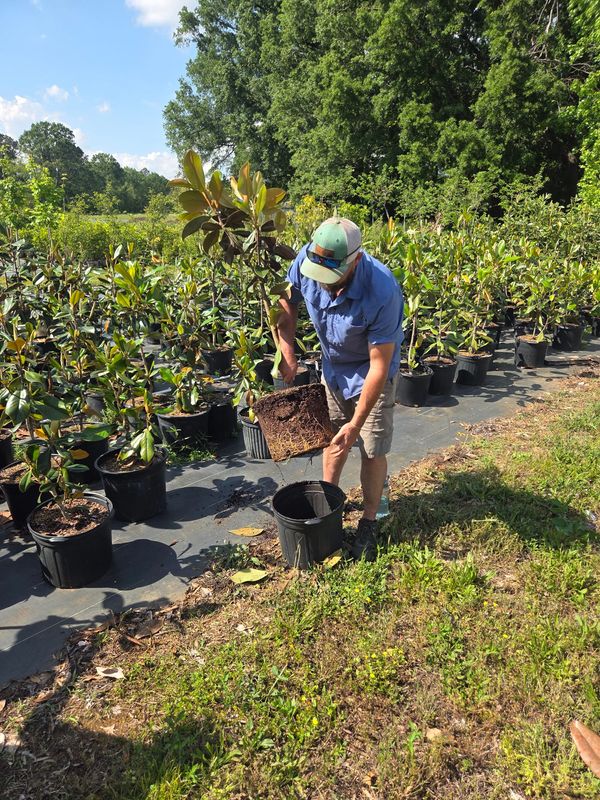
Once you have homed in on your desired species and are standing in front of it at the nursery, it is time to start evaluating the available trees of that variety for their health and structure.
Health factors include things like signs of pest chewing or boring activity on leaves and stems respectively, dieback of twigs or discoloration/necrosis of leaves in the crown, mechanical damage to the trunk or branches such as breakage or scraped bark, and foul-smelling or dark brown roots visible on the outer portions of the rootball.
Trees with any of these conditions should be avoided if possible. A healthy tree should have leaves that are appropriately colored for the species, indicating good nutrition and a lack of environmental stress such as sunscorch, drought stress, or cold damage.
Trees with a multitude of poor health factors may be able to be nursed back to health but are much more likely to struggle through the establishment process for the first several years after planting or simply die.
Evaluate tree structure
One last important factor to consider is tree structure. Trees that will mature at heights over 35 to 40 feet benefit from having a single dominant trunk with smaller diameter scaffold branches coming off of it (visualize the structure of a Christmas tree).
This characteristic will lead to strong branch attachments that are less likely to break as the tree matures and branches become heavier. Trees that have two or more stems of similar diameter originating at the same point below the midpoint of the tree should be avoided if possible.
The stem structure of trees that mature under 35 to 40 feet tall, such as Japanese maples and crape myrtles for example, does not matter as much because the stems will not become as heavy compared to those of large maturing shade trees.
Moving downward to the roots, it is best to select trees that are neither severely pot-bound with circling roots nor insufficiently rooted to the point where the stem moves around freely within the rootball. Severely pot-bound trees may never fully form properly developed structural roots that help anchor the tree to the ground. Roots of trees that are poorly rooted in the rootball can be easily torn or broken during planting, stunting or killing the plant before it can become fully established.
In conclusion, selecting a quality tree begins with a good understanding of the planting site and then selecting a species that will thrive under those conditions. Next, conducting an informed inspection of the trees at the nursery will help to discover any health or structural concerns. It can be difficult to find a tree with perfect structure and health; therefore, the goal should be to avoid any trees with major concerns and select the tree that is in the best overall condition. This step in the tree planting process is important, and following these guidelines is sure to help set your tree up for success.In a future article we will take a closer look at best practices and common mistakes to avoid when it comes to actually planting your trees.
Daniel Greenwell is an ISA Certified Arborist with Bartlett Tree Experts and is a volunteer writer for UF/IFAS Extension Leon County, an Equal Opportunity Institution. For gardening questions, email the extension office at AskAMasterGardener@ifas.ufl.edu
This article originally appeared on Tallahassee Democrat: Planting a tree? Here’s how to pick a good one for your yard
Reporting by Daniel Greenwell, Guest columnist / Tallahassee Democrat
USA TODAY Network via Reuters Connect