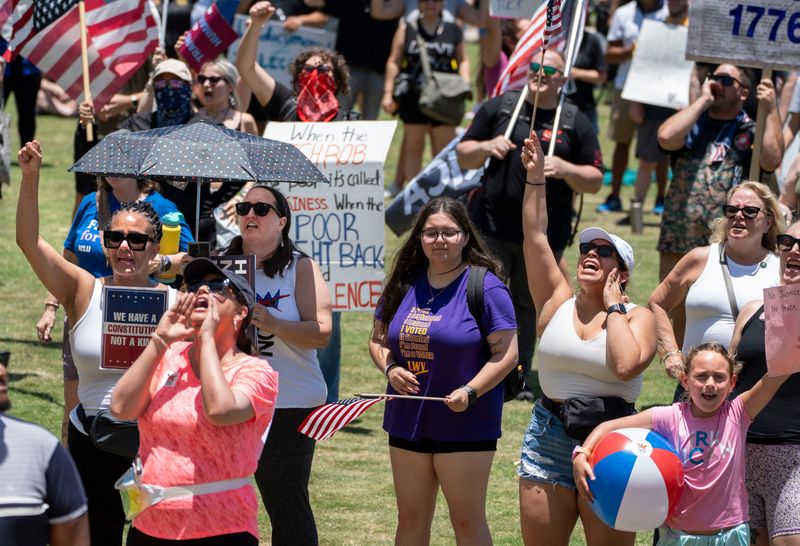
On Saturday, Oct. 18, thousands of Floridians are expected to show up at more than 80 “No Kings” protests around the state to voice opposition to President Donald Trump, his policies, the escalating immigration raids by U.S. Immigration and Customs Enforcement (ICE), and the president’s attempts at deploying National Guard troops to Democrat-controlled cities. There are about 2,500 such protests planned across the nation.
Protests are protected by the First Amendment, but Florida protesters may want to keep an eye on the road.

In June, ahead of the last “No Kings” protests, Gov. Ron DeSantis said Floridians have the right to hit protesters with their car if they felt threatened, and state and local officials said “rioting” could bring jail time, or even death.
“We also have a policy that if you’re driving on one of those streets and a mob comes and surrounds your vehicle and threatens you, you have a right to flee for your safety,” DeSantis said on The Rubin Report on June 11, “and so if you drive off, and you hit one of these people, that’s their fault for impinging on you.”
Brevard sheriff warned protesters: Florida is ‘anti-riot’ state
Brevard County Sheriff Wayne Ivey was even more direct.
“If you throw a brick, a fire bomb, or point a gun at one of our deputies, we will be notifying your family where to collect your remains, because we will kill you, graveyard dead,” he said at a June press conference.
If you plan to attend or participate in a protest in Florida, here’s what you should know.
Is protesting legal in Florida?
Public protests are protected in the United States by the First Amendment and are legal in public areas providing you are not blocking car or pedestrian traffic or blocking access to government buildings.
However, Florida laws further restrict where protests can happen, and they come down hard on anything law enforcement perceives as rioting. A sweeping “anti-riot” bill in 2021 was temporarily blocked in the courts for being potentially unconstitutional, chilling against free speech, and overly vague about what defines a “riot” but the Florida Supreme Court ruled in favor of the new law in 2024 and an appeals court allowed the state to enforce it.
As of this year, Florida also has the HALO Law which requires everyone to move 25 feet away from a first responder, including law enforcement, if asked to. The law is intended to protect first responders but critics worry that it will prevent anyone from shooting video or pictures of ICE arrests or police brutality.
What are Florida laws regarding protests?
The law “does not prohibit constitutionally protected activity, such as a peaceful protest,” according to Florida statutes. That said, the state does have restrictions:
Can I shine laser pointers at helicopters in protest?
Absolutely not.
In Portland, where protesters have been jeering at ICE operations, often while wearing silly inflated costumes (or nothing at all), a self-proclaimed anarchist group has urged people to “unleash your beam” and aim laser pointers at police helicopters. Portland activists were quick to condemn the practice on social media.
This is extremely dangerous, as it can distract and disorient pilots and endanger the lives of not only everyone on board but also anyone on the ground underneath the aircraft. The Department of Homeland Security (DHS) issued a statement vowing to track down anyone doing this.
Under Florida law, intentionally pointing a laser light device at a person operating an aircraft, motor vehicle or marine vessel is a third-degree felony punishable by up to five years in prison. If the act results in bodily injury, it becomes a second-degree felony punishable by up to 15 years.
Anyone accused of misusing a laser device may also face federal charges and a fine from the FAA.
Is it legal to hit a protester with your car in Florida?
Florida law does not specifically say people can drive into crowds.
But it does provide civil (not criminal) immunity by allowing anyone charged with causing property damage, personal injury or even death to plead self-defense because their actions “arose from” someone “acting in furtherance of a riot.”
“You don’t have to sit there and just be a sitting duck and let the mob grab you out of your car and drag you through the streets. You have a right to defend yourself in Florida,” DeSantis said in June.
Between May and October 2020, there were over 100 incidents of drivers driving into crowds of protesters, and at least eight of them were in Florida, Vice.com reported.
I’m going to a protest. How can I protect myself?
First and foremost, the “No Kings” website tells participants not to bring any weapons, to act in accordance with local laws, and de-escalate any potential confrontation with law enforcement or anti-protesters.
The organization is hosting an ACLU rights and de-escalation training call for event hosts on Oct. 15.
The Human Rights Campaign advises protesters to scope out the area of the protest ahead of time and identify multiple routes out of the area. An offline-accessible map can help. During the protest, remain aware of your surroundings and what’s happening around you.
What should I bring to a protest?
Protest signs and sunscreen are just the beginning, especially if you’re in a place where confrontations are expected. Experts at Physicians for Human Rights suggest bringing the following:
Many organizations advise protesters to leave their phones at home to protect their privacy as they can easily be tracked. If you must take your phone, keep it turned off until you need it and, before you go, disable Face ID or fingerprint security and stick with the 6-digit passcode instead. You may also consider buying a cheap secondary phone to use.
Where can I find a No Kings protest near me in Florida?
According to the No Kings website, more than 80 protests (including more than one in some cities) are planned across Florida as of Oct. 14.
You can see the full list here.
When protesting, know your rights
According to the ACLU of Florida, the First Amendment generally prohibits restrictions based on speech content; however, the the Constitution doesn’t completely protect all types of speech in every circumstance. Threatening someone with violence is not protected, and government officials can place “reasonable” restrictions on the time, place and manner.
Your rights are strongest in “traditional public forms” such as streets, sidewalks and parks, but you can be asked to disperse if you are blocking car or pedestrian traffic. You may also protest at government buildings as long as you don’t block access to them or interfere with the purpose of it.
Can I take photographs or video at a protest? What is Florida’s ‘HALO’ law?
When you are lawfully present in a public space, you have the right to photograph or video anything in plain view, including federal buildings and the police, the ACLU said.
Law enforcement may not confiscate your photos or video without a warrant and may not demand you delete anything, but they can order you to stop if you’re interfering with legitimate law enforcement operations.
In Florida, that can be a wide definition. The “HALO” law (Honoring and Listening to Our Officers) went into effect in January.
Under the law, if a first responder such as law enforcement, firefighters and medical personnel ask you to back off in the course of their duties, you must move 25 feet away or face a second-degree misdemeanor charge punishable by up to 60 days in jail or a $500 fine.
(This story was updated to add new information.)
This article originally appeared on Palm Beach Post: ‘No Kings’ protests planned in Florida. Know these Florida laws, safety tips before you go
Reporting by C. A. Bridges and Samantha Neely, USA TODAY NETWORK – Florida / Palm Beach Post
USA TODAY Network via Reuters Connect