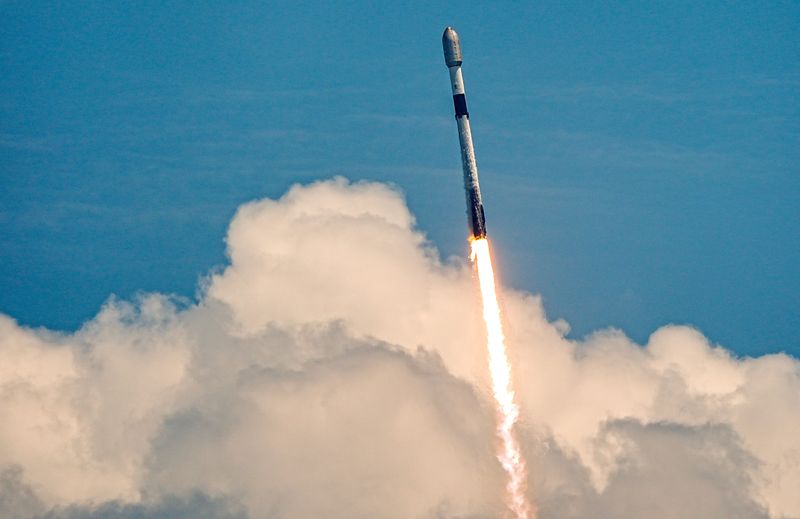
SpaceX rockets have become a weekly ritual on the Space Coast, sometimes averaging two Falcon 9 launches per week. However, that rumble has suddenly gone quiet, raising the questions: What’s going on and when is the next rocket launch from Florida?
The last rocket launch was Friday, May 1, and the next one is not expected until May 12. Such a gap is unusual.

Last year, SpaceX’s Falcon 9 made up 101 out of the 109 launches out of Florida. Yet here we are into the fifth month of the year and the Space Coast has seen a launch count only into the 30s.
As of right now, the next liftoff from Florida is no earlier than 7:16 p.m. Tuesday, May 12 from Launch Complex 40 at Cape Canaveral Space Force Station. A SpaceX Falcon 9 rocket will send a resupply cargo Dragon spacecraft full of supplies and science to NASA’s current crew onboard the International Space Station. The mission is known as SpaceX CRS-34.
Why are the launch ranges so quiet?
SpaceX only has one launch pad for Falcon 9 rocket launches
While SpaceX is currently preparing for a NASA launch, other factors come into play.
SpaceX has transitioned all Falcon 9 rocket launches to one launch pad, Launch Complex 40 at Cape Canaveral Space Force Station. This move comes as the company works to finish up the Starship launch pad at Kennedy Space Center Pad 39A ahead of a possible launch from the site by the end of the year.
In February, SpaceX removed the crew access arm from the Falcon 9 launch tower at 39A, moving all astronaut launches over to Launch Complex 40, which had a crew access arm installed back in 2024.
While still only launching from Texas, SpaceX’s massive Starship is expected to launch from Florida this year. The launch site at Kennedy Space Center Pad 39A is almost complete and work at Launch Complex 37 in Cape Canaveral is underway
For now, Kennedy Space Center Pad 39A is exclusively designated for the rare Falcon Heavy launches. The last launch from the pad was on April 29 when a Falcon Heavy rocket launched the ViaSat-3F 3 satellite. The next publicly announced launch atop a Falcon Heavy from the site will be NASA’s Nancy Grace Roman Space Telescope, currently set for as soon as September.
Shifting to Starship, SpaceX has only one drone ship
SpaceX is now down to only one drone ship to recover its Falcon 9 first stage boosters. These drone ship are stationed in Atlantic Ocean for a booster landing and recovery after liftoff.
The “Just Read the Instructions” drone ship returned with the first stage booster from the April 21 launch of the GPS III mission, sailing into Port Canaveral April 23. According to SpaceX, it would be the last time this specific drone ship carried a Falcon 9 booster. Now it will prepare to support Starship operations.
“With 39A becoming a primarily Falcon Heavy and Starship pad, we don’t actually need two operational droneships on the East coast to maintain our Falcon manifest,” SpaceX VP of Launch Kiko Dontchev wrote on X. “Think of pads/drone ships like airplane runways where you need a landing runway for each takeoff runway (ideally they are the same runway I.e. starship).”
While SpaceX has Landing Zones 2 and 40 in Cape Canaveral to support Falcon 9 landings, it has not revealed much detail about whether it intends to use those more. Starlink internet satellites are the most frequently launched payload from Cape Canaveral. Due to the weight of the Starlink satellites launched − upwards of 29 at a time − and fuel needed per flight, the company has always chosen to land the first stage on drone ships out at sea.
While it is unknown when SpaceX’s cadence will pick up again, two other rocket companies are also seeing a lull in launches.
Blue Origin and ULA see rocket issues
Both Blue Origin and United Launch Alliance (ULA) have ongoing investigations into their rockets after recent mishaps during flight.
While United Launch Alliance’s Atlas V rocket is still launching, most recently a batch of Amazon Leo internet satellites, the company’s Vulcan rocket is currently down. The Vulcan incident occurred when a Feb. 12 launch for the Space Force saw a solid rocket booster issue. While the spacecraft made it to orbit, sparks flew from the area of the solid rocket boosters shortly after liftoff.
“The USSF SYD 80 team will work closely with ULA per our mission assurance space flightworthiness process before the next Vulcan national security space mission,” a statement from the Space Force read.
It remains to be seen when the next Vulcan launch will be. Vulcan is poised to eventually replace the company’s Atlas V and already retired Delta IV.
Meanwhile, Blue Origin’s New Glenn rocket encountered a problem as well.
The company, founded by Jeff Bezos, saw its New Glenn orbital rocket launch a payload from Cape Canaveral for the third time on April 19. While the rocket’s first stage carried out the flight well and even successfully pulled off a second booster landing, the rocket’s upper stage did not perform as expected. As a result, the payload, an AST SpaceMobile satellite, was deployed into a low orbit. This led to the loss of the satellite and an investigation into the rocket’s upper stage issue.
It is currently unknown when New Glenn will fly again. On May 4, the company rolled its third booster from the Merritt Island facility to the Cape Canaveral launch site.
Brooke Edwards is a Space Reporter for Florida Today. Contact her at bedwards@floridatoday.com or on X: @brookeofstars.
This article originally appeared on Florida Today: Next SpaceX launch is not for a week: Why Florida rocket launches are quiet
Reporting by Brooke Edwards, Florida Today / Florida Today
USA TODAY Network via Reuters Connect