The ninth, and last, Florida-Friendly Landscaping principle is to Protect the Waterfront.
Brevard County has a large amount of waterfront property, heavily populated along the Indian River, Sykes Creek and Banana River. The only waterbody still in its natural state is the Mosquito Lagoon. The Indian River Lagoon (IRL), in its entirety, stretches 156 miles from Ponce De Leon Inlet in New Smyrna Beach south to Jupiter Inlet near West Palm Beach. Brevard County contains approximately 71% of the IRL’s area and nearly half its length. The Indian River Lagoon includes the Mosquito Lagoon, Indian River, and Banana River.

If you live directly on any portion of the Indian River Lagoon, there are multiple ways to protect the waterbody that borders your yard. Check out the suggestions below to see if there are any new ones that you can implement in your yard!
Many yards bordering the Indian River Lagoon have bulkheads for smaller properties or seawalls for larger properties constructed to protect the property from erosion, flooding, etc. Seawalls can be constructed from concrete, wood, metal, or rip-rap. Whereas many seawalls are vertical walls, a rip-rap seawall is sloped with filter fabric covered with rocks. If seawalls are not constructed correctly, soil erosion can occur, either behind the seawall or on neighboring properties.
Planting native plants behind the structures can help protect against erosion, add beauty, and attract wildlife. There are several plants that are salt-tolerant and can handle the brackish water found throughout the Indian River Lagoon, so you have many options to choose from.
Starting from short to tall, here are some native ground covers that grow a maximum of 2 feet tall or less: Blue Curl (Trichostema dichotomum), Dune sunflower (Helianthus debilis), and Gopher apple (Licania michauxii). Here are suggestions for flowering plants: Gaillardia (Gaillardia puchella) and Horsemint (Monarda punctata), which can be pruned when young to keep the plant shorter and more compact; the tall-growing (3-10 feet) Ironweed (Vernonia gigantea), Red sage (Salvia coccinea), Sea ox-eye daisy (Borrichia frutescens), Seaside Gentian (Eustoma exaltatum), Seaside Heliotrope (Heliopropium angiospermum), Standing cypress (Ipomopsis rubra), and Verbena (Verbena maritima).
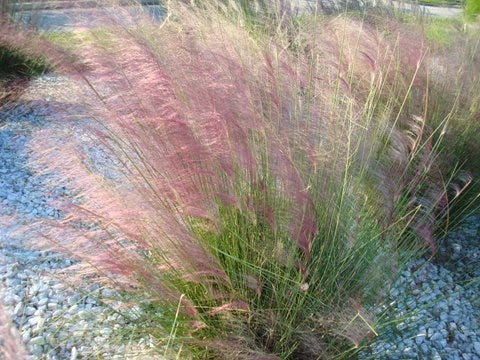
For ornamental grasses, consider Eastern Gama grass (Tripsacum dactyloides), Lovegrass (Eragrostis spectabilis), Muhly grass (Muhlenbergia capillaris), Saltmeadow cordgrass (Spartina patens), and Sand cordgrass (Spartina bakeri). And for native shrubs, some options are Beautyberry (Callicarpa americana), Cassia (Senna ligustrina) and (Cassia mexicana var. chapmanii), Christmas berry (Lycium carolinianum), Cocoplum (Chrysobalanus icaco ‘Horizontal’) and (Chrysobalanus icaco), Coontie (Zamia pumila), Firebush (Hamelia patens), Lantana (Lantana involucrata), Necklace pod (Sophora tomentosa), Simpson stopper (Myrcianthes fragrans), Walter’s viburnum (Viburnum obovatum), and Wax Myrtle (Myrica cerifera).
Think yard protection with red, black or red mangroves
Some yards that border the water are low enough that they don’t have a seawall or rip-rap; instead, they have mangroves to provide protection. The following three mangroves can be found throughout Brevard County: the Red mangrove (Rhizophora mangle), the Black mangrove (Avicennia germinans), and the White mangrove (Laguncularia racemosa). Buttonwood (Conocarpus erectus), which is not a mangrove but typically grows with mangroves.
Red mangroves are easily recognized by their arching prop roots that extend down into the water. They also produce propagules, which are the plant’s germinated seeds. Black mangroves are also easy to identify because their root system is characterized by vertical root projections called pneumatophores (breather roots) that protrude above the water. White mangroves grow on land, though they can handle high water levels for at least a few months, and there is no recognizable root system by which to identify them. The foliage is large, light green, succulent, and 1 to 3 inches long. One distinguishing characteristic of the white mangrove is the two glands on the petiole just below the base of the leaf, where excess salt is excreted. The tree also produces white, fragrant flowers year-round. Buttonwood is a native tree that can also be found growing near water, and it produces either green or silver foliage.
I have seen large mangrove trees, 20 feet or more, that provide fantastic protection for properties along the Indian River or Banana River. Mangroves are protected throughout Florida, and the Florida Department of Environmental Protection sets strict pruning rules. For more information: https://floridadep.gov/sites/default/files/mangrove-trimming-2-08-16.pdf.
Examples of other things you can do in your waterfront yard include creating a low-maintenance zone of at least 10 feet between the landscape and the water’s edge. That area should not be mowed, fertilized, or sprayed with pesticides. Choose plants that will grow well without fertilization and irrigation. This area will also help to capture stormwater runoff. In addition, don’t let plant debris, including grass clippings, get washed into any waterbody. Plant material will add organic matter and nutrients, which can lead to problems within a water body. For all dog owners that includes pet waste in the landscape. Pet waste carries harmful bacteria and a lot of nutrients, so please pick up all pet waste and dispose of it in your household garbage.
For those living along the Indian River Lagoon, add some of these suggestions to your yard routine to beautify your yard and protect the waterfront. Add some native plants along your seawall or some mangroves if you can walk into the IRL from your yard. Improving your yard will benefit you and the Indian River Lagoon!
Sally Scalera is an urban horticulture agent and master gardener coordinator for the University of Florida’s Institute of Food and Agriculture Science.
This article originally appeared on Florida Today: Live directly on the Indian River Lagoon? Be a part of protecting it
Reporting by Sally Scalera, For FLORIDA TODAY / Florida Today
USA TODAY Network via Reuters Connect
By Sally Scalera, For FLORIDA TODAY | USA TODAY Network