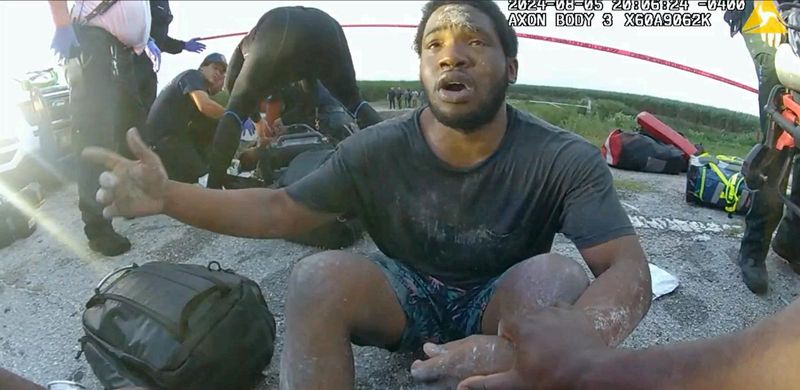
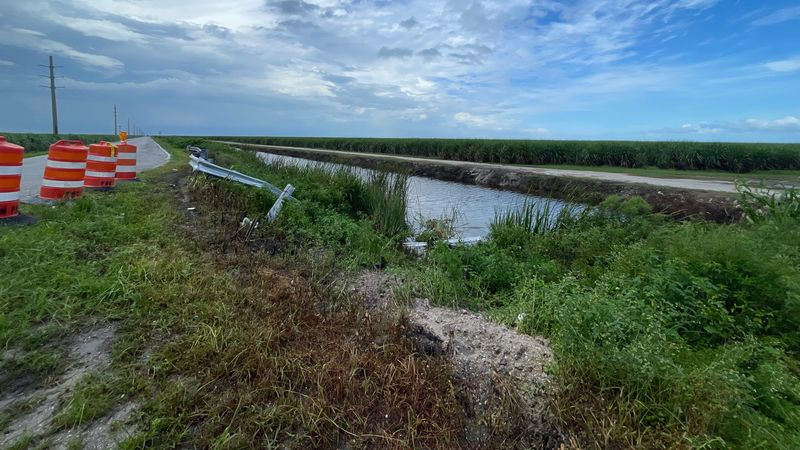
Jorden Hall was the only of 10 family members to escape through an open window of their rented Ford Explorer after it veered off a remote two-lane road near Belle Glade, struck a guardrail and plunged into a canal.
Two years later, Hall and the estates of his nine drowned relatives — six of whom were between the ages of 1 and 14 — are suing Palm Beach County over infrastructure failures they say made the Hatton Highway crash inevitable.

Coupled with records from a federal safety investigation that include transcripts of the driver’s final phone call, the 21-page lawsuit paints the most detailed portrait yet of the moments preceding the Aug. 5, 2024, crash.
Rental vehicle’s reported odd noise dogged family on Florida trip
“It’s clank, clank, clank,” Pamela Wiggins told a rental car employee as she drove along the highway. “I’ve been going through this ever since Wednesday.”
Wiggins, a Connecticut woman one day shy of her 57th birthday, organized the trip to South Florida to celebrate her mother’s 80th birthday. She flew into Palm Beach International Airport days earlier with her children, grandchildren and cousins in tow and was met with car trouble almost immediately.
According to a report by the National Transportation Safety Board, Wiggins booked a Chevy Traverse through Budget Rent a Car but learned when she arrived that only the Ford Explorer was available. Assured that it functioned the same as the Chevy, Wiggins loaded her family of 10 inside the seven-seater and made for Cape Coral.
It was on that 2.5-hour drive that a “clunk, clunk, clunk”-ing sound began. The report says Wiggins, who drove with a walking boot on her right foot, called Budget three times in the days that followed to report the issue and also visited three rental locations trying to swap cars. None had an SUV large enough.
The group was driving to the airport for their return flight during Wiggins’ final call to Budget. Because of a resurfacing project underway on the main highway, State Road 700, she followed marked detour signs onto Hatton Highway, a winding rural road.
Federal investigators say by then, the Ford’s air conditioning had stopped working and the clunking sound had gotten worse. An apologetic Budget representative agreed that she could hear it through the phone.
According to a transcript of their conversation, the employee then told Wiggins she would owe an extra $215 upon returning the car late — late because her flight had been delayed, and because a system outage had prevented an earlier representative from extending her reservation.
Wiggins disputed the charge as she drove, asked for a supervisor but got none, then asked for a corporate number and was told there wasn’t one. Her children helped navigate from the passenger seats, calling out once that a traffic light had turned green.
“Never mind green,” Wiggins said. “I’ve got to get this straightened out.”
She was 40 minutes from the airport when she ended the call to Budget. The first call to 911 came 16 minutes later.
The caller, a passing driver waved down by Hall at 7:29 p.m., described an overturned and submerged car and several passengers floating in the water. Others, including children, remained unresponsive inside the car.
The Palm Beach County Medical Examiner later said the families’ injuries were limited to small bruises and abrasions, meaning they survived the impact of the crash but later drowned.
In addition to Wiggins, the victims included her 30-year-old daughter Leiana Hall; 21-year-old Anyia Tucker and her 1-year-old daughter Na’Leia; 3-year-old Ziaire Mack; 5-year-olds Kamdien Edwards and Yasire Smith; 8-year-old Imani Hall; and 14-year-old Michael Hall Jr., a teenager from Jamaica who had spent the summer meeting his American cousins for the first time.
Only Jorden Hall, Wiggins’ son, survived. He told federal investigators that his mother tried to turn the wheel but couldn’t, and that he continued to hear the clunking sound up to the moment of impact.
Lawsuit faults condition of highway for family’s deadly crash, not SUV
Jorden Hall’s attorneys, however, have taken a different approach. Their lawsuit makes no mention of the car’s mechanical trouble and instead argues that Hatton Highway had been neglected for years and should never have been used as a detour in the first place.
Unlike the main highway they’d been pulled from, Hatton was poorly maintained and marked, the lawyers say. Its lanes were narrow. Its shoulders, in some places, were less than a foot wide. Canals ran along both sides.
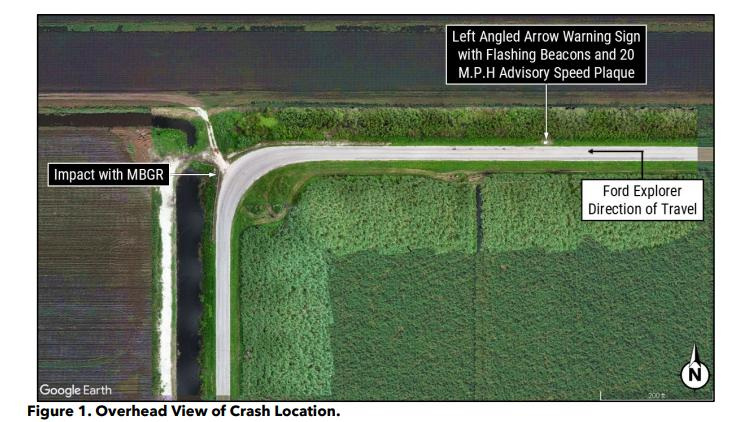
And at one particular stretch, the road makes a 90-degree turn that, according to the lawyers, far exceeds accepted engineering standards for highway design.
Wiggins didn’t know the road curved, the lawsuit said. A large sign that should have warned drivers was not there. It had been missing for more than a year, found later beneath a pile of vegetation.
The speed limit on that section of road was 55 mph, though a small advisory plaque — posted 414 feet before the curve began — recommended slowing to 20. Agricultural crops owned by a sugar company crowded the roadside, blocking sight lines.
The lawyers argue there was no way for an unfamiliar driver to see the turn until it was nearly upon them.
They added that the guardrail at the curve, the last line of defense between the road and the canal, made things worse.
It was split into two sections, divided by a private dirt road used by employees of U.S. Sugar to access their fields. Because of that gap, the guardrail did not follow the curve of the road but instead straightened and angled away from the highway’s edge, suggesting that the road continued straight.
Engineers would later calculate that the guardrail’s posts were too short for the slope they’d been driven into, that the rail itself sat too low to stop a vehicle, and that the installation violated industry guidance on multiple counts. The same guardrail had been struck by other drivers at least six times before that night.
The lawsuit does not mention Budget Rent a Car as a defendant. Instead, it targets the state Transportation Department that requested the detour, Palm Beach County which approved it, engineering firms that designed and installed the guardrail, and two sugar companies whose land and access roads the complaint says made a dangerous curve even more deadly.
Attorneys for each have not yet filed a response and did not return requests for comment.
Hannah Phillips covers criminal justice at The Palm Beach Post. You can reach her at hphillips@pbpost.com. Help support our journalism and subscribe today.
This article originally appeared on Palm Beach Post: Lawsuit blames Palm Beach County for 9 deaths, not rental car
Reporting by Hannah Phillips, Palm Beach Post / Palm Beach Post
USA TODAY Network via Reuters Connect