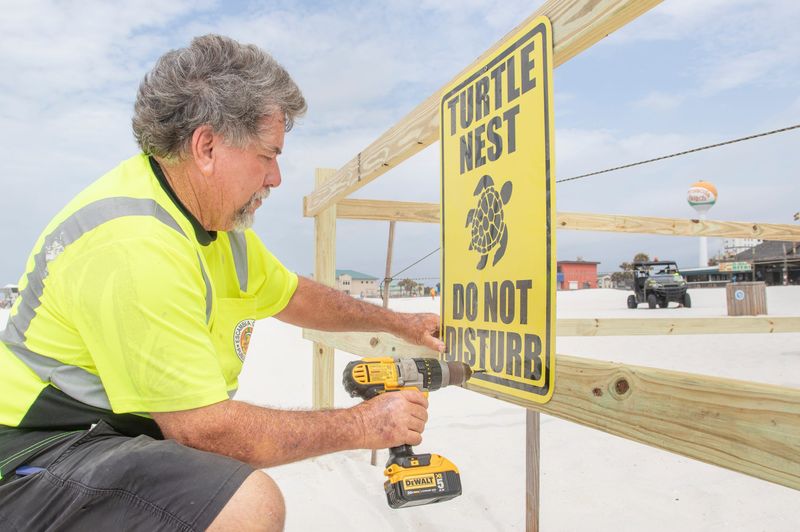
Sea turtle nesting season has begun on Pensacola Beach and Perdido Key as Escambia County Sea Turtle Conservation Program volunteers resume daily early morning patrols, looking for nesting and other turtle activity occurring overnight.
Volunteers start their patrols at first light to have the best chance of spotting tracks, nests and other turtle activity before footprints, wind and waves obscure the tracks. Volunteers and staff will continue to check on nests during the incubation period, ensuring they remain undisturbed and remain on stand-by to assist with strandings and other turtle-related incidents.

The nesting season will run through September, although late season nests can hatch as late as October.
What species of sea turtles nest in Escambia County?
Four species of sea turtle nest in Escambia County. The loggerhead and green sea turtles are the most common nesters, followed by the less common Kemp’s ridley and leatherback.
Female turtles will make their way onto the beaches through early summer and may nest several times in a single season.
After 60 days of incubation, the tiny hatchling turtles will emerge all at once under cover of darkness and race to the water. The hatchlings will make their way to open water with fewer predators. After a few years of growing and feeding, they will return to the area as juveniles and sub-adults. Here, they will continue to grow and feed until they are mature enough to mate and lay their nests.
Juvenile and adult sea turtles can often be seen foraging in the bays and sounds, including near local fishing piers and artificial reefs.
Shorebirds nest on Pensacola Beach
Sea turtles aren’t the only summertime visitors, as several species of shorebirds nest on local beaches in the summer months, including the least tern, snowy plover, Wilson’s plover and black skimmer.
Shorebird nests are shallow scrapes in the sand with tiny, well-camouflaged eggs. Eggs will incubate up to 30 days before the small, cotton ball-like chicks hatch. Parents often sit on the eggs with newly hatched chicks to protect them from predators and the hot Florida sun.
Summer is a busy tourist season, and big crowds can have significant impacts on sea turtles, shorebirds, and other coastal wildlife. Keep in mind that people and pets approaching too close disturb birds.
Help protect coastal wildlife
Visitors to the beach can help protect coastal wildlife by taking the following precautions:
This article originally appeared on Pensacola News Journal: Watch where you walk. Sea turtle nesting seasons begins
Reporting by Pensacola News Journal / Pensacola News Journal
USA TODAY Network via Reuters Connect