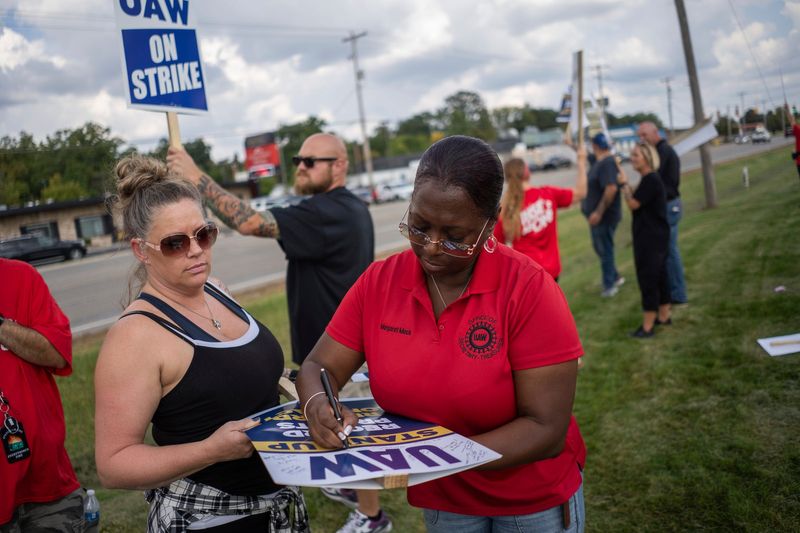
The federal monitor overseeing the United Auto Workers has found yet another instance of retaliation and infighting at the top level of the union, as well as “dysfunction” regarding the union’s investment processes.
In his latest report, monitor Neil Barofsky focused on allegations that the union’s top financial steward, Secretary-Treasurer Margaret Mock, had failed to reinvest about $125 million after the union’s 2023 strikes. The UAW keeps millions of dollars invested in stocks and will liquidate that money to pay striking members while they are out on the picket line. Last summer, allegations emerged that the union had failed to reinvest that money, missing out on potential profits from a massive stock market surge.

Reports of the mismanaged finances were leaked to the media in 2025, prompting a request from U.S. Rep. Tim Walberg, R-Tipton, a few months later to explain, as news agencies had reported, how the union had missed out on approximately $80 million dollars by failing to reinvest the strike fund.
Mock had largely been blamed for the misstep as the top steward of union funds, but Mock has also been the target of retaliation schemes in the union, something the monitor has reported on in-depth before.
This finger-pointing over the investment flub was retaliatory, too, the monitor concluded in his latest report issued on Thursday, April 30. According to the 82-page report, numbers were “exaggerated,” and blame was placed unfairly on Mock while union officials spun their wheels regarding the missed investment.
The report is the latest in a series of disputes between Mock and the union’s president, Shawn Fain.
What happened with the money?
In 2023, when the UAW launched the so-called “Stand-Up Strike” against all Detroit Three automakers at once, there were thousands of autoworkers who dropped their duties at the manufacturing plant to negotiate for a better contract. During the strike, the union liquidated about $340 million from the stock market in order to pay the striking employees while they missed out on their paychecks.
According to union policy, the strike fund can be liquidated after the International Executive Board (the leadership council of the union) votes to do so. The board was in accord and voted to pull the money out of the market in late August, agreeing to reinvest it after the contracts were ratified.
But the money was not reinvested promptly, something that went under the radar for most leaders at the union.
Mock was later blamed, with leaders of the union saying she unilaterally decided to not reinvest the funds, though the report indicates that other leaders of the union had a responsibility to flag the issue but instead turned it into an opportunity for retribution against Mock.
Previously, Mock’s attorney Michael Nicholson told the Detroit Free Press that he believed the duty to reinvest in this instance was not Mock’s alone — it is a responsibility that is collectively shared by the UAW president, the secretary-treasurer and the UAW’s vice presidents. The monitor, in his latest report, concurred with Nicholson.
“The Union’s failure to reinvest the proceeds of its Strike Trust was the result of errors and dysfunction across the organization, and did not fall solely at the feet of an affirmative, unilateral action by the Secretary-Treasurer herself, as alleged by the President’s Office,” Barofsky wrote.
Barofsky cited a number of internal rules and memos that outlined the purview of investment authority, including a 1996 resolution that stipulated the president, secretary-treasurer, and the three vice presidents of the union share responsibility for the investments, though Fain’s office insisted the misstep was Mock’s alone.
In fact, days after the monitor found that Fain had treated Mock unfairly in another instance by stripping her of most of her duties, reports emerged about the massive investment error. A majority of the members of the International Executive Board penned a public letter supporting Fain and blaming Mock for the blunder.
“(Mock) is under investigation by the Monitor for a significant compliance failure regarding our union’s investments,” read the letter, in reference to the strike fund, which was submitted in federal court and signed by 11 of the 14 highest-ranking members of the union.
The money has since been handled appropriately, although later than what would have been ideal. Of the $340 million initially liquidated, after paying stipends for the strike, about $188 million was left over. The union, by a unanimous vote of the board, chose to use $74 million of that money to pay off a loan held by the Voluntary Employees’ Beneficiary Association, a UAW trust fund used to pay for retirees’ healthcare benefits.
The rest of the money was not promptly reinvested according to company policy.
Pattern of retaliation
According to the monitor, Mock has been regularly and unfairly punished by Fain and his office. Painting Mock as the sole bearer of the failure to reinvest, he said, was another instance of retaliation, one that “followed an identical playbook” to a previous retaliation scheme — one that led to the resignation of Fain’s chief of staff.
The president’s office knew of the error as early as November 2024, but did not raise the issue until the following February. During that time, the monitor alleges that Fain’s office attempted to “build a political case against Mock.”
UAW staff members miscalculated the gains the union could have made by reinvesting promptly and used those numbers to besmirch Mock in leaks to the press, the monitor said. Reuters published a story citing anonymous sources that blamed Mock for the error.
“The manner in which the false allegations were disclosed to the public and press provides additional evidence of retaliation,” Barofsky wrote.
“In addition to finding the allegation against Secretary-Treasurer Mock to be false, the Monitor has also found that from mid-November 2024 forward, the President’s Office was largely responsible for the lack of compliance with the Investment Policy, and from at least January 8, 2025, that responsibility also fell on President Fain,” Barofsky wrote.
He added: “The President’s Office’s conduct bears all the hallmarks of retaliatory action prioritizing retribution against Mock over the Union’s best interests.”
‘Dysfunction’ in investments
Though the monitor’s report largely exonerates Mock from allegations of negligence, the monitor did report that he found significant failures across the board in the union’s handling of investments, including among Mock’s subordinates.
When the strike fund should have been reinvested, the monitor reported that key players failed to communicate with each other regarding the investments, including employees under Mock’s oversight.
“Some of the dysfunction relating to the Union’s investment record was attributable to subordinates who reported to Mock and for whom she was ultimately responsible,” the monitor said.
Those circumstances, as drawn out by the report, include a nebulous “patchwork” of conflicting internal policies and a failure to hold meetings between the directors of investments within the union and a lack of initiative to reinvest the money promptly.
Currently, the union’s policies on investments come from a variety of internal resolutions and guidelines issued decades apart, including rulings from 1996, 2008 and 2015. The monitor said this lack of clarity about investment procedures muddled the process while the union sought to reinvest.
“Each of these roles must be clarified to best protect the Union against further compliance failures,” the monitor wrote.
The UAW, in a statement to the Detroit Free Press, said it has issues with the latest report but agrees that the union needs clearer guidance about the management of investments.
“The Union strongly disagrees with aspects of the Monitor’s report, but we agree on these key facts: The Union internally identified the compliance concern, notified the Monitor, remediated the issue, and came back into compliance with its investment policy almost a year ago,” the UAW said, adding that the union “will implement the Monitor’s recommendations to enhance its governance and investment-management processes.”
Incoming changes
To prevent such an issue from occurring again, the monitor suggested a series of changes:
Barofsky said the union told him that it looks forward to working with him as it implements the recommendations.
Liam Rappleye covers Stellantis and the UAW for the Detroit Free Press. Contact him: LRappleye@freepress.com.
This article originally appeared on Detroit Free Press: Monitor: Shawn Fain, staff unfairly blamed UAW treasurer over investments
Reporting by Liam Rappleye, Detroit Free Press / Detroit Free Press
USA TODAY Network via Reuters Connect