More than 50 Lakeland and Polk County residents from a broad spectrum of different political persuasions took a rare unified stance to express concerns about a proposed hyperscale data center in Lakeland.
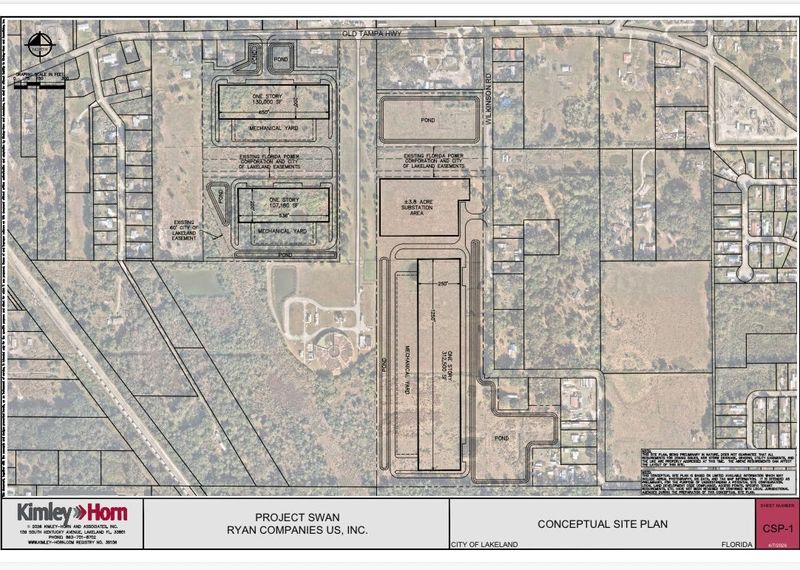
Lakeland-based engineering firm Kimley-Horn submitted a conceptual site plan in May to build an approximately 600,000-square-foot data center off Old Tampa Highway near Wilkinson Road, dubbed “Project Swan.”

“Some of the largest corporations in the world are coming to Florida looking for cheap power, cheap water and tax incentives,” said Lakeland resident Sam Romain, chair of Polk County’s Republican Executive Committee. “In a lot of communities, the result is the same: The company gets benefits and ordinary families end up subsidizing them. I don’t want that to be Lakeland’s story.”
Romain asked that Lakeland officials and staff members refrain from signing non-disclosure agreements or entering into legally binding contracts that would prohibit them from publicly sharing details about the proposed data center. He called on the commission to deny any requests for tax incentives before water needs are met and power demand and traffic studies are completed.
Fears of water use, power demands and negative impacts
The conceptual site plan application does not contain any estimates of what electric demand the data center will generate, or how much water the center will require for its daily operations. City Manager Shawn Sherrouse said city staff has plans to meet with the developer, Ryan Companies U.S. Inc., to discuss the proposal in greater detail on June 3. News of staff meeting has magnified the skepticism of some residents.
“We cannot trust you to have our best interests if you make decisions behind closed doors that will negatively affect us all,” said Jennifer Hardeman, crying. “I’d like to put all officials on notice. We expect elected officials to be our voice and represent us. We demand transparency regarding permits, impacts on health and quality of life, and we will not be blindsided or pushed aside. We will be heard.”
Lakeland resident Athena Wilson, a member of the political activist group Defund Oligarchy, Blessed by Liberty, raised concerns about the proposed data center’s possible water usage, citing most use water as their primary coolant. Wilson pointed out Polk County has been in a severe drought and water restrictions since fall 2025.
“The prospect of running a hyperscale data center under these conditions as well as Florida being in the worst drought since 2001 doesn’t just bother me, it scares me,” she said.
Wilson acknowledged Gov. Ron DeSantis signed SB 484 into law on May 7, which creates detailed requirements for the approvals and operations of data centers, with a particular focus on power and water use.
“I fear it’s not actually protecting the environment the way it’s being claimed,” she said. “The wording in the bill leaves our community open to legal loopholes.”
Lakeland native Spike Poma, a member of the grassroots Polk County Democratic Socialists of America, also voiced concerns about data center’s water usage worsening water shortages in addition to other possible negative effects of groundwater contamination, noise pollution and serious health impacts.
“The reported health effect from these facilities, including heart disease, permanent hearing loss, skin irritation, diarrheal illness, E.coli and more,” Poma said, sharing a stack of printed research with commissioners. “It would cost more money to treat these patients than build the facility.”
A general sense of distrust in government interactions with private corporations underscored many of the residents’ concerns about the proposed center.
What’s Lakeland process for evaluating data centers?
Michael B. Schmidt, a former Polk County planning commissioner, raised several questions about Lakeland’s process for evaluating the proposed data center site plans moving forward.
Schmidt peppered the commission with questions about its zoning categories for large data centers and what its permitting process is.
“If you have no engineering criteria already established, if you have no process or review of such a facility, whether you are going to approve it or deny it, your decision to deny the application or to even approve it can be considered prejudiced, as you have no real substantial competent evidence to judge the proposal with which you are being given,” he said.
Schmidt encouraged city staff and elected officials to “ask the tough questions” when reviewing the proposed data center application on water use, electrical demands and potential impacts.
“I will tell you you seldom get both sides of the story when a proposal is being given to you,” he said. “It is incumbent upon you to ask.”
Commissioners should evaluate the proposal differently from a standard office building, Schmidt said. He highlighted that most data centers operate 24/7, 365 days a week. And while they might not draw as much traffic, the emphasis should be on the impacts immediately surrounding it.
Paul Cruz, a U.S. Army veteran, said many seem to feel the forward march of technology is inevitable, but encouraged officials to spend more time asking questions.
“I think the thing that is most concerning for a lot of folks here on every side of the aisle is that issues regarding this data center, other things of that nature, and technology are moving very, very, very quickly without any consideration to the many, many, many questions that should be asked,” Cruz said.
Commissioner Ashley Troutman tried to remind residents that the Developer Review Committee meeting is part of a larger process for reviewing new proposed projects in the city.
“We have to follow the process no matter what the application that is before us,” he said.
Data center ‘not on the agenda’ message sparks backlash
Several speakers took issue with the city running social media ads that the data center was not on the June 1 meeting agenda and would not be discussed.
“Let me clear the confusion: The data center is on our agenda and will be discussed at all meetings,” Hardeman said.
Commissioner Stephanie Madden attempted to address the controversy sparked by the city’s social media campaign as an attempt to explain that the city doesn’t have any additional information on the proposal.
“I think when our city manager and our communications team said we are not going to be talking about it, it didn’t mean you could not talk about it,” she said. “It meant we didn’t have any information to share yet. We don’t know the square footage, water use or power needs.”
Madden said hopeful more information will be provided by the developer on June 3. She said she had taken detailed notes on the questions and concerns raised by residents to address in the future.
This article originally appeared on The Ledger: Lakeland residents flood officials with concerns about data center
Reporting by Sara-Megan Walsh, Lakeland Ledger / The Ledger
USA TODAY Network via Reuters Connect