Hunters are competing to kill Burmese pythons in the annual Florida Python Challenge this month with the No. 1 reason being the invasive snakes are killing native animals in the Everglades.
Of course $25,000 in cash prizes is a motivating factor for the 10-day Python Challenge that started July 10, along with a $10,000 grand prize for most pythons killed – or eliminated from an ecosystem that’s under siege.

There is no denying a python invasion is taking place.
Professional python hunter Amy Siewe said in a recent post on her Facebook page: “Every python we remove matters. Every single one means fewer predators hunting our native wildlife −and one less python growing into an apex predator.”
How do pythons in Florida catch their prey?
In the same post, Siewe featured a video of a python in the process of constricting a rat.
“It was too late for the rat − but witnessing this in the wild is something we rarely get to see,” Siewe wrote.
According to the Florida Fish and Wildlife Conservation Commission (FWC) web site, pythons “are generalist predators.”
A variety of species have been found in their gut contents during necropsies including a variety of mammals (like rats and rabbits), birds, reptiles, and protected species such as the Federally-designated Threatened wood stork and the Federally-designated Endangered Key Largo woodrat. Burmese pythons can consume meals equivalent to 100% their body mass.
How a python kills its prey: ‘It’s an unsettling feat’
Conservancy of Southwest Florida biologist Ian Easterling, who is a member of the organization’s python team, provided details on the process of how a python “hunts” for its food and then how it kills its prey leading to the python swallowing it whole.
Here is what Easterling said in an email: Burmese pythons are ambush predators, they do not chase down prey. Like other snakes, they have evolved incredible senses in order to detect the perfect place to wait for the right opportunity. Sitting along a game trail or under a fruiting tree brings potential prey right to them. They feel the vibrations of the animal’s footsteps, catch scent particles from the air in their nose or on their tongue, and use their heat sensing labial pits to detect their warm-blooded prey.
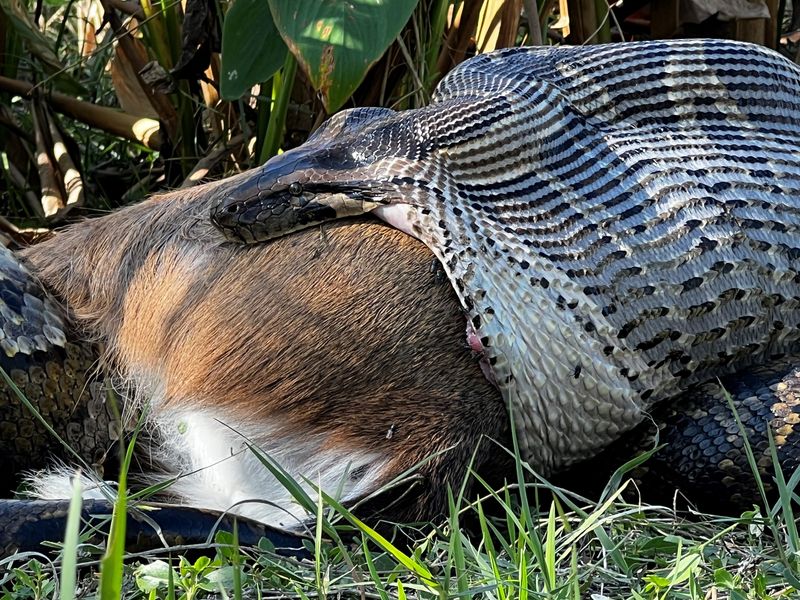
Once the animal comes within range, the snake strikes quickly and secures it with their needle sharp, curved teeth and powerful coils. While many people assume that pythons suffocate their prey, research has shown that constriction primarily disrupts circulation of blood to the brain and other vital organs. The animal quickly loses consciousness and passes away, after which the snake is able to swallow it whole.
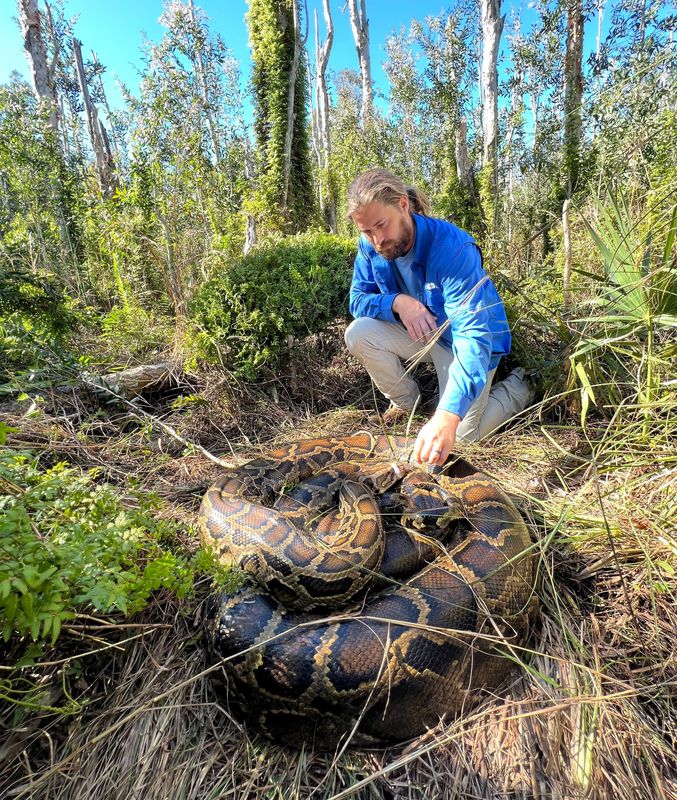
Constriction is not unique to pythons. It is a feeding strategy employed by many snake species, including many of our harmless native snakes. The key difference is the scale, with these large-bodied snakes able to swallow animals the size of white-tailed deer, feral pigs, and alligators. It is a remarkable and simultaneously unsettling feat that we have been able to observe.
How does Everglades’ food chain fuel a Burmese python’s growth?
Pythons eat to survive and grow. They are classified as invasive because they are not native to this part of the world and they are having a negative impact on the native species. Female pythons can produce hundreds of eggs. The hatchlings learn to “hunt” and eat and it helps the snake grow.
Easterling explained, in the same email, the process of pythons eating and growing and the details of how it works:
Young pythons start out feeding on relatively small prey, namely rodents and small birds. As they grow, they gradually move to larger animals as their gape allows. A majority of pythons are likely consuming animals the size of ducks, rabbits, opossums, raccoons, etc.
A python’s growth rate depends on prey availability, environmental conditions, and the individual animal. Claims that a python reaches ten feet in three years should be viewed as generalizations based on the growth of captive animals, not an actual biological rule.
In captivity, python’s can be fed year-round with constantly available tropical temperatures. Many captive snakes are even “power fed” to speed up growth and achieve sexual maturity more rapidly.
Our observations of wild hatchling pythons did show a female reaching almost 7 feet in about a year, which was very impressive.
From a management perspective, every python removed prevents years of future predation. If that snake is a large reproductive female, the benefit extends beyond the prey she was capable of consuming to the hundreds of offspring she could produce over her lifetime.
The more Florida pythons devour animals, the bigger they get
To further emphasize the importance of eliminating the pythons from the Everglades, even one at a time, Siewe drove home her point in her Facebook post.
“Even though this is ‘just a rat,’ it’s a gateway meal for these pythons that will soon be big enough to eat the raccoons, wading birds, bobcats, alligators and deer,” she wrote. “A Burmese python can reach 10 feet in just three years − and it takes roughly 200 animals to get it there.”
“One python. 200 animals,” Siewe said. “Now, multiply that by the thousands of pythons hiding in the Everglades.”
Mark H. Bickel is the Audience Development Director for The News-Press & Naples Daily News. Reach him by emailing mbickel@usatoday.com.
This article originally appeared on Naples Daily News: ‘It’s an unsettling feat’: How Florida’s invasive python kills its prey
Reporting by Mark H. Bickel, Fort Myers News-Press & Naples Daily News / Naples Daily News
USA TODAY Network via Reuters Connect
By Mark H. Bickel, Fort Myers News-Press & Naples Daily News | USA TODAY Network