The worst has happened, and a hurricane has hit Florida.
That’s the scenario of today’s topic on Day 6 of National Hurricane Preparedness Week, which focuses on what to do after a storm. Bottom line: Be careful.

The 2026 Atlantic hurricane season starts June 1.
Every year, no matter what the predictions are, forecasters urge residents to prepare early for hurricanes rather than wait until a storm is approaching.
➤ Weather alerts via text: Sign up to get updates about current storms and weather events by location
The National Hurricane Center and National Weather Service have established May 3-9, 2026, as Hurricane Preparedness Week.
The week covers a different topic each day, providing valuable information for those new to hurricanes and good reminders to seasoned Florida residents.
Early predictions are for a below-normal season but in records dating back to 1851, Florida has been hit by more hurricanes than any other state so it pays to be prepared.
What to expect from Hurricane Preparedness Week 2026
To raise awareness about the dangers posed by hurricanes and tropical storms and encourage people to prepare early for storms, the National Hurricane Center and National Weather Service established May 3-9, 2026, as Hurricane Preparedness Week.
➤ Miss a day? Here are highlights and links to each day’s story
The week covers various topics each day, providing valuable information for those new to hurricanes and good reminders for seasoned Florida residents.
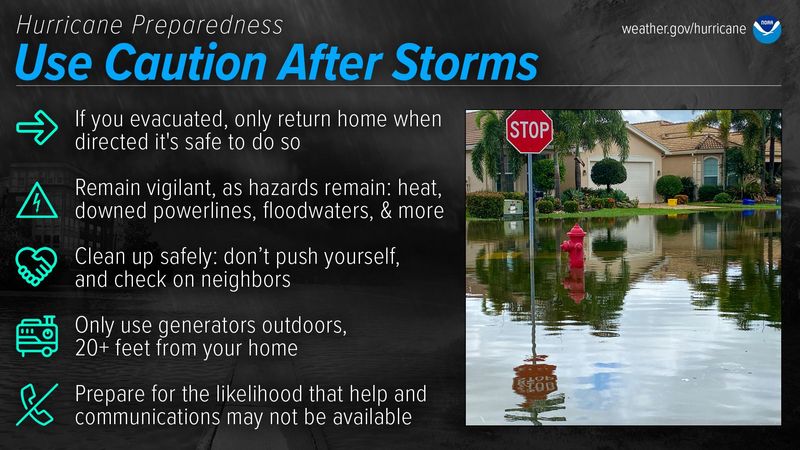
Hurricane Preparedness Week, Day 6: Use caution after storm
“Dangers remain even after the skies turn blue” after a hurricane, NOAA said.
“This is NOT the time to put your guard down. Nearly half of hurricane fatalities occur after the storm.”
Highlights today include:
Return home only when told to do so if you evacuated before hurricane
“Return home ONLY when officials say it is safe,” NOAA said.
“Check with local officials both where you’re staying and back home before you travel.”
Dangers doesn’t end after hurricane passes by
The hazards left behind by tropical storms or hurricanes don’t end after landfall or the storm leaves your area. Here’s what you should watch out for:
Don’t push yourself when cleaning up after hurricane
Remember, this is Florida, where summer temperatures regularly hit the 90s and a heat index rises into the triple digits.
Tempting as it is to try to get back to normal, don’t push yourself, NOAA said. Suggestions include:
“Straining the body can lead to heart attacks, heat strokes, and other serious issues.
“Make sure to check on your elderly neighbors and other vulnerable people in your community.
“If your area is under a heat advisory, use extreme caution and consider cleaning up when the heat has subsided.”
Don’t become a statistic. Know how to use generator safely
“Carbon monoxide poisoning is one of the leading causes of death in areas dealing with power outages,” NOAA said.
“Be very careful with portable generators and never use a generator inside your home or garage, even if doors and windows are open.
“Only use generators outside, more than 20 feet away from your home, doors, and windows.”
Help, communications may not be immediately available after storm so plan accordingly
“After a hurricane, emergency responders may be overwhelmed,” NOAA said.
“Be aware that it could take hours or days for them to reach your area.
“Communication systems may be impacted, and making phone or video calls might be difficult due to network congestion. If possible, communicate via text, email, or social media.”
The USA Today Network-Florida team has years of experience covering hurricanes and we know what’s important to you and the problems associated with widespread power outages. In the event of a storm, we provide critical information in a quick, text-based format to minimize the the drain on your cellphone battery.
When is the Atlantic hurricane season?
The Atlantic hurricane season runs from June 1 through Nov. 30.
➤ Hurricane Center testing new cone: What’s changing this season?
Countdown clock to start of 2026 hurricane season
What are predictions for 2026 hurricane season?
Here are some of the predictions released so far for this year’s hurricane season. NOAA will release its forecast toward the end of May.
A major hurricane is a storm that is a Category 3 or stronger, with maximum sustained winds of at least 111 mph.
Sign up now to get latest weather alerts
Set up several different ways to get weather warnings so you’re always aware of the latest information and forecast.
The USA Today Weather Watch team sends SMS messages straight to your phone. Sign up today for the free service.
Could Florida be hit by a hurricane in 2026? See which counties have highest chance
What are names for 2026 Atlantic hurricane season?
Names for the 2026 Atlantic hurricane season, and how to pronounce them, are:
Stay informed. Get weather alerts via text
What’s next?
We will start providing daily tropical weather coverage May 15, unless something with potential for development appears earlier. Download your local site’s app to ensure you’re always connected to the news. And look for our special subscription offers here.
Cheryl McCloud is a journalist for the USA TODAY Network-Florida’s service journalism Connect team. You can get all of Florida’s best content directly in your inbox each weekday day by signing up for the free newsletter, Florida TODAY, at https://naples.com/newsletters.
This article originally appeared on Florida Today: Hurricane Preparedness Week tackles what to do after a storm hits
Reporting by Cheryl McCloud, USA TODAY NETWORK – Florida / Florida Today
USA TODAY Network via Reuters Connect