You thought Peter’s rock agama was bad? Florida, meet tegu.
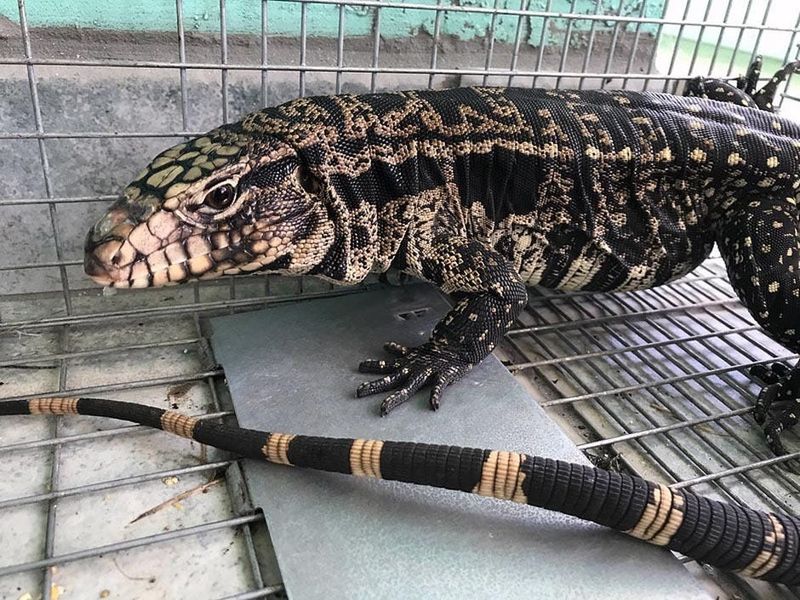
This foreign lizard — the Argentine black and white tegu — can grow almost five feet long, is making itself at home in Florida. And with plenty to feast on here in the Sunshine State, tegus are coming to a town near you.

That is if they’re not already chilling in your backyard.
This cold-blooded, devilish-looking lizard is stomping through the Space Coast, the rest of Florida, Georgia and is scattered as far north as Maryland. And taming tegu in our wild has proven not so black and white.
“All it takes is a couple, then we end up with a ‘pythons-in-the-Everglades’ sort of scenario,” said Dave Yolitz, who caught and humanely euthanized a three-foot black and white tegu at his home in Viera on April 28.
There are no known reports of tegus attacking humans, but experts still suggest giving the critters a wide berth because they will defend themselves if cornered..
Yolitz grew up hunting and fishing. He knew what he was dealing with. For those less initiated, wildlife officials warn it’s best not to try any sort of backyard tegu taming at home.
Pet lizards let loose on Florida
Like many invasive species in Florida, tegus first arrived here as pets. They likely were introduced into Florida’s wild in 2002, according to the Florida Fish and Wildlife Conservation Commission.
As far as lizards go, tegus are sharp. They can recognize people, learn routines, even respond to their names. But in wildlands, they wreak havoc.
Tegus raid nests of ground‑nesting animals, including sea turtles, gopher tortoises, alligators and ground‑nesting birds. Your yard plants are on the tegu menu, too.
Tegus will wolf down any native or non-native animal or plant it can sink its peg-like teeth into. Doesn’t matter. This relentless reptile is an equal-opportunity ecological offender. It will gobble up an agama, no problem, if tegus can catch those quick little guys (invasive African agamas only grow to about one foot long).
Like agamas, tegus appear here to stay.
Governments warn to watch for tegus, but be careful
On June 12, Cape Canaveral urged on its Facebook page for residents to report tegu sightings to Florida’s Exotic Species Hotline (1-888-483-4681). You can snap a shot, note the location, and upload sightings to IveGot1.org.
But, “Do not attempt to capture them yourself,” the post warns.
Tegu claws in on Space Coast, especially near Lake Poinsett
Think tegus are all media hype?
Consider the University of Georgia’s EDDMapS site. It shows more than 11,700 tegu sightings in Florida in recent years, 46 of them in Brevard including several this year.
More bad news: tegus are looking for and finding love in all the wrong places. Reproducing populations of tegus are established in Hillsborough, Miami-Dade and Charlotte counties, according to the Florida Fish and Wildlife Conservation Commission, and an emerging population was recently discovered in St. Lucie County.
And tegu’s knocking on Brevard’s door.
Locally, there were several reports on April 12, of a three-foot tegu on Sidewheel Drive in Viera. Two days later, a large tegu was seen on Stadium Way in Viera: “As I was driving I saw this one walking across the road then I lost track of it,” the person who reported it said on the EDDSMapS site. “About 30 minutes later as I was returning home I saw it again on the side of the road. I think it was hit by a car.”
For some reason, tegus seem to be clustering just east of Lake Poinsette west of Cocoa, where 14 have been sighted in just the past few years.
Brady Deluca saw one of them and snapped photos and video of the large tegu on April 28 in Poinsett Shores, on Mallard Road, crossing the street heading into the canal between June Drive and Cardinal Road.
“I’m not sure about anyone owning any, but we have definitely seen one a couple times,” Deluca said via email. “My neighbor also found one in their crab trap (that was on their dock, not set) about a year ago. Fish and wildlife said to kill it, but that is HARD to do. (plus, I’m scared of them lol).”
She said they’re “gross” and shouldn’t be pets, given the risks.
“They’re fast, and their tails whip,” Deluca said Wednesday. “Apparently, they’re great swimmers.”
The EDDSMapS site also shows several tegu sightings in recent years clustering in Palm Bay and scattered reports on Merritt Island and Brevard’s more rural outskirts.
Tegus on Florida’s list
Not that many years ago, you could go to the pet store and buy a tegu for $200 to $600. Now, it’s illegal to sell them as pets.
Tegus were among more than a dozen ‘high‑risk’ nonnative reptiles that Florida regulators moved to prohibit in 2021, including multiple large python species and the green anaconda, with new limits on breeding and most ownership. That means they are not allowed to be acquired, bred, or sold as pets in the state.
Tegus haven’t seemed to have inflicted any ecological havoc on the 28,000 acres managed through Brevard County’s Environmentally Endangered Lands program — yet.
“Fortunately we have not had any issues yet,” EEL Program Manager Mike Knight said via email. “No sightings reported so far. So we have not had to consider a control strategy yet.”
But tegus threaten to establish in Brevard, as it recently did in St. Lucie County.
So how do we temper tegus?
Outreach campaigns by state and federal wildlife agencies have warned for years about the dangers of releasing tegus and other unwanted reptiles, encouraging people to report sightings.
The Burmese python also already is likely in Brevard. Global warming favors more tropical reptiles in Florida.
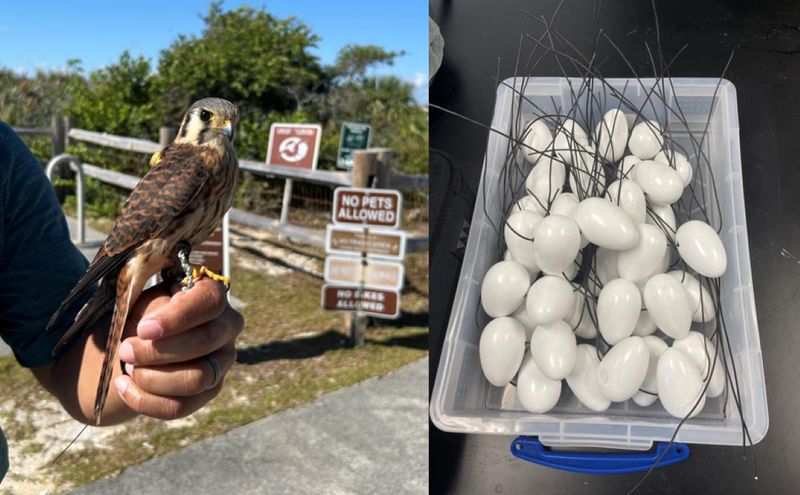
Wildlife managers are trying dogs, drones and even raptor to try to find foreign lizards before they find too many native Florida species.
Can falcons find tegus and other lizards?
In a recent event targeting Peter’s rock agama, a local falconer in St. Lucie County came out with his American kestrel, named “Baby Bird,” who he trained to specifically hunt for invasive lizards.
But such pilot programs using falcons are experimental, targeted and limited, not likely to be scaled up to any degree that would make agamas or tegus flinch, especially tegus that can grow five feet long.
Yolitz wasn’t afraid to take tegu matters into his own hands.
On April 12, when his neighbor told him he saw a large tegu wandering between properties of his Viera home, the two decided to corner the lizard and Yolitz caught the tegu with a trash grabber claw. Yolitz knew his and other small dogs in the neighborhood wouldn’t stand a chance.
“It was pretty strong,” Yolitz said. “It’s a pretty hefty creature.”
They euthanized the tegu similar to how FWC recommends putting down alligators humanely: by severing the spinal cord with a knife.
“It brought us no pleasure to have to do that,” Yolitz said, adding that the blame is on pet owners who let their lizards go. “It wasn’t on my ‘Sunday to-do list.’ “
If you see a tegu or some other invasive species?
Report tegu and other invasive species sightings to the FWC’s Exotic Species Hotline at 1-888-483-4681. You can also take a picture, note the location, and upload sightings to IveGot1.org. Do not attempt to capture them yourself.
Jim Waymer is environment and government reporter at FLORIDA TODAY. Contact Waymer at 321-242-3663 or jwaymer@floridatoday.com. Follow him on X at @JWayEnviro
This article originally appeared on Florida Today: Giant lizards are invading Florida yards
Reporting by Jim Waymer, Florida Today / Florida Today
USA TODAY Network via Reuters Connect
By Jim Waymer, Florida Today | USA TODAY Network